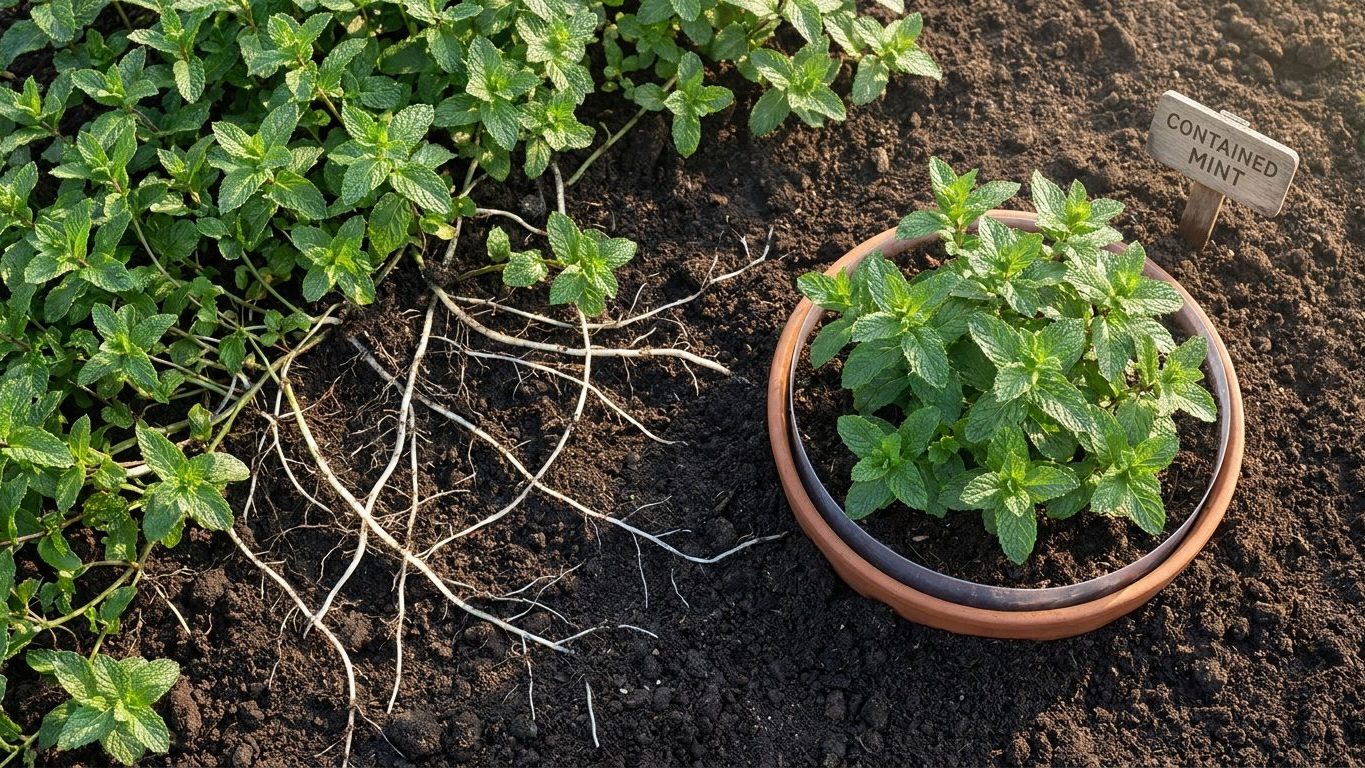

Mint planted straight in a garden bed will show up somewhere else within a season, usually further away than seems possible. The fix isn’t distance or vigilance. It’s a physical barrier, sunk deep enough and closed off at the surface, because mint doesn’t wander overhead where you’d catch it. It travels underground.
What is actually going on
The thing to understand here is runners. Mint spreads by underground stems called rhizomes that push out sideways from the mother plant, sometimes a foot or more in a single growing season, and root a new shoot wherever they surface. It’s not the seed drop that’s the problem, though mint can flower and seed too. It’s this horizontal network, moving under mulch, under adjacent plants, occasionally under a low garden edging, and popping up wherever the soil is loose and warm enough to encourage it.
This is true across the mint family broadly. Whether it’s a peppermint type, a spearmint type, or one of the many hybrid mints sold at nurseries, the growth habit is the same because it’s a trait of the genus, not a quirk of one variety. Some spread faster than others depending on soil and moisture, but none of them stay put on their own. A gardener who plants one small mint start in a bed with no barrier is, functionally, planting a groundcover for the whole bed, whether or not that was the intention.
Mint has a long-standing reputation as a medicinal herb in various traditions, and it’s worth being straightforward here: this page doesn’t evaluate that reputation one way or another. It’s a garden and culinary page. What matters for the reader standing in front of a bed is horticultural, not therapeutic.
Why does this matter more than it would for, say, a rosemary or a thyme? Because those herbs grow as clumps, expanding slowly from a fixed crown. Mint doesn’t have a fixed crown in the same sense. Cut it back and the rhizomes underground keep pushing new shoots up at a distance, so top growth isn’t a reliable guide to what’s actually happening below the surface. A bed that looks tidy in June can be laced with new roots by August, none of them visible until shoots break through.
This is also why mint pulled by hand rarely comes out clean. Rhizomes snap rather than release whole, and any fragment left behind with a node on it can generate a new plant. That single fact, more than any other, explains why containment has to happen before planting rather than as cleanup afterward. Once the network is established through a bed, removing it completely takes repeated effort over more than one season, not a single afternoon of digging.
In the garden
Containing mint means putting a barrier between the rhizomes and the open soil around them, and doing it in a way that closes off every path a runner could take, including the one straight down and back up outside the barrier’s rim. The most common method is a container, whether that’s a freestanding pot or a pot sunk into the ground to look like an in-bed planting. Each step has a specific way it fails when done halfway.
Step by step, and what goes wrong
| Step | What it involves | What happens if skipped or rushed |
|---|---|---|
| Choose a solid-walled container | A pot or bucket with no drainage holes along the sides, only at the bottom | Rhizomes find any side opening and grow straight through it into the surrounding bed within one season |
| Sink it with the rim above soil level | Bury the container so at least an inch or two of rim stays above the surrounding soil grade | If the rim sits flush or below grade, runners simply climb over the top edge through the mulch layer and root outside |
| Leave the bottom open or add drainage carefully | A container with a solid bottom needs drilled drainage holes; watch that runners don’t use the excess space around loose gravel fill as a tunnel | Waterlogged mint sitting in a sealed container with no drainage struggles and rots at the roots over a wet season |
| Check the rim edge every few weeks | Look along the buried rim for any runner that has looped over rather than staying inside | A single missed runner re-establishes the whole spreading problem within the same growing season |
| Divide and repot every year or two | Lift the mint, cut the rootball down, and refresh the soil in the container | Left too long, the container becomes root-bound, growth stalls, and the plant pushes harder at the rim looking for room |
A sunk pot works only when that rim stays proud of the soil line. That single detail is where most containment attempts fail, because burying the pot flush looks neater and gardeners do it for the appearance, not realizing the runners treat mulch as open ground just as easily as soil.
Removing an established sunken container once the mint has outgrown it is its own job. Lifting straight up rarely works cleanly if roots have grown through the drainage holes and anchored below; loosening the surrounding soil with a spade first, cutting any anchoring roots at the drainage holes, then lifting, keeps the rootball mostly intact and avoids leaving fragments behind in the surrounding bed.
Above-ground containers, whether on a patio or a raised deck, avoid the rhizome problem entirely as long as the container doesn’t sit directly on soil where a drainage hole could let a runner reach the ground. Raised beds with solid bottoms work the same way. The common thread across every method: mint needs a barrier it can’t get under, over, or through, not just a barrier it can’t get past on the surface.
What it depends on where you are
How fast mint spreads, and how long the growing season gives it to do so, changes by region in ways this page can’t specify without knowing where a given reader gardens. Longer, wetter summers tend to push rhizome growth harder and for more months of the year, while shorter or drier seasons slow it down but don’t eliminate the spreading habit. Winter severity affects whether top growth dies back to almost nothing or persists through a mild season, but the underground rhizome network is what determines next year’s spread either way, not the visible foliage.
Soil type plays into this too. Loose, well-worked garden soil lets rhizomes travel with less resistance than dense clay, which is part of why raised beds and container culture, already common in areas with heavy or poor native soil, double as a convenient containment method almost by accident.
None of that adds up to a single national answer for when to plant, when to divide, or how aggressively a given mint will behave in a specific yard. Season length, summer heat, and summer rainfall all shift the picture, and this page doesn’t know which combination applies to the reader’s own garden.
Two resources fill that gap better than a general guide can. The state-level pages on this site cover regional growing conditions in more specific terms, and the reader’s local Cooperative Extension office, run through the land-grant university system in every state, can speak to soil, rainfall, and season length for the exact county in question. Extension offices field mint-spreading questions often enough that the answer is usually quick and specific, not theoretical.
That local knowledge matters more for timing decisions, like when to divide an established container or how late in the season a runner might still root successfully, than it does for the core containment method itself. A sunken barrier with a proud rim works the same way whether the summer is long and humid or short and dry. What changes is how often that barrier needs checking, and that’s a local question, not a universal one.
The mistake that costs the most
The single costliest mistake is planting mint directly in open garden soil “just for one season” on the assumption it can be pulled out later if it gets out of hand. It can’t, not fully, and not in one attempt. By the time the spread is visible above ground, the rhizome network is usually well past the point where hand-pulling removes it. Every broken fragment left in the soil, and there will be many, is a new plant waiting for the next warm week.
The instinct behind this mistake is reasonable. The mint start looks small, the bed looks big, and containment feels like overkill for one modest plant. That’s exactly the miscalculation. Mint’s spreading rate isn’t proportional to how large the plant currently looks; it’s a property of the rhizome system, which is already working outward before the top growth gives any visual cue that something needs attention.
What to do instead is decide on containment before the mint goes into the ground at all, not after the first runner appears. That means choosing a sunk container with a rim above grade, or an above-ground pot, from the start, rather than treating containment as damage control once the bed shows signs of trouble. If mint is already loose in a bed, the honest fix is a full-season commitment: dig out as much rootball and rhizome as can be found, expect regrowth from missed fragments, and repeat the removal through the following season until nothing new appears, rather than a single weekend of pulling and calling it solved.
The gap between those two approaches, planning ahead versus cleaning up after, is the difference between a mint patch that stays a foot wide for years and one that eventually pushes out everything else planted nearby.