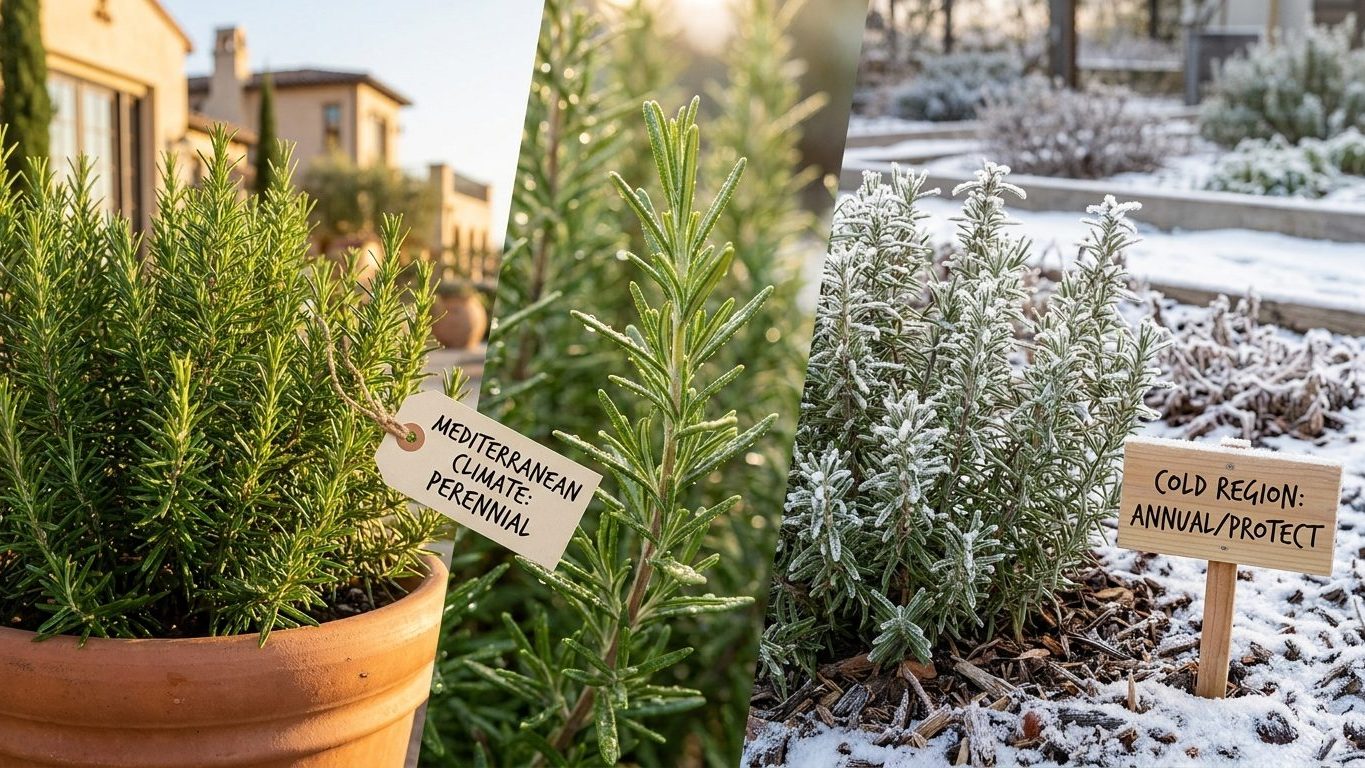

Rosemary survives winter outdoors in the Southeast, the Gulf Coast, and much of the Pacific coast, where it settles into a woody perennial shrub for decades. Everywhere colder, it behaves as an annual unless someone moves it indoors before the first hard freeze. The line between the two isn’t about the zone number printed on a plant tag; it’s about how far the stems drop below a specific temperature, and for how long.
What is actually going on

Rosemary comes from the coastal hills of the Mediterranean, a region with wet, mild winters and dry summers. It never evolved to handle a hard freeze, and its woody stems show that limit clearly. Somewhere in the range of 10 to 20°F, depending on the plant’s age, its recent growing conditions, and how long the cold lasts, ice starts forming inside the stem tissue instead of just on the surface. That ice ruptures the cells that move water and nutrients up the plant. A short dip might only damage the tips. A hard, sustained freeze kills the cambium layer running around the stem, and once that layer dies in a ring, everything above it is finished, even if the roots underground are still alive.
This is why mulch, so often recommended for perennials, does close to nothing for rosemary in a genuinely cold climate. Mulch insulates soil and protects roots from freeze-thaw cycling. It does not warm the air six inches above the ground where the woody stems sit exposed. A gardener can bury the base in four inches of straw and still lose the entire plant, because the failure point isn’t the roots, it’s the standing wood.
Container growing changes the math again, and usually for the worse. A pot has no surrounding soil mass to buffer temperature swings; cold reaches the root ball from every side, not just the top, so a potted rosemary can freeze solid at air temperatures that a ground-planted one shrugs off. That’s part of why so much rosemary sold in spring, in small pots at garden centers, quietly dies over the following winter in a colder state. It was never a hardiness failure so much as a mismatch nobody flagged at the time of purchase.
Rosemary also has a well-known reputation tied to traditional and medicinal uses. This page is about growing the plant in a garden or a pot, not about evaluating that reputation, so it stops there.
None of this means cold-climate gardeners are wasting their time. It means the plant needs a plan attached to it: ground planting only where winters genuinely stay mild, or a pot with a clear exit strategy before temperatures drop, or an intentional decision to grow it as a one-season annual, purchased fresh next spring.
In the garden
The decision that matters is made in spring or early fall, not in December when frost is already forecast. Waiting until the cold snap to figure out a plan is the single most common reason rosemary dies each winter. The table below breaks the decision into steps, with the failure mode attached to each one.
| Step | What to do | What goes wrong if skipped |
|---|---|---|
| Assess the climate honestly | Ground-plant only where winter lows reliably stay above the plant’s tolerance for the whole season, not just most years | An unusually cold night, the kind that happens every five to ten years, kills a shrub that looked established and safe |
| Choose pot from the start in marginal or cold climates | Grow rosemary in a container all year so it can be relocated instead of dug up under stress | Digging a mature rosemary out of the ground in fall damages roots badly enough that it often dies indoors anyway |
| Bring it in before the first hard freeze | Move the pot indoors once nights are reliably dropping toward the plant’s limit, not after a frost has already hit it | Rosemary caught outside in one bad night can lose stems even if it’s moved indoors the next morning |
| Give it bright, cool light indoors | A south-facing window or an unheated sunroom works better than a warm, dim living room corner | Warm rooms with weak light push weak, stretched growth that mildews and drops needles by midwinter |
| Water sparingly | Let the top inch or two of soil dry before watering again; rosemary indoors uses far less water than it did outside | Overwatering in low light is the most common way indoor rosemary dies, not underwatering |
| Watch airflow | Keep some space around the plant and away from other crowded houseplants | Still, humid air around the foliage invites powdery mildew, which spreads fast on stressed rosemary |
| Reintroduce it outdoors gradually | Once nights are reliably mild again, move the pot outside for a few hours at a time before leaving it out full-time | A plant moved straight from indoor conditions to full sun and wind can scorch or collapse within days |
None of these steps require special equipment. What they require is timing, decided ahead of the calendar rather than reacted to after it.
What it depends on where you are
Everything above describes the species. What actually happens in a specific yard depends on local conditions: how long the growing season runs, how hot and how humid the summer gets, how much rain falls in July versus how little falls in a Mediterranean-style dry summer. A rosemary plant in a humid summer climate faces a different set of pressures, mostly fungal, than one in a dry summer climate, where the main challenge is simply surviving winter at all.
Season length matters too. In a region with a long, mild fall, a rosemary plant has time to harden off before real cold arrives, which measurably improves its odds. In a region where summer heat drops straight into freezing weather with barely any transition, the same plant gets caught mid-growth, softer and less prepared, and tends to suffer more damage at the same temperature that a hardened plant would tolerate.
This is exactly the kind of detail that a national page can’t responsibly settle, and a state-specific page can. The reader’s own state guide on this site accounts for typical first and last frost timing, summer rainfall patterns, and how local gardeners commonly handle rosemary through that particular winter. It’s worth checking that page directly rather than assuming a rule written for the country as a whole applies to one address.
The other resource worth using is the reader’s local Cooperative Extension office, which tracks conditions at the county level, well below what any general hardiness map can capture. For a broader reference point, the USDA Plant Hardiness Zone Map shows average winter minimum temperatures by region, though it describes typical years, not the occasional hard winter that does the actual damage.
The mistake that costs the most
The costliest mistake isn’t picking the wrong spot in the yard or watering on the wrong schedule. It’s planting rosemary directly in the ground, in a climate where it can’t survive winter, and treating a thick layer of mulch as if it were a substitute for bringing the plant indoors. This single decision accounts for more dead rosemary than any pest, any disease, or any watering error combined, because it sets the plant up to fail months before the cold actually arrives.
The reasoning behind it is understandable. Mulch works for plenty of perennials, so it seems reasonable to expect it will work here too. But rosemary’s vulnerable point sits above ground, in woody stems exposed directly to freezing air, not in the root zone that mulch protects. No amount of straw, wood chips, or leaf litter changes what happens to the plant’s cambium layer once the air around it drops below its limit for long enough.
The fix isn’t complicated, it just has to happen earlier than most gardeners think to act. Decide at planting time, in spring, whether the local climate genuinely supports rosemary as a permanent shrub outdoors. If there’s any doubt, grow it in a container from day one instead of the ground. A potted rosemary can be moved to a bright, cool spot indoors before the first hard freeze, with no digging, no root damage, and no gamble on a mulch layer holding back winter air. That one decision, made months ahead of the first cold night, is what separates a rosemary plant that comes back for another decade from one that gets replaced every spring.