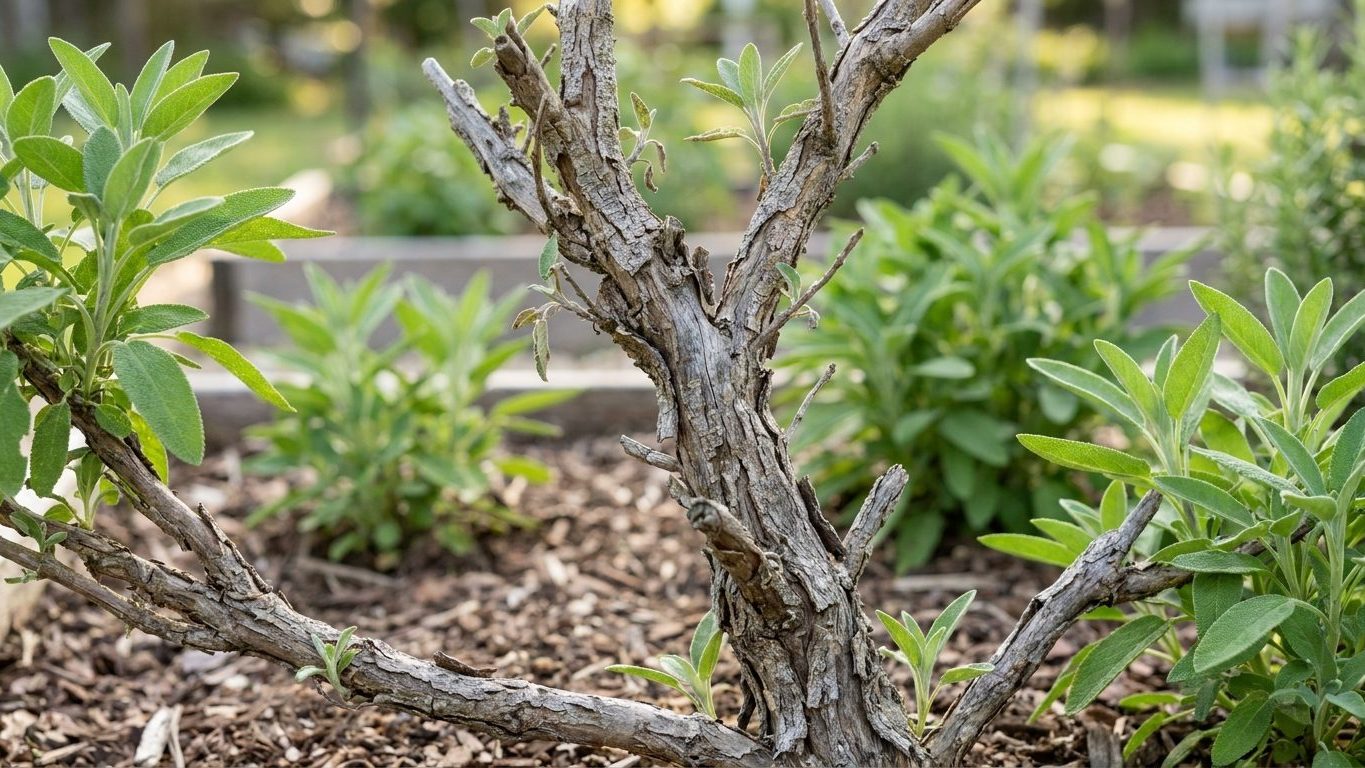

Sage doesn’t die of disease or neglect most of the time. It dies of age. A common garden sage plant tends to stay productive for three to five years before it turns woody, sparse, and slow to leaf out, and no amount of fertilizer or pruning brings that back. The fix isn’t a cure. It’s a replacement schedule, planned before the decline starts rather than after.
What is actually going on

The thing to understand here is woodiness. Sage, like many Mediterranean subshrubs, grows new stems each season on top of the previous year’s growth. Over time, the base of the plant converts from soft, leafy stem tissue to hard, bark-covered wood. That woody base doesn’t resprout the way a tomato plant recovers after a hard pinch. It just sits there, thicker every year, sending out fewer and fewer new leafy shoots from its tips.
This isn’t a disease, and it isn’t a sign the plant is struggling in a way you can treat. It’s the normal life cycle of a woody perennial herb. Rosemary, thyme, and lavender follow the same pattern, though sage tends to show it faster and more visibly, because its leaves are large and its decline is easy to spot: fewer new shoots, more bare wood, leaves that get smaller and more sparse toward the center of the plant.
Why pruning doesn’t reset the clock
Gardeners often try to fix an aging sage plant with a hard cutback, the same move that works on many flowering perennials. With sage, that approach has limits. Cutting into the woody base, below where leafy growth is happening, frequently produces no regrowth at all, because that old wood has largely lost its ability to push new buds. Cutting only the soft, green tips keeps the plant tidy but does nothing to address the woody core underneath, which keeps expanding regardless.
The plant’s real productive window is the section of stem that’s still soft and green. Every year, that section makes up a smaller percentage of the whole plant. A three-year-old sage might still be mostly productive stem. A six-year-old sage might be mostly bare wood with a thin ring of new growth at the edges. That ratio, not any nutrient deficiency or pest problem, is what drives the decline most gardeners notice and misread as a health issue to solve.
None of this is unique to any particular variety. Common culinary sage (Salvia officinalis) and its various forms, whether purple-leaved, tricolor, or golden, all share this woody-perennial growth habit. The species matters here far more than the specific type sold at a garden center.
In the garden
Managing an aging sage plant is really about two separate jobs: stretching out the good years, and knowing when to stop trying and start over. Neither job is complicated, but skipping either one is where most gardeners lose productive plants earlier than they need to.
| Task | What to do | What happens if skipped |
|---|---|---|
| Light pruning each spring | Trim back the soft tips by a few inches once new growth starts, staying within the green, non-woody stem | The plant grows leggy, flops open in the middle, and puts energy into woody stem instead of leafy growth |
| Removing spent flower stalks | Cut flower spikes after bloom before they set seed | The plant diverts energy into seed production, leaving less for leaf growth the following season |
| Watching the base each year | Check every spring how much of the plant is still soft stem versus hard wood | Decline goes unnoticed until the plant suddenly produces almost nothing, with no time to start a replacement |
| Starting a new plant early | Take cuttings or start new seedlings by year two or three, before the original plant fails | The garden goes a full season without usable sage while a replacement establishes |
| Dividing or layering (where the plant habit allows) | Encourage low stems to root where they touch soil, then separate them once rooted | You lose a low-effort way to get a genetically similar replacement without buying new stock |
The most common failure point on this list is the last one. Gardeners treat sage like a perennial they plant once and revisit only when it’s already declined, then scramble for a replacement in the middle of the growing season. Starting new plants a year or two before you expect to need them means the transition is invisible in the kitchen. There’s no gap, no season where the sage in the garden bed is producing next to nothing while a brand-new seedling is still just a few leaves.
Soil and drainage matter too, though less than the age factor. Sage planted in heavy, wet soil tends to decline faster and can develop root problems that shorten its useful life even further. Raised beds, containers, or amended soil with good drainage give the plant its best shot at reaching that three-to-five-year window rather than falling short of it.
What it depends on where you are
How long a sage plant actually lasts, and how it declines, isn’t the same from one region to the next. Winter cold, summer humidity, and the length of the growing season all shift the timeline.
In regions with mild, dry winters, sage can stay evergreen and keep growing slowly through the cold months, which sometimes extends its productive life but also means the woody-base process keeps advancing year-round without a true dormant pause. In colder regions, winter dieback of the soft top growth is common, and what survives underground or at the base has to push all the new growth each spring, which can either mask the woody decline for a while or accelerate it, depending on how harsh the winter was.
Humidity plays its own role. Sage evolved for dry Mediterranean summers, and in regions with hot, humid summers, the combination of moisture and heat around the woody base can invite rot and fungal problems that shorten the plant’s life well before the normal woodiness would have ended its usefulness. That’s a different failure mode than the slow, expected decline described above, and it’s one where local humidity and rainfall patterns matter more than the plant’s inherent age.
Season length also determines how quickly a replacement plant catches up. A shorter growing season means a new sage seedling or cutting has less time to establish before the following winter, which can push the entire replacement timeline back by a year in colder states compared to warmer ones.
Because these factors vary so much by state and even by microclimate within a state, this page won’t assign a specific timeline or hardiness detail to any one region. Check this site’s state-level herb growing pages for guidance closer to your actual conditions, and treat your local cooperative extension office as the most reliable source for frost dates, soil recommendations, and regional pest or disease pressures specific to where you garden.
The mistake that costs the most
The single costliest mistake with sage is treating it as a permanent fixture in the garden and only reacting once it’s already failing. By the time a sage plant is visibly struggling, mostly bare wood with a thin fringe of leaves, it’s usually too late to do anything meaningful for that particular plant. The decline that got it there took a year or more to develop, and no pruning technique or feeding schedule reverses woody growth back into productive stem.
What costs even more than losing the plant is losing the growing season along with it. A gardener who only notices the problem in midsummer, when the sage that used to fill half a raised bed is suddenly producing a handful of small leaves, has no realistic path to a full replacement before the season ends. Starting a new plant from seed at that point often means waiting until the following year for anything usable. Starting from a cutting is faster but still needs weeks to root and establish before it can be harvested from with any regularity.
The fix costs almost nothing and takes almost no time: treat sage as a plant with a known, limited lifespan from the day it goes in the ground, and build its replacement into the plan from year one rather than year four. Mark a rough date, three years out, to start a new plant alongside the existing one. Let the two overlap for a season. When the older plant finally does turn mostly woody, there’s already a younger one filling in, and the kitchen never runs short.
That single shift, planning for a plant’s ordinary lifespan instead of reacting to its failure, applies just as well to rosemary, thyme, oregano, and most other woody perennial herbs. Sage just tends to show its age sooner and more obviously than the rest.