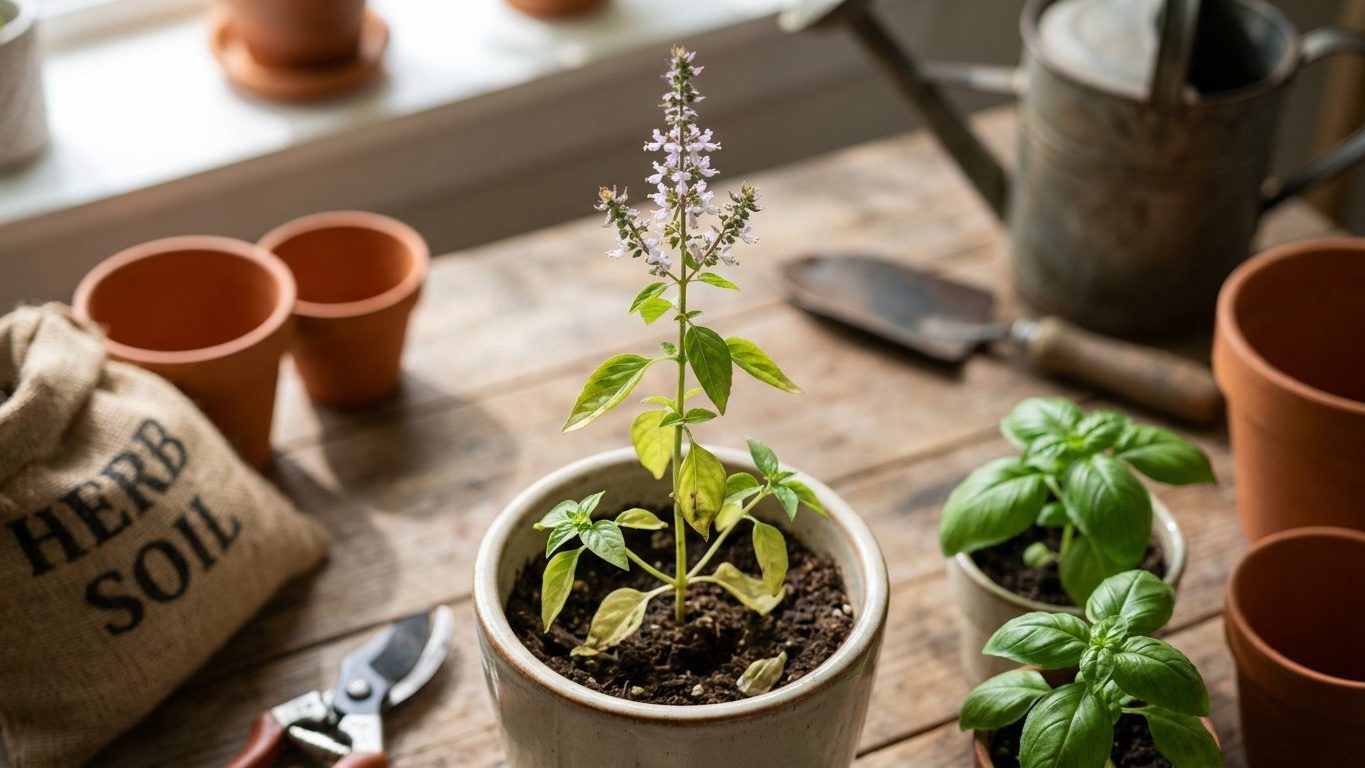

Bolting means a herb has stopped growing leaves and started building a flower stalk, and once that shift happens, the leaves that follow usually turn bitter or sparse. It’s not disease and it’s not a mistake you necessarily made. It’s the plant reading its environment and deciding it’s time to make seed. The question worth asking isn’t how to stop it entirely, but how to slow it down and how to read the signs early.
What is actually going on
Every annual and biennial herb carries a built-in timer, and that timer is set by two inputs: day length and temperature. Some species respond mainly to how many hours of daylight they’re getting (a signal called photoperiod), while others respond to accumulated heat, sometimes called degree-days. Coriander, cilantro’s seed-producing cousin, is the classic example people bring up, but the same switch exists in basil, dill, arugula, and most leafy annual herbs. The plant isn’t malfunctioning when it bolts. It’s completing its life cycle on schedule, just faster than the gardener wanted.
Here’s the mechanism in plain terms. A young herb plant spends its early weeks in what growers call the vegetative stage, putting energy into roots and leaves. At some point, an internal hormonal signal, triggered by lengthening days, rising soil temperature, or both, tells the plant to switch modes. Once that switch flips, the plant redirects its energy toward a central flower stalk. Leaf production slows or stops, the stem elongates rapidly (this is the “bolt” itself), and the plant starts flowering and setting seed. Chemically, this often coincides with the plant producing more bitter compounds in its leaves, which is why bolted basil or bolted lettuce-adjacent herbs taste harsher than they did two weeks earlier.
Why the plant can’t be talked out of it
This is the part that trips people up: once the flowering signal has been triggered, pinching off the flower stalk slows the visible symptom but doesn’t reset the internal clock. The plant will often just send up another stalk within days. That’s because the hormonal cascade that initiates flowering isn’t undone by removing the flower itself, it’s undone (if at all) by changing the environmental conditions that triggered it in the first place, which for a home gardener usually isn’t practical mid-season.
Stress accelerates the whole process. A herb that’s been underwatered, crowded, or exposed to a sudden heat spike will often bolt earlier than a well-tended plant of the same species, because stress itself can act as a secondary trigger alongside day length and heat. This is why two basil plants started from the same seed packet, grown ten feet apart, can bolt weeks apart from each other. One thing this page won’t get into: the medicinal reputation some of these bolting herbs carry (dill and coriander both have long folk-use histories) isn’t something this page evaluates one way or the other. That’s a separate conversation from what’s happening physiologically in the garden bed.
In the garden
Not all herbs bolt for the same reason, and knowing which trigger applies to which plant changes what you can actually do about it. Broadly, herbs split into heat-triggered bolters and day-length-triggered bolters, with a few responding to both at once.
| Herb type | Primary trigger | What happens when it goes wrong | What helps |
|---|---|---|---|
| Cilantro/coriander (leaf stage) | Heat and day length together | Leaves thin out and turn feathery, flavor turns soapy-bitter within days of a hot stretch | Succession sow every few weeks; grow during cooler shoulder seasons rather than midsummer |
| Basil | Day length, worsened by heat and stress | Central stem stretches, leaves get smaller and more pungent, flower spikes form at every node | Pinch growing tips regularly before flower buds form; harvest heavily and often |
| Dill | Heat and plant maturity | Feathery foliage growth stops, plant sends up a single tall flower umbel | Succession sow; accept that mature plants will eventually flower and plan seed harvest around it |
| Arugula and other leafy annual herbs | Heat, sometimes day length | Leaves turn increasingly peppery-bitter, growth shifts to a central stalk | Grow in cooler months; provide afternoon shade during warm stretches |
| Parsley (biennial) | Day length and a cold period (vernalization) | Second-year plants bolt hard once warm weather returns, often with little warning | Treat as an annual, replacing plants each year rather than overwintering them |
| Chives and other perennial alliums | Day length, seasonal | Flower stalks emerge and leaf texture toughens once flowering starts | Cut flower stalks at the base as they appear if leaf production matters more than blooms |
The through-line in that table is timing rather than heroics. Succession sowing, meaning planting a fresh round of seeds every couple of weeks instead of one big batch, is the single most reliable tool across nearly every heat-triggered herb, because it guarantees a supply of young, pre-bolt plants coming along even as older ones flower out. For day-length-triggered herbs like basil, regular harvesting and pinching (removing the top set of leaves before a flower bud fully forms) buys real time, even if it can’t cancel the process outright.
Where gardeners get it wrong most often is treating every bolting herb the same way, assuming that if pinching works on basil, it must work on cilantro. It doesn’t, not reliably, because cilantro’s trigger is heat-driven in a way that pinching can’t override once a hot week arrives. Matching the response to the actual trigger is what separates a herb bed that produces steadily from one that peters out by July.
What it depends on where you are
Everything above describes the mechanism, but the timing of it is entirely local, and that’s the part this page genuinely cannot answer for you. How long your growing season runs, how fast your region heats up in spring, and how much day length shifts between your last frost and midsummer all change when a given herb will bolt. A cilantro crop planted in a region with a short, cool spring might give three or four weeks of usable leaf before flowering. The same variety planted somewhere that jumps from cool to hot in a matter of days might bolt in half that time.
Summer rainfall patterns matter too, in a less obvious way. Herbs under drought stress tend to bolt earlier than well-watered ones, so a region with a dry, hot early summer will often see bolting arrive faster than the calendar alone would suggest. Humidity plays a role as well, since it affects how much heat stress a plant actually experiences at a given air temperature.
Because none of that is knowable at the level of a general guide, the more useful move is checking two local sources. First, the state-specific herb and vegetable guides elsewhere on this site, which speak to regional planting windows in more concrete terms than a national page can. Second, and more authoritative still, your local Cooperative Extension Service office, which tracks the actual heat and frost patterns for your county and can tell you, for instance, whether a fall cilantro planting will outperform a spring one in your specific area. No national article, this one included, can replace that local data.
The mistake that costs the most
The single costliest mistake is waiting until a herb has already bolted to do anything about it. By the time the flower stalk is visibly elongating and buds are forming, the plant has already committed its energy to reproduction, and there’s very little that reverses that. Gardeners often try anyway, pinching off the flower stalk after the fact and expecting the plant to go back to making tender leaves. Sometimes it produces a little more growth. More often it just sends up a second stalk within a week, because the underlying trigger, whether that’s day length, heat, or both, hasn’t changed.
The fix isn’t a rescue technique. It’s a shift in when you intervene. Watch for the early signs, a stem that starts thickening at the base, leaves that begin growing smaller and more tightly clustered near the top, a plant that suddenly seems to be growing “up” rather than “out”, and act then, not after buds appear. For heat-sensitive herbs, that means having the next succession planting already in the ground before the current one shows stress, so there’s no gap in supply while you wait for it to bolt. For day-length-sensitive herbs like basil, it means harvesting on a schedule rather than only when you need leaves for a specific meal, since regular cutting keeps the plant in vegetative mode longer than occasional, heavy harvesting does.
Put another way: bolting isn’t really a problem to solve once it starts. It’s a deadline to plan around before it starts. A gardener who treats the first hot week of the season as the cue to check on cilantro, rather than the day the leaves start tasting off, ends up with a longer harvest window every single year, without changing anything about the plant itself.