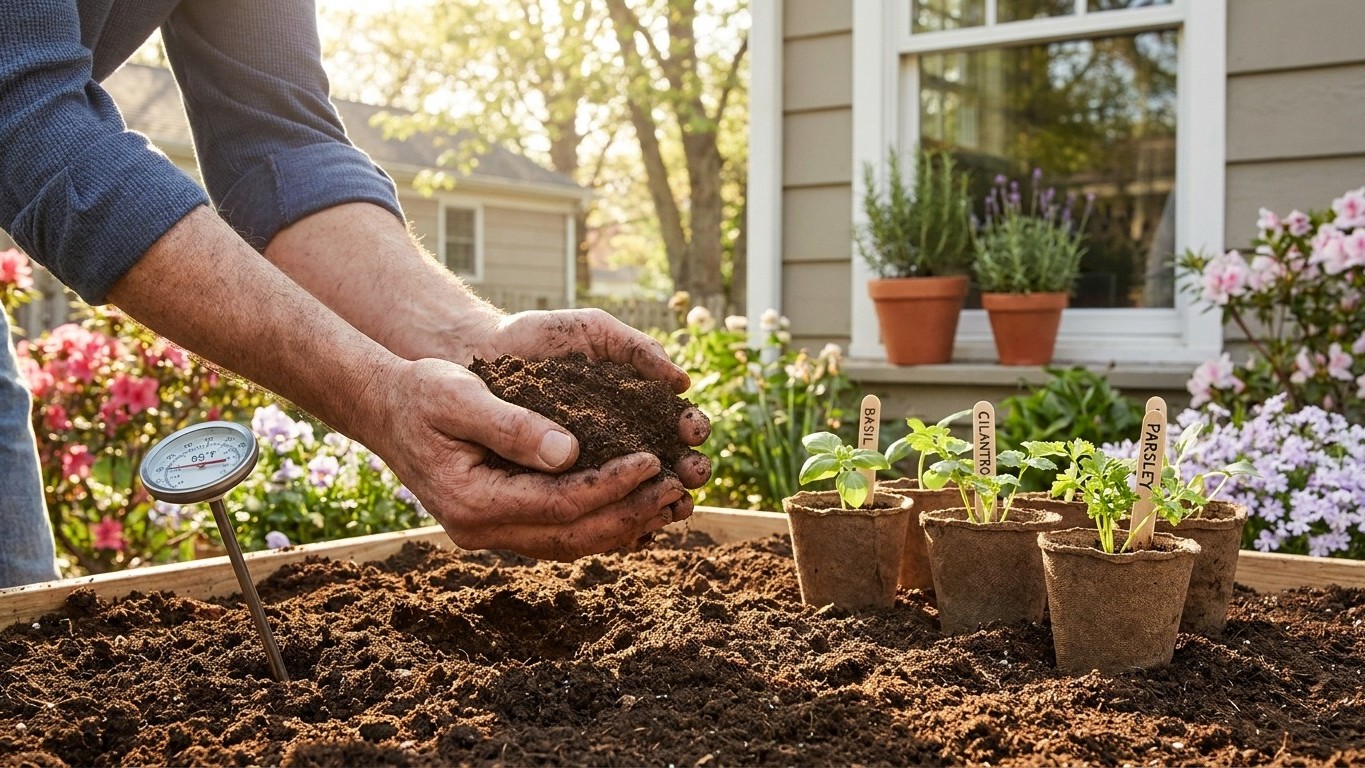

In most of Arizona’s low desert, around Phoenix, you can put herbs in the ground almost any month of the year: NOAA counts the frost-free season there at 365 days. That answer flips fast once you leave the valley floor, though, because Flagstaff and the high country freeze hard most winters. For herbs here, the real limit isn’t cold. It’s heat, and knowing which Arizona you’re gardening in decides almost everything else.
When the soil is warm enough in Arizona

Ask any gardener east or north of the Rockies when to plant, and they’ll point to the last spring frost date. In the low desert around Phoenix, that question barely applies. NOAA’s 1991-2020 Climate Normals, built from daily records at station USW00023183, show that a 32F freeze showed up in only 6 of the last 30 springs, arriving anywhere from late December to mid-January when it did happen at all. The station’s official frost-free season is listed as 365 days. There’s effectively no spring frost date to wait out.
That number is a probability, not a promise, and it matters for one reason: it changes what “soil warm enough” even means here. Everywhere else, frost is used as a stand-in for something gardeners actually care about, which is soil temperature. Herbs germinate and root when the ground itself has warmed, and that usually happens some weeks after the frost risk has cleared. In low-desert Arizona, there’s no frost risk to clear in the first place. Soil warms fast, often before many transplants are ready, and the constraint shifts from “is it warm enough yet” to “is it already getting too warm.”
This is where a lot of general planting guides mislead Arizona gardeners. A calendar built around frost dates assumes a cold season that ends and a warm season that follows. Around Phoenix, the cold season barely exists, and the warm season arrives so early and stays so long that many cool-loving herbs need to be started and finished before the heat locks in, not after some spring thaw. The practical answer is to watch soil and air temperature trends through late winter rather than any single frost marker, since the marker itself is nearly absent.
None of this applies uniformly across the state. Arizona’s high country, Flagstaff and similar elevations, is a different climate on the same map. Those areas do freeze hard, on a schedule closer to what gardeners in the Rocky Mountain states plan around, and a Phoenix-based calendar would be wrong for them in the opposite direction. Anyone gardening above the low desert should treat this page’s timing as describing the valley floor, not the whole state.
How long the season lasts here
Normally this is where you’d subtract the last spring frost from the first fall frost and get a number of frost-free days to work with. That subtraction doesn’t work in the low desert around Phoenix, because neither date is really fixed. NOAA doesn’t give a reliable spring or fall freeze date for the station; instead it reports a 365-day frost-free season outright. There’s no gap to calculate. The window is, in effect, the whole year.
A year-round frost-free window sounds like an unlimited invitation, and in one sense it is. It allows repeated sowings of quick cool-season herbs across fall, winter, and early spring, when temperatures sit in a range most leafy herbs actually prefer. Gardeners elsewhere plan two or three succession sowings around a single warm season; in the low desert, the more useful mental model is two overlapping cool seasons (fall through early spring) bracketing one brutal summer stretch that most tender herbs simply sit out.
That reframing matters for anyone deciding whether to direct-sow or transplant. Where the season is short, transplanting buys precious weeks, and checking root development before setting plants out is worth the extra step. Where the season is effectively unlimited but interrupted by heat rather than cold, the calculation changes: timing a sowing to finish before the heat arrives matters more than squeezing out extra growing days, and a second or third round of the same cool-season herbs often makes more sense than pushing one planting to its limit.
Anyone mapping out exactly when to start each round, and how to stagger plantings so beds don’t go empty between them, should work from the site’s succession sowing guide, which lays out the mechanics of spacing sowings through a growing calendar shaped like this one.
Heat and water in Arizona

Summer heat is the part of Arizona’s reputation everybody already knows, and it does matter for herbs, mostly by shutting down growth and pushing gardeners toward shade cloth and afternoon protection for anything not built for full desert sun. But heat isn’t the number that reorganizes an Arizona herb bed. Winter is, and the deciding figure is smaller and quieter than any summer statistic: the mean daily minimum temperature of the coldest month, which at the Phoenix reference station sits at 45.3F.
That number is not a record low and not a monthly average; it’s the typical overnight floor during the coldest stretch of the year. At 45.3F, most nights never come close to freezing, which is exactly why the USDA Plant Hardiness Zone Map, built on average annual extreme minimum temperature, places Phoenix and similar low-desert locations in a warm zone within Arizona’s statewide range of 4b-10b. That range itself is a warning label: it spans nearly the entire zone system on one map, because a state that includes both Sonoran Desert floor and 7,000-foot forested plateau can’t be described by a single number. Any dated recommendation should cite the reference city, not the range, and say plainly that other parts of the territory sit somewhere else entirely on that scale.
This is the fact that actually reorganizes the herb bed. In a place where winter minimums rarely approach freezing, woody perennial herbs that would need to come indoors or die back in colder zones can simply stay in the ground year-round, planted once and left as permanent landscape rather than replanted each spring. In Arizona’s high country, where the same USDA map assigns a much colder zone, those same herbs are pots to bring indoors or annuals to replant, not permanent fixtures. The gardening decision that matters most here isn’t how many days climb past 90F. It’s whether winter ever gets cold enough to force a plant indoors, and in the low desert, for most of the year, it doesn’t.
Which herbs suit Arizona
Reasoning from these two facts, an effectively frost-free season and a mild coldest-month minimum, points toward a herb bed organized around life cycle rather than variety names. Woody Mediterranean-type herbs, the group that includes rosemary-types, thyme-types, and oregano-types, tend to handle both the mild winters and the dry heat of the low desert well once established, provided they get sharp drainage and don’t sit in wet soil. Tender leafy herbs, the basil-types and similar warm-season annuals, thrive during the warm months but usually need afternoon shade once temperatures climb into extreme territory, since intense sun on top of high heat stresses leaf tissue faster than it stresses roots.
Cool-season herbs, the cilantro-types, dill-types, and leafy parsley-types, are the opposite case: they do their best growth during the mild low-desert winter and tend to bolt or decline once real heat arrives, which is exactly why the succession-planting approach from the previous section matters so much here. The table below sketches the general pattern by type, not by variety.
| Herb type | Behavior in low-desert Arizona | Main challenge |
|---|---|---|
| Woody Mediterranean type (rosemary, thyme, oregano) | Can persist as a permanent planting year-round | Needs sharp drainage, not winter cold |
| Tender leafy annual (basil type) | Grows through the warm months | Extreme heat and direct sun stress; benefits from afternoon shade |
| Cool-season annual (cilantro, dill, parsley type) | Best growth in fall through early spring | Bolts quickly once real heat sets in |
What this page won’t do is put a name on any of those types. Arizona State University’s cooperative extension network at extension.arizona.edu runs the trials that actually test named varieties against local heat, water, and soil conditions county by county, and that local trial record is the only recommendation with real weight behind it. A national gardening page naming a favorite variety would be guessing at conditions it hasn’t tested; refusing to do that guessing, and pointing to the office that has actually run the trials, is the more useful answer here.
One more claim worth stating plainly: several herbs common to home gardens carry long-standing medicinal reputations, and this page doesn’t evaluate those claims one way or the other. It sticks to what grows, when, and how, in a climate that runs from desert floor to forested plateau inside one set of state borders.