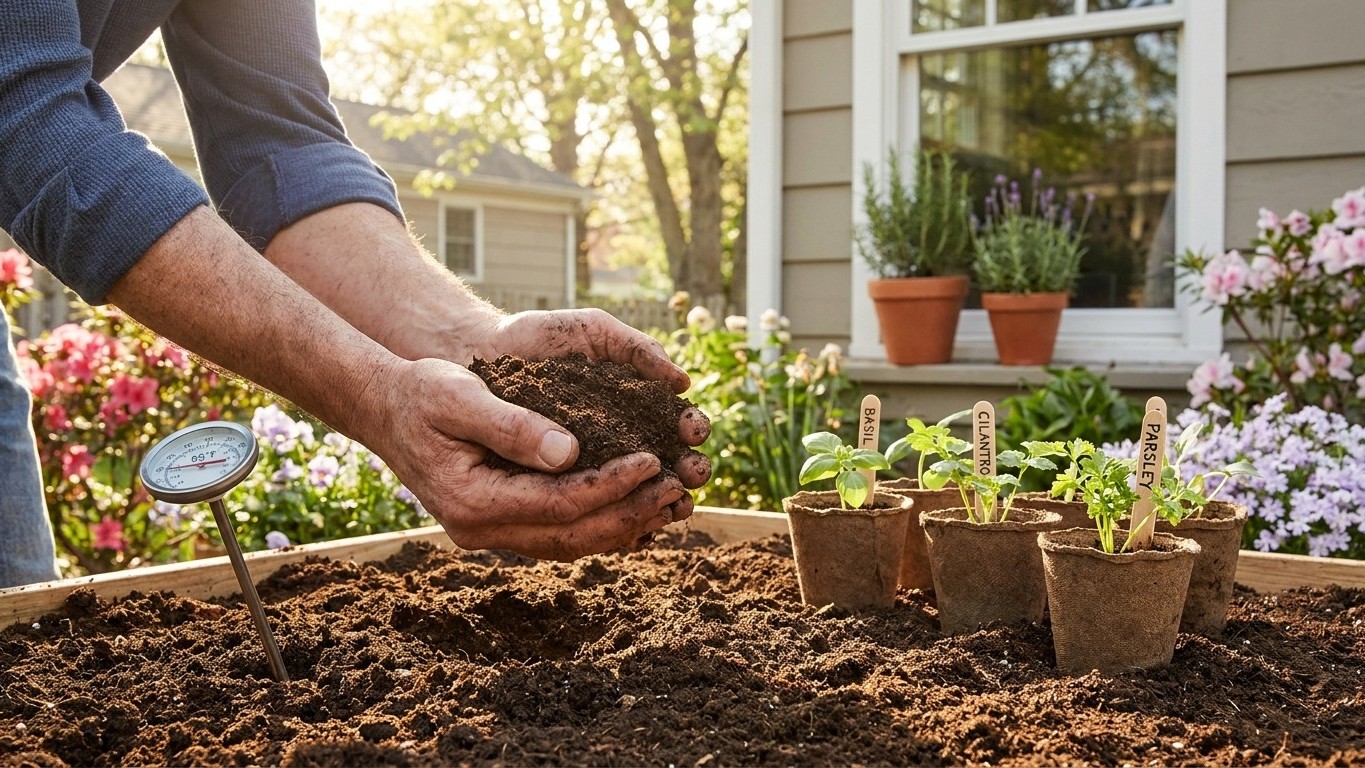

Most of Georgia can put herb transplants in the ground from mid-to-late March through November, but that’s a rough average across a large state. The real answer depends on soil temperature, not the calendar, and on whether you’re growing an annual you’ll pull in fall or a perennial expected to survive winter where it stands.
When the soil is warm enough in Georgia

At the Atlanta reference station (USW00013874), NOAA’s 1991-2020 Climate Normals put the last spring freeze (32°F) somewhere between March 11 and March 29, the window where the probability of a freeze runs from 30% to 70%. That’s not a single magic date. It’s a band of risk, and planting on the early edge of it means accepting real odds of a freeze event still happening.
Here’s the part that trips people up: frost date and planting date are not the same thing. Frost is a proxy for something the roots actually care about, which is soil temperature. Air can clear the freeze risk while the top few inches of ground are still cold and slow. Basil, for instance, sulks or rots in cool soil even on a frost-free week, while a hardier annual like parsley or cilantro tolerates the same soil without complaint. So the frost window from NOAA tells you when the danger of losing a plant to cold air drops off, not when the ground is actually warm enough to wake roots up and get them growing.
That distinction matters more in Georgia than the tidy statewide dates suggest. The NOAA freeze data above comes from the Atlanta airport, which sits in an urban heat island and runs warmer than the surrounding countryside. Head north into the mountains and the foothills around Blue Ridge or Dahlonega, and both frost dates shift, with spring freezes lingering later and fall freezes arriving several weeks earlier than what the Atlanta station shows. Drop down to the coastal plain around Savannah or Valdosta, and the opposite happens: the window opens earlier and stays open longer, with a milder, wetter winter overall. If you garden outside the immediate Atlanta metro, treat the March 11 to March 29 figure as a reference point to adjust from, not a firm date to circle on the calendar.
None of this is an invitation to gamble on tender herbs before soil temperature catches up with the calendar. A soil thermometer pushed a few inches into a prepared bed is a cheap, honest second opinion. It won’t tell you the day a freeze will hit, since that’s a probability, not a promise, but it will tell you whether the ground itself is ready for a herb that hates cold feet, regardless of what the sky did last night.
How long the season lasts here
Run the two ends of the frost data together and Georgia’s frost-free window comes out somewhere between roughly 229 and 265 days, depending on where you land inside each probability band and where in the state you’re gardening. That’s the gap between the last spring frost (March 11 to March 29) and the first fall frost, which NOAA’s 1991-2020 Normals put at November 13 to December 1 for the same Atlanta station. Even the short end of that range works out to well over seven months of frost-free ground, and the long end pushes close to nine.
A window that generous changes the math on what’s worth doing with herbs. Where a short-season northern garden gets one shot at a crop before frost shuts it down, a Georgia gardener has room to sow a batch of a fast annual like cilantro or dill in spring, let it bolt in early summer heat, then sow again in late summer for a fall harvest that beats the first freeze comfortably. That kind of staggered planting, known as succession sowing, is worth building into a herb bed here rather than treating as optional; the season length supports it in a way that a shorter climate simply can’t. If you haven’t planned a succession schedule before, this site’s succession sowing guide walks through the timing logic in more detail.
The long window also changes how you think about transplants versus direct-seeded herbs. With months of growing time ahead rather than weeks, there’s less pressure to rush transplants into the ground the moment risk clears, and more room to check root health, harden plants off properly, and even hold a second round of starts in reserve in case an early planting gets knocked back by a late-season freeze on the early edge of that March window. A short season punishes hesitation. A long one rewards a little patience.
That said, the two frost dates only tell you when killing cold arrives and departs, not what happens in between. A nine-month frost-free stretch in a hot, muggy climate is a very different growing experience than the same nine months somewhere cooler and drier, and that’s where Georgia’s summer conditions start to matter more than the calendar does.
Heat and water in Georgia

Georgia summers run hot and humid across most of the state, which is common knowledge to anyone who’s spent a July afternoon outdoors here, but the number that actually decides which herbs survive as permanent plants isn’t a summer figure at all. It’s winter. Specifically, it’s the mean daily minimum temperature during the coldest month, which at the Atlanta reference station sits at 35.6°F according to NOAA’s 1991-2020 Climate Normals. That’s not a record low and not a monthly average; it’s the typical overnight floor during the coldest stretch of winter, and it’s the figure that separates a herb that overwinters outdoors from one that has to come inside or get replanted every spring.
Layered on top of that single-station reading is Georgia’s USDA hardiness zone range of 6a to 9b, built on the average annual extreme minimum temperature. That’s a wide spread for one state, and it’s the reason a herb bed plan that works in the north Georgia mountains can fail completely on the coastal plain, or vice versa. A perennial that shrugs off winter in Savannah’s Zone 9 conditions may not make it through a Zone 6a winter in the mountains around Blairsville. Treat the 6a-9b figure as a starting point for locating your own spot on the map, not as a single answer for the whole state.
That winter split reorganizes the whole herb bed more than summer heat does. In the warmer end of Georgia’s zone range, woody Mediterranean herbs can behave as true perennials, holding their structure through winter with minimal protection. Push toward the cooler end, and those same herbs become container plants that need to move indoors or into a sheltered spot once the coldest month’s overnight lows start testing that 35.6°F average. The practical decision that follows from this isn’t about coping with July heat at all; it’s about deciding, herb by herb, which plants get a permanent spot in the ground and which get a pot with wheels.
Summer humidity still plays a supporting role, mostly as a disease pressure rather than a heat-stress one. Warm, damp air sitting in dense foliage is what pushes fungal issues on herbs with tight growth habits, more than the thermometer reading on any given afternoon. Spacing plants for airflow and avoiding overhead watering late in the day does more for a Georgia herb bed’s health through summer than any amount of shade cloth.
Which herbs suit Georgia
Reasoning from the state’s own numbers gets you further than reaching for a favorite variety. The long frost-free window (229 to 265 days) favors herbs that can go through more than one cycle in a season, so fast annual types that bolt quickly in heat, like cilantro or dill, are worth planting twice rather than once. The wide hardiness range (6a-9b) means the perennial-versus-container question has to be answered locally: woody Mediterranean types can stay in the ground year-round toward the milder end of that range, and need a pot and a winter move toward the cooler end, near that 35.6°F coldest-month minimum. And the humid subtropical summer common across most of the state makes disease resistance, and good airflow around the plant, a bigger factor in success than heat tolerance alone.
Some herb families carry a well-known reputation for traditional or medicinal use. This page doesn’t evaluate those claims one way or another; it sticks to what a herb needs to grow well in a Georgia bed, culinary and garden considerations only.
What this page won’t do is hand you a specific variety name. That’s not an oversight. Variety trial results change from year to year and differ sharply between north Georgia’s cooler mountain counties and the humid coastal plain, and a name printed on a general page like this one has no way to account for that. The University of Georgia Cooperative Extension runs its own trials and keeps current, region-specific variety recommendations for exactly this reason. Their site is the resource that actually knows which selections have performed well in your county this year.
Refusing to name a variety here is the honest answer, not a dodge. A herb bed built around the right types for Georgia’s season length and winter split, then filled in with locally trialled varieties from Extension, will outperform anything picked off a generic list every time.