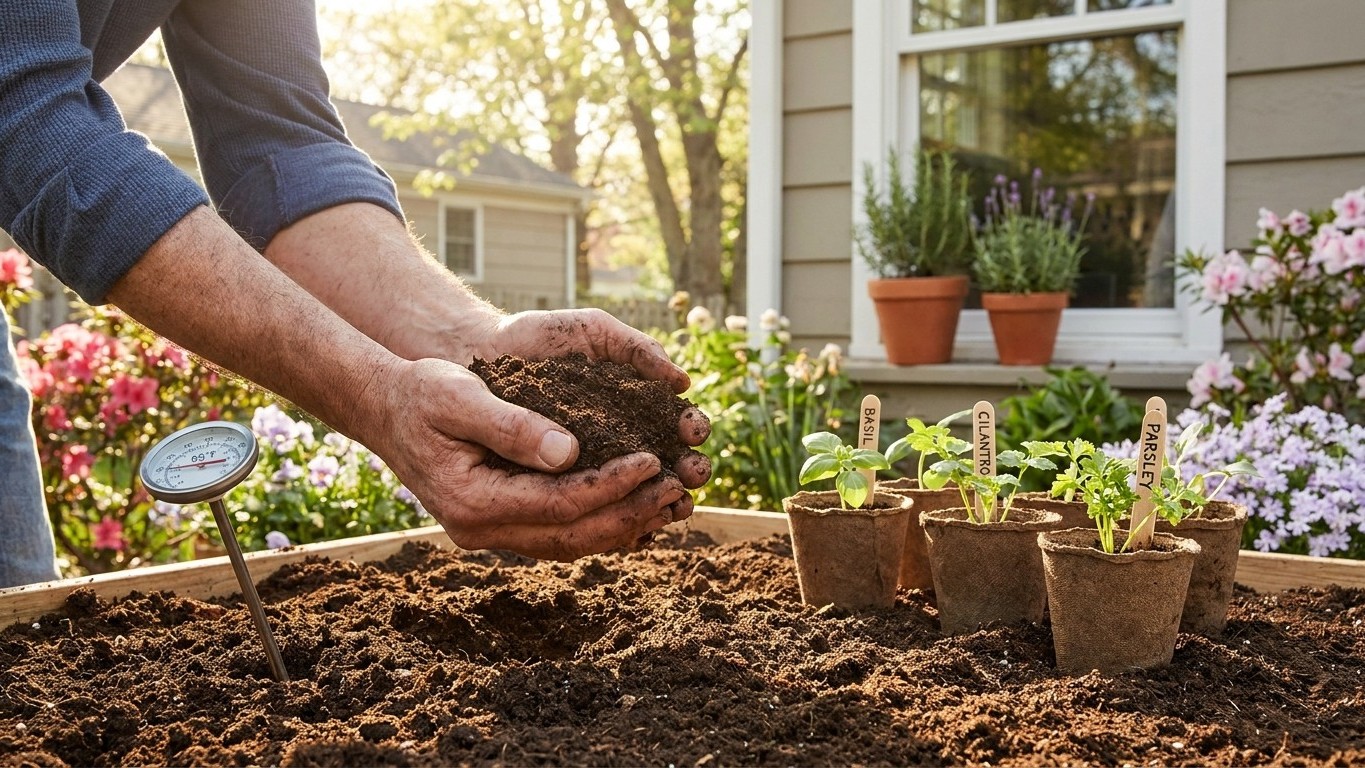

Herbs go into Connecticut ground once the soil itself has warmed, typically a couple of weeks after the last frost risk clears, and the real decision for this state isn’t when to plant tender annuals but which herbs can stay in the ground year-round at all. Coastal towns near Long Island Sound and the hills of the northwest corner don’t share a growing calendar, and for herbs that gap matters more than it does for most vegetables.
When the soil is warm enough in Connecticut
The question everyone actually wants answered is a date, so here it is: at Bridgeport’s reference station (USW00094702), NOAA’s 1991-2020 Climate Normals put the last spring 32°F freeze between April 2 and April 12, the range where freeze probability runs 30 to 70 percent. That’s the frost date. It is not the planting date, and treating the two as the same thing is the single most common mistake in a Connecticut herb bed.
Frost dates track air temperature at a specific hour on a specific morning. Herbs don’t respond to air temperature at dawn. They respond to soil temperature at root depth, and soil warms on its own schedule, lagging behind the air by anywhere from one to three weeks depending on how much sun a bed gets and whether the ground is bare or mulched. A tender herb tucked into cold, wet soil right on the frost date often just sits there, stalled, sometimes rotting at the stem before it ever puts on new growth. Waiting those extra two or three weeks after the frost window closes usually costs nothing and prevents that stall entirely.
It also helps to remember that Bridgeport sits directly on Long Island Sound, which makes it the mildest station in the state. Inland towns and the northwest corner cool off earlier in fall and stay cold later in spring than this coastal number suggests, sometimes by a meaningful margin. Anyone gardening away from the shoreline should treat the April 2 to April 12 window as an early estimate, not a fixed date for their own yard.
None of this is a guarantee, either. A frost date is built from decades of probability, not a promise about any single spring. Some years bring a hard freeze after the window closes; the range only describes the odds, not the certainty.
Hardy perennial herbs like chives or established oregano can usually go in the ground close to that frost window without much drama, since a light freeze rarely sets them back. Tender annual types are the ones that benefit from the extra wait, since a check in growth this early in the season tends to show up later as a smaller, slower plant all summer.
How long the season lasts here
Connecticut’s frost-free window, using the same Bridgeport normals, runs from that April 2-12 spring frost to a first fall frost of October 28 to November 10. Doing the arithmetic across the widest and narrowest combinations of those two ranges gives a growing season of roughly 209 to 212 days at this coastal station, call it about seven months. Inland and northwest Connecticut will run shorter on both ends, since those areas warm later in spring and cool earlier in fall than the shoreline does.
Seven months sounds generous, and for a lot of herb growing it is. But herbs aren’t one homogeneous group here. Fast annual types like dill or cilantro move through their whole productive life in a fraction of that window, which means a Connecticut gardener working with even the shorter inland season usually has room for more than one sowing of these quick crops. A planting that bolts in the July heat can be followed by a second one in late summer that finishes before the fall frost arrives. That kind of staggered planting, known as succession sowing, is worth planning around rather than leaving to chance, and the mechanics of spacing those sowings correctly are covered in this site’s succession sowing guide.
Slower herbs change the math. A woody perennial that takes most of a season just to establish a root system isn’t a candidate for a second sowing at all; the only real decision there is whether to start it from seed indoors or bring in an already-rooted plant, since seed-started woody herbs may not reach a size that can survive winter before the season closes. That’s a case where transplanting isn’t a shortcut, it’s close to the only workable option in a state where the growing window, even at its longest, still closes by early-to-mid November.
The practical takeaway is that a seven-month season is long enough to run two full cycles of a quick annual herb, but only one cycle of anything that grows slowly or needs to overwinter as an established plant. Knowing which category a given herb falls into, before it goes in the ground, decides whether that succession sowing plan is even worth building.
Heat and water in Connecticut
Southern New England summers bring humidity most years, and that combination of warm, damp air is a bigger practical issue for herbs here than any run of hot afternoons. Fungal problems like downy mildew or leaf spot spread fastest in exactly those conditions, sitting on foliage overnight and slowing to a crawl only when the air finally dries out. For herb growers, a humid summer usually means more attention to airflow between plants than to shade or extra watering.
But the number that actually reorganizes a Connecticut herb bed isn’t a summer figure at all. It’s winter. The state sits across USDA Hardiness Zones 6a to 7b, a range built entirely on average annual extreme minimum temperature, and at the Bridgeport reference station the coldest month has an average daily minimum of 24.4°F. That single number, not the day’s record low but the average nightly minimum in the coldest stretch, is what decides whether a given herb survives winter outdoors in this state or needs to come inside.
Zone 6a to 7b is genuinely a wide range for one state to span. Bridgeport, on the Sound, sits at the milder end. Inland valleys and the northwest hills run colder, often by a full zone or more, which means a herb that reliably overwinters outdoors near the coast can fail to survive the same winter forty miles inland. Anyone planning a permanent bed of woody perennial herbs needs to know which end of that range their own yard falls into, since the difference between 6a and 7b is roughly the gap between “needs winter mulch and a sheltered spot” and “comes through most winters without help.”
That zone range is also why container culture is such a common answer for Connecticut herb gardeners rather than an afterthought. Moving a marginally hardy herb into a pot each fall and bringing it into an unheated garage or a bright indoor spot sidesteps the whole hardiness question, and it’s often more reliable than betting on a mild winter at the edge of that plant’s range.
Which herbs suit Connecticut
The season length and the winter numbers together point toward a fairly clear split by type rather than by variety. Fast-growing annual herbs, the kind that finish their whole life cycle in a matter of weeks, fit comfortably even in the shorter inland version of Connecticut’s season and tolerate a second sowing without trouble. Herbs prone to fungal trouble in damp weather do better with wider spacing and airflow built into the layout from the start, since Connecticut’s humid summer stretches give mildew and leaf spot exactly the conditions they need.
Perennial types split along the hardiness line described above. Herbs rated hardy well into zone 6 generally come through a Connecticut winter outdoors, especially near the coast, while herbs whose hardiness rating sits closer to zone 7 or warmer are a real gamble outside the mildest parts of the state and are usually grown as annuals or moved into containers each fall. That’s a decision worth making at planting time, not discovered the following spring when a bed comes up empty.
Several herbs commonly grown for cooking also carry long-standing reputations in traditional medicine. This page doesn’t evaluate those claims one way or the other; it sticks to what a Connecticut garden can grow and how it behaves through this state’s frost dates and winter lows, and any assessment of medicinal use belongs elsewhere.
What this page deliberately won’t do is name a specific variety. Extension trial programs test named cultivars for disease resistance, cold tolerance, and performance under exactly the humid summers and 6a-7b winters described above, and those trial results shift from year to year as new cultivars come through testing. The UConn Extension service publishes that local trial data directly, and it’s the only recommendation that actually reflects a variety’s performance in this state’s specific conditions rather than a general description of the species. That’s not a dodge, it’s the honest answer: a species-level type can be recommended from climate data, a named variety can’t, at least not by a page that hasn’t run the trial itself.