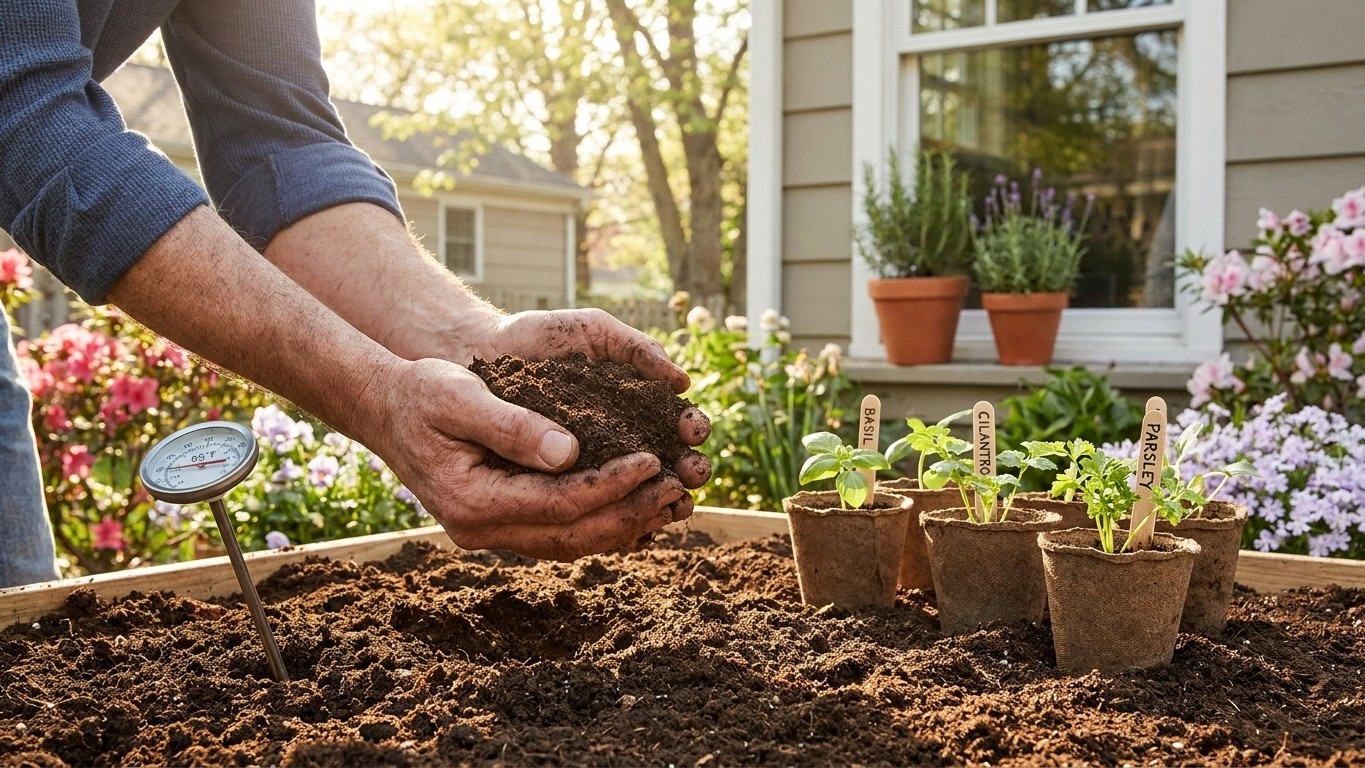

Herbs can grow well in the Northwest Territories, but the calendar here works against most gardeners’ instincts. With an average frost-free window of roughly four months and a Canadian hardiness zone of 1b, the real decision isn’t which herbs taste best. It’s which ones survive the cold enough to be worth planting at all, and which ones simply live in pots.
When the soil is warm enough in Northwest Territories
The Yellowknife A station, tracked by Environment and Climate Change Canada under the 1981-2010 Canadian Climate Normals, puts the average last spring frost at May 25. That date gets treated as gospel by a lot of gardening advice, but it’s worth being clear about what it actually means: it’s a mean, not a guarantee. In one year out of two, frost shows up later than May 25. Some springs it’s earlier. The number is the midpoint of a range, and treating it as a safe date is how a tray of seedlings ends up blackened overnight.
Frost dates are also a proxy for something herbs care about more directly: soil temperature. Air can clear of frost risk while the ground underneath is still cold enough to stall root growth or rot a transplant sitting in it. For herbs, that gap matters. Most culinary herbs, whether from the mint family, the carrot family (dill, parsley, cilantro), or the mustard-adjacent group, want soil that has had time to warm past the frost date, not soil that simply survived the frost date.
Yellowknife sits at 62 degrees north. That’s not a detail to skip past. A single station reading doesn’t describe the whole territory, and NWT covers terrain from river valleys to exposed uplands where the ground stays colder longer. If you garden outside the immediate Yellowknife area, especially somewhere elevated or more exposed, expect the real soil-ready date to land later than the station’s average, not earlier.
A note on scope, because it matters for what this page will and won’t do: this is a culinary and garden page. Several herbs carry long-standing medicinal reputations, and this page doesn’t evaluate those claims one way or the other. It also won’t walk through how to distinguish a garden herb from a wild look-alike, because that kind of identification guidance is exactly the sort of thing that goes wrong for someone, somewhere, with plants that can be dangerous. If you’re foraging, that’s a different skill set with different resources, and it’s not part of what’s covered here.
With the timing question framed honestly, the next thing to work out is how much growing time that timing actually leaves you.
How long the season lasts here
Take the average last spring frost, May 25, and the average first fall frost, September 18, also from the Yellowknife A station’s 1981-2010 normals, and the gap between them is 116 days. That’s the average frost-free window. It sounds almost respectable on paper. In practice, because both dates are averages rather than promises, the usable season for a cautious gardener runs shorter, since you’re planting after the risk has genuinely passed and pulling herbs in before the first real cold snap, not before the calendar average.
What a window like this allows, and doesn’t, shapes the whole approach to planting herbs. A 116-day average isn’t long enough to bank on a second sowing of most herbs after an early one bolts or gets harvested hard. In warmer zones further south, gardeners often treat their first planting of something like cilantro or dill as the opener, not the whole show, and follow it with a second round once the heat backs off. Here, that second act mostly doesn’t exist. The first sowing, timed to soil that’s actually warmed rather than a frost date on a chart, tends to be the only sowing that has time to produce anything worth harvesting.
That single fact changes another decision too: whether starting herbs indoors and transplanting is worth the trouble. In a short-season territory, a transplant that’s already several weeks old when it goes into the ground effectively buys back time the outdoor season doesn’t have. But a transplant with a cramped or circling root system loses some of that advantage the moment it’s set out, since it spends its first days recovering instead of growing. Checking root condition before transplanting isn’t a nice-to-have in a 116-day window. It’s closer to the whole game.
For a broader breakdown of how to time a first and, where climate allows, a second sowing, the site’s succession sowing guide walks through the mechanics in more depth than this page needs to.
Heat and water in Northwest Territories
Ask most American gardeners how their herbs handle summer, and the conversation is usually about heat stress, bolting, and how much water a bed needs during a run of 90-degree days. That conversation doesn’t really apply here. Yellowknife’s summers don’t rack up meaningful counts of days above 90°F in a typical year, and treating this as a hot-climate herb page would be misleading. The climate challenge in the Northwest Territories isn’t excess heat. It’s the opposite problem, plus a short window to work with it.
Cool, often damp summer stretches change what actually threatens an herb bed here. Instead of scorched leaves or a plant bolting to seed early to escape the heat, the more common issues are slower ripening of anything that needs real warmth to develop flavor, and a higher risk of fungal problems like powdery mildew on herbs planted too densely or without decent airflow. A cool, humid patch of garden is a fine environment for mildew and a mediocre one for herb growth, so spacing and airflow do more work here than shade ever would.
But the number that actually reorganizes the herb bed isn’t a summer figure at all. It’s winter. The coldest month at the Yellowknife reference station has an average daily minimum of -21.1°F, and the territory sits in Canadian hardiness zone 1b. That’s worth pausing on, because the Canadian zone system isn’t the same scale as the USDA zones used elsewhere on this site. It’s built from seven climate variables instead of one, and Natural Resources Canada is explicit that there’s no clean conversion between the two systems. A single Canadian zone can overlap several USDA zones at once. So zone 1b shouldn’t be read as “extremely cold” in some translated American sense. It should be read as its own number, describing conditions few perennial herbs are built to survive outdoors.
That’s the fact that decides how the whole bed gets planned. Most Mediterranean-origin herbs, the group that includes many woody perennial types, aren’t built for a coldest-month minimum anywhere near -21.1°F. In a climate like this, they function as container plants that come indoors for winter rather than permanent garden residents, regardless of how hardy they’re marketed as being further south.
Which herbs suit Northwest Territories
Given a short average window and a winter that rules out most woody perennials as permanent outdoor plants, the herbs that make sense here sort by type rather than by variety name. Fast-maturing annual and cool-tolerant herbs, the ones that don’t need a long stretch of sustained warmth to produce something usable, fit a 116-day average window better than slower types do. That points toward things like chives, parsley, and dill as reasonable outdoor bets, planted once the soil has genuinely warmed rather than on the frost date itself.
Herbs from warmer origins, the tender annual types like basil, can still be grown here, but they’re better treated as a start-indoors, plant-out-late crop, or kept in containers where they can be moved if a cold night threatens before the average first fall frost of September 18 actually arrives. Woody perennial herbs, the group that includes many well-known Mediterranean kitchen staples, generally need to be grown as potted plants brought indoors for the winter rather than left in the ground, given the coldest-month minimum this territory sees.
Because the growing conditions run cool and sometimes damp rather than hot and dry, disease resistance matters more here than heat tolerance does. Airflow between plants, reasonable spacing, and not overcrowding a raised bed do more to protect an herb planting from mildew than any variety selection could.
This page won’t name specific cultivars, and that’s a deliberate choice, not an oversight. Variety trial results are locally specific: a type that performs well in a trial garden near Yellowknife may behave differently a few hundred miles away, and no general guide can responsibly hand out a variety name without that local data behind it. The Northwest Territories’ Department of Industry, Tourism and Investment maintains an agriculture services page that connects growers to the kind of territory-specific guidance this page isn’t positioned to replace. For anyone planning an herb bed for next season, that’s the more useful next stop than a list of brand names.