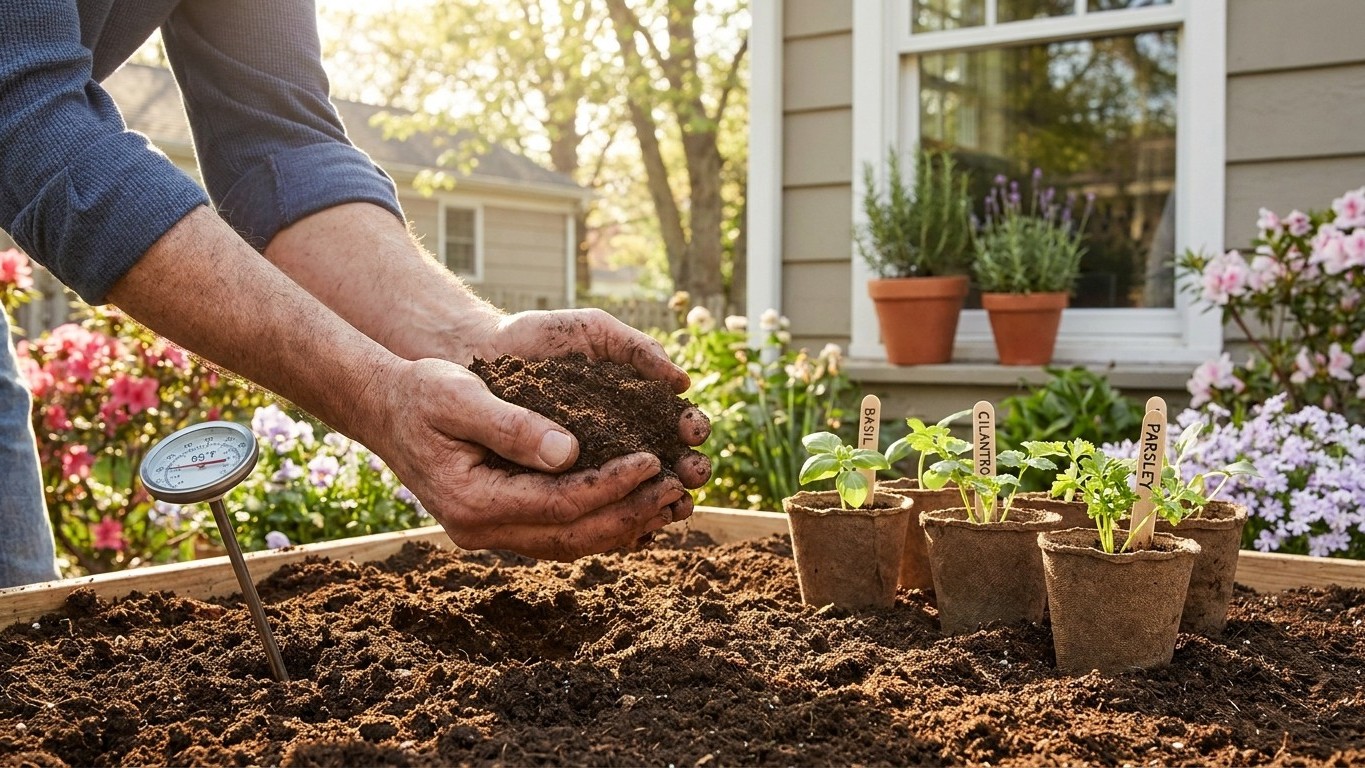

Idaho’s answer to growing herbs depends less on the calendar than on elevation and winter cold. In the Boise valley, most culinary herbs go in the ground from mid-May through early June, once the soil has actually warmed. But that answer changes fast at higher elevations, and it changes again once you ask which herbs survive the winter outright versus which ones need a pot and a window.
When the soil is warm enough in Idaho

The question every gardener actually asks is simpler than it sounds: when can I put plants in the ground without losing them? In the Boise valley, NOAA’s 1991-2020 Climate Normals put the last spring frost at station USW00024131 somewhere between April 23 and May 7. That’s a 30-70% probability band, not a single date, which means some years the risk clears earlier and some years it lingers past the first week of May.
Frost is a useful marker, but it’s a proxy, not the actual condition herbs respond to. What basil, cilantro, and tender perennials like rosemary actually need is warm soil, and soil temperature lags behind air temperature by days, sometimes weeks. A morning with no frost on the ground can still sit on soil in the low 50s, which is too cool for heat-loving annual herbs to root well. That’s why experienced growers in the valley often wait one to two weeks past the last frost date before setting out anything beyond the hardiest herbs, letting the ground itself catch up rather than trusting the calendar alone.
That April-to-May window applies to Boise specifically, and Boise sits low in a valley, which makes it one of the warmer, earlier pockets in the state. Most of Idaho sits higher and colder. Mountain valleys, the Panhandle’s higher elevations, and much of eastern Idaho see frost risk extend later into spring and return earlier in fall, which shrinks the whole planting calendar. If you’re gardening outside the Boise area, treat this frost window as a starting reference, not your local date, and check conditions specific to your elevation before you plant.
Certain herbs carry long-standing reputations for traditional or medicinal use, rosemary and sage among them. This page doesn’t evaluate those claims one way or another. It sticks to what it means to grow the plant in a garden bed: how it handles this territory’s soil, cold, and season length.
One more caution worth repeating: a frost date is a probability, not a promise. Even inside the 30-70% band, a late cold snap can still happen. Gardeners who push planting to the earliest edge of that window are accepting real risk, not eliminating it.
How long the season lasts here
Pair the spring number with the fall one and you get the actual growing window. NOAA’s same station data puts the first fall frost in the Boise valley between October 7 and October 21. Stack that against the spring range of April 23 to May 7, and the frost-free season runs somewhere between roughly 153 and 181 days, depending on which edge of each probability band a given year lands on. That’s a swing of about four weeks built into the estimate itself, which is exactly why it’s presented as a range rather than a fixed number.
Five to six months of frost-free growing is a genuinely workable window for herbs, most of which don’t need nearly that long to produce usable growth. A short-cycle annual herb sown in mid-May can be harvested well before summer’s end, with room left over for a second round. That’s the practical payoff of a season this length: it supports succession sowing rather than a single planting that has to carry the whole year. Anyone stretching a herb bed’s output across the season should look at the site’s succession sowing guide for how to stagger plantings so the kitchen doesn’t get flooded with one crop all at once and then nothing.
Where the window shrinks, so does that flexibility. At higher elevations across Idaho, where frost risk lingers longer in spring and returns sooner in fall, the season can run considerably shorter than the Boise figures suggest. In that case, the first sowing often has to be the only sowing, and transplanting decisions carry more weight. Starting herbs indoors and checking root development before transplant becomes worth the extra step when there isn’t enough season left to recover from a slow, root-bound start. In a longer window like the valley’s, that root check matters less, because there’s enough time in reserve to absorb a rough transplant and still get a full harvest window out of the plant.
Heat and water in Idaho

Specific counts for days above 90°F and summer rainfall aren’t part of the verified data set for this territory, so this page won’t guess at them. What the confirmed figures do settle, and settle clearly, is the question that actually matters most for herbs in Idaho: not how hot the summer gets, but how cold the winter gets.
The USDA Plant Hardiness Zone Map places Idaho across a wide span, zone 3b to 7b, built on the average annual extreme minimum temperature. That’s an enormous range for one state, and it means a herb that overwinters without trouble in a Boise backyard can die outright in a colder pocket a few hours away. The map is a statewide range, not a single answer, so treat the reference city, Boise, as the anchor for any dated recommendation and assume other parts of the state run colder.
The more telling number for the Boise reference station is the coldest month’s mean daily minimum: 25.4°F. That’s not the record low and not a monthly average, it’s the typical overnight floor during the coldest stretch of winter. Sitting in the mid-20s on a routine basis is enough to kill many perennial herbs marketed as hardy in warmer states. Rosemary, for instance, is often winter-hardy outdoors in mild climates but struggles to survive a Boise-area winter without protection, which is why it gets grown as a container plant here, brought indoors before the cold sets in, rather than left in the ground year-round.
That single figure, the coldest month’s mean minimum, reorganizes the whole herb bed. It splits the herb list into two groups: plants that can stay in the ground through winter across most of the state’s lower elevations, and plants that need a pot and a warm spot indoors from fall through spring. Nothing about summer heat changes that split. It’s decided entirely by what happens in January.
Which herbs suit Idaho
None of this points to a specific variety, and that’s deliberate. The trials that actually tell you which basil, thyme, or oregano selection performs best under Idaho’s soil and swings in cold happen at the state’s land-grant extension service, not on a general content page. The University of Idaho Extension runs those local trials, tracks results by region, and updates recommendations as new selections come through. That’s the only variety guidance worth trusting here, because it’s tied to actual conditions in this state rather than a national average.
What this page can do is reason by type, using the numbers already on the table. A frost-free window of roughly five to six months in the valley, shorter at elevation, favors annual herbs with fast, compact growth cycles: basil types, cilantro, dill. These finish their productive life within the season without needing to survive a single Idaho winter. Perennial types built for cold, including chives, many thyme and oregano selections, and most sage, can handle the state’s lower hardiness zones outright and stay in the ground year after year.
Tender perennials sit in a different category entirely. Rosemary and bay laurel, both reputed for hardiness in milder regions, run into that 25.4°F coldest-month minimum and generally don’t make it through an Idaho winter outdoors. Growing them here usually means treating them as container plants: outdoors through the frost-free season, indoors near a bright window once temperatures drop. Mint, known for vigorous, spreading growth wherever it’s planted, does fine across most of the state’s zones but is worth containing in a pot or buried barrier regardless of climate, simply because it spreads faster than most gardeners expect.
Reasoning by type instead of by named variety is the honest answer for a page covering a whole state with a hardiness range this wide. The right cultivar for a Boise backyard and the right one for a colder mountain valley aren’t the same plant, and no general guide can responsibly claim otherwise. That’s exactly the gap the extension service’s local trial data is built to fill.