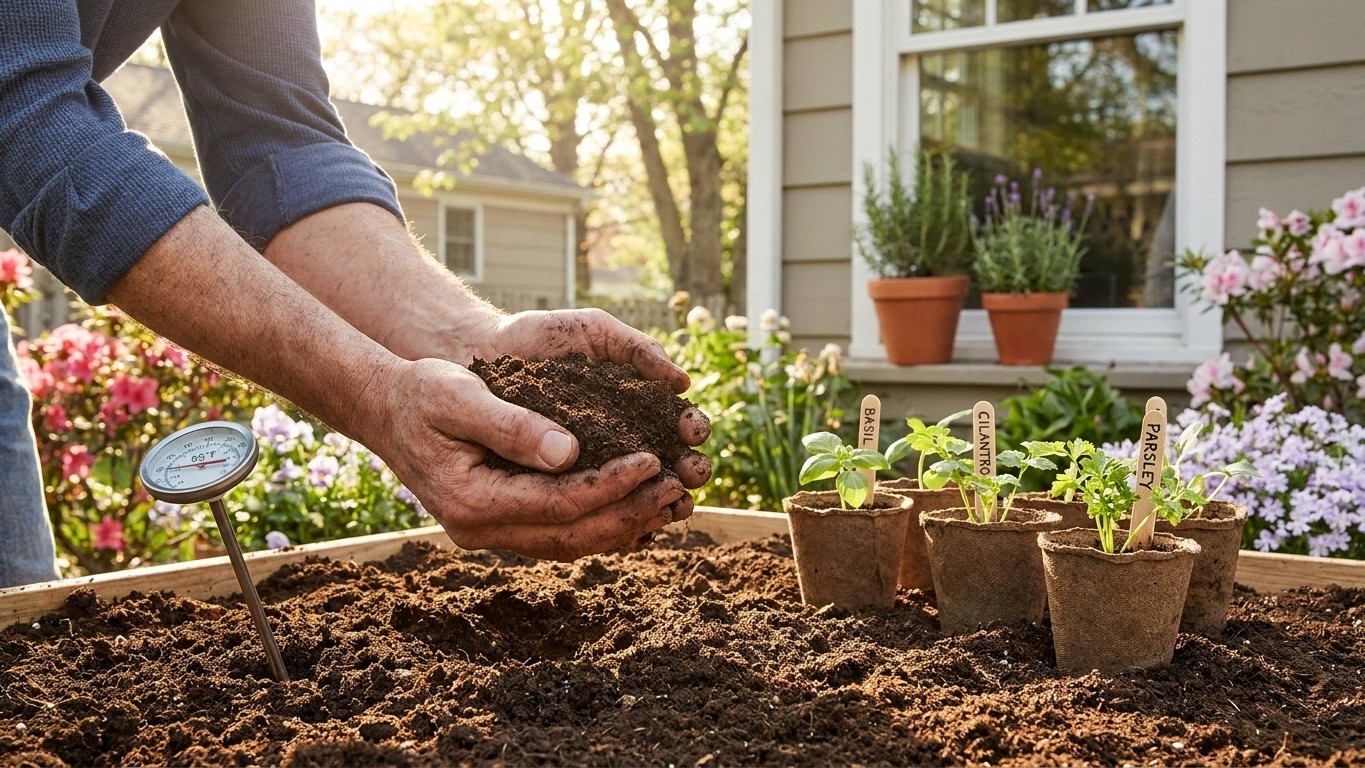

Yes, you can grow herbs in South Dakota, but the state’s short frost-free window and harsh winters change how you do it. Most gardeners here treat tender herbs as annuals, replanted each spring once the soil actually warms, while a handful of hardy perennials stay in the ground year-round. Which approach makes sense depends on your local frost dates, your USDA hardiness zone, and how much winter cold your particular herb bed sees.
When the soil is warm enough in South Dakota

The question every South Dakota gardener asks first is simple: when do I put herbs in the ground? The honest answer starts with frost, but frost is only half the story. At the NOAA reference station used for this region (station USW00014944), the last spring freeze at 32°F typically falls between April 29 and May 9, based on the 1991-2020 Climate Normals. That’s a 30 to 70 percent probability band, not a guarantee, and it’s worth saying once clearly: a frost date is a statistical likelihood, not a promise that cold air will respect the calendar.
Frost is also a proxy for something herbs actually care about, which is soil temperature. Air can clear of frost risk while the ground underneath stays cold and slow. Tender annual herbs, the kind that die outright at 32°F, generally need soil that has warmed well past the last frost date before their roots will do anything useful. Planting into cold, wet soil right after the frost risk clears often means seeds that rot or seedlings that sit and sulk for weeks rather than grow.
There’s a second layer of caution here. The dates above come from an airport weather station, and airport stations tend to run warmer than the surrounding countryside because of pavement, buildings, and open exposure. Suburban yards and rural gardens across South Dakota typically see their last spring frost arrive later, sometimes by one to two weeks, and gardens at higher elevation can lag further still. Treat the April 29 to May 9 window as a regional reference point, then watch your own soil and your own local frost history before committing tender transplants.
Hardy perennial herbs behave differently. Types like chives and many mints tolerate a light frost without damage, so they can go into the ground earlier than basil or other tender annuals. This page won’t name specific cultivars, because variety performance is local and beyond what a general climate page can responsibly claim, and it won’t wander into medicinal territory either. Several herbs common in home gardens carry long-standing reputations for traditional remedies; this page doesn’t evaluate those claims, and it also won’t describe how to distinguish a garden herb from a wild look-alike, since that’s a job for a trained forager, not a general gardening article.
How long the season lasts here
Subtracting the two frost dates gives a real number to plan around. Using the earliest possible last frost (April 29) against the latest possible first fall frost (October 4), the frost-free window stretches to roughly 158 days. Using the later last frost (May 9) against the earlier fall frost (September 24), the window shrinks to about 138 days. Both figures come from the same NOAA station and the same 30 to 70 percent probability band, so the honest planning range for most South Dakota gardens sits somewhere between 138 and 158 frost-free days, depending on your location and the year.
That range matters more than it looks. A season on the long end, close to 158 days, leaves enough time for a second round of quick-growing annual herbs like dill or cilantro after the first planting bolts or gets harvested hard in midsummer. A season on the short end, closer to 138 days, often makes the first planting the only realistic shot for slower-maturing herbs, since there isn’t enough runway left after a June bolt-and-replant cycle to bring a second crop to a useful size before fall frost shuts things down.
The length of the window also changes whether starting herbs indoors and transplanting is worth the extra effort compared to direct-sowing straight into the garden bed. In a shorter window, transplants that get a jump on the season under lights can matter, but only if the plants are hardened off properly and their roots handled with care, since a stressed transplant can lose more time recovering than it gained. In a longer window, direct-sowing tender herbs after the soil has genuinely warmed is often simpler and skips the transplant shock question entirely.
Anyone planning multiple plantings through the season, rather than one spring sowing and done, will get more out of pairing these frost dates with a structured approach. The site’s succession sowing guide walks through how to stagger plantings so that a short South Dakota season still produces a steady harvest rather than one big flush followed by nothing.
Heat and water in South Dakota

Summer in South Dakota runs warm, but for herb growing here, heat isn’t the variable that decides what survives. Cold does. The state spans USDA Plant Hardiness Zones 3b to 5b, according to the 2023 USDA Plant Hardiness Zone Map built on 1991-2020 climate normals, and that’s a wide range across one state. It’s built on a single measure, the average annual extreme minimum temperature, so a gardener in the milder pocket of zone 5b is working with a genuinely different winter than one in zone 3b territory. Cite your own county’s zone before making any planting decision that assumes hardiness.
The more telling number for herb survival is the coldest month’s mean daily minimum temperature, which at the Sioux Falls reference station sits at 8.5°F. That’s not the record low for the year and not a monthly average; it’s the typical overnight low across the coldest month, and it’s the figure that actually determines whether a woody perennial herb makes it through winter outdoors or freezes solid at the roots. An 8.5°F average overnight low is well below what many popular culinary herbs can tolerate unprotected.
This is where South Dakota herb gardening splits into two completely different projects. Cold-hardy perennial herbs, the ones bred or naturally adapted to survive winters this severe, can live in the ground year-round with some mulch protection. Herbs with Mediterranean origins, adapted to mild coastal winters rather than northern Plains cold, generally can’t survive an 8.5°F average low outdoors at all. For those, the practical answer in South Dakota isn’t a hardier planting spot; it’s a container that comes indoors before the first hard freeze, or accepting the plant as a one-season annual.
Because specific figures for summer heat extremes and rainfall totals for this territory aren’t part of the verified data behind this page, this section won’t guess at numbers that could mislead a planting decision. What’s verified and useful is this: the winter side of the climate ledger, not the summer side, is what reorganizes a South Dakota herb bed into “stays outside” and “comes in for winter.”
Which herbs suit South Dakota
Sorting herbs by type, rather than by brand-name variety, is the only responsible way to answer this for a whole state. The short season favors fast-establishing annual herbs that don’t need a long runway to become useful. The wide hardiness range means the same herb can behave as a permanent perennial in one part of the state and a container plant everywhere else.
| Herb type | Behavior in South Dakota | Common examples (species, not cultivars) |
|---|---|---|
| Tender annual | Killed by any frost; needs warm soil to establish | Basil, dill, cilantro |
| Hardy perennial | Can survive zone 3b-5b winters in the ground with mulch | Chives, mint, some oregano and thyme types |
| Tender perennial (Mediterranean origin) | Not reliably hardy at an 8.5°F winter low; needs containers or indoor overwintering | Rosemary, bay laurel, some lavender types |
A short growing season pushes the balance toward the fast annuals, since there simply isn’t always time for slow growers to produce much before fall frost. Where a garden sits in a warmer microclimate with good sun exposure, giving Mediterranean-type herbs excellent drainage and airflow around the base matters more than the heat itself, since these types generally fail from wet roots and stagnant air long before summer temperatures bother them. In a wetter or more humid pocket of the state, disease resistance becomes the deciding factor for which annual herb types are worth the garden space at all, since fungal problems spread faster in still, damp air than dry heat ever causes trouble on its own.
This page deliberately stops short of naming specific cultivars, and that’s a decision, not an oversight. Variety trials that actually mean something for South Dakota conditions come from local testing, not from a general climate overview. South Dakota State University Extension runs exactly that kind of regional variety testing and publishes results specific to conditions here, which makes it the right next stop for anyone ready to pick actual varieties rather than plant types.