
The short answer: soil warm enough for herbs in Illinois usually means waiting until late April to early May downstate and into mid-May in the north, because herbs germinate and root by soil temperature, not by the calendar. What changes that answer is winter, not spring, and that’s the part most guides skip.
When the soil is warm enough in Illinois

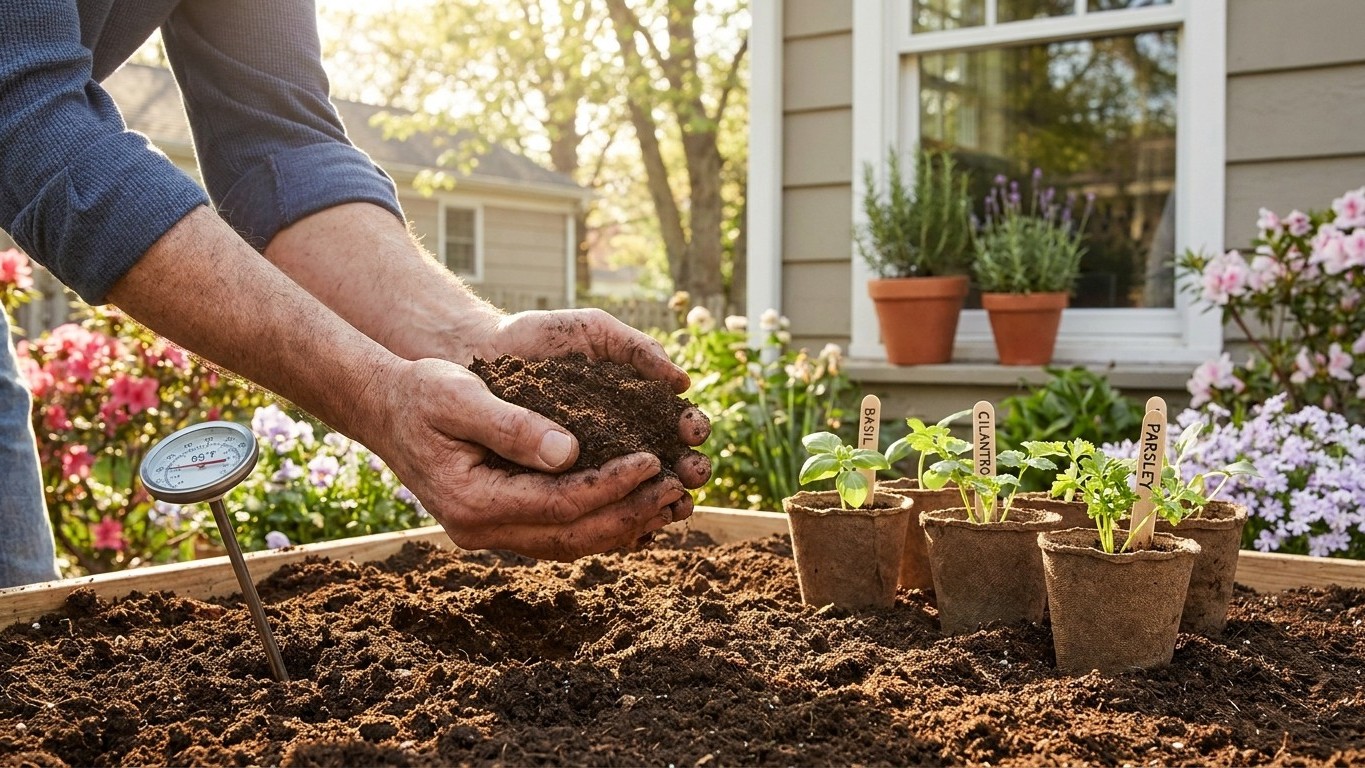
Frost dates get all the attention, but they’re a stand-in for the number that actually matters: soil temperature. At the Chicago O’Hare reference station, NOAA’s 1991-2020 Climate Normals put the last spring 32°F freeze in the window of April 11 to April 22. That’s a probability band, not a promise, and soil doesn’t cross the threshold herbs need the day frost risk ends. It usually takes another one to three weeks of settled warmth after that date before the top few inches of soil hold steady enough for seeds or transplants to take.
That gap matters more for herbs than for a lot of vegetables, because most culinary herbs are Mediterranean or warm-season plants at heart. Basil, in particular, sulks in cold soil and can stall or yellow if it goes in too early. Cool-season herbs like parsley, cilantro, chives, and dill tolerate a chillier start and can go in closer to the frost date itself, sometimes even a week or two before it, since they handle a light frost better than a cold snap in early growth hurts them.
Why the airport date isn’t your backyard date
The April 11-22 window comes from a single airport weather station. Suburban yards and rural gardens away from that station’s urban heat tend to see their last frost land later, sometimes by one to two weeks, and gardens at higher elevation or in low-lying frost pockets can lag further still. Treat the NOAA figure as the reference point for the wider region, then watch your own soil and your own microclimate before committing transplants to the ground. A soil thermometer pushed a few inches down tells you more than any calendar date.
One more note on herbs specifically: several of the most popular ones, including rosemary and certain mint relatives, carry long-standing reputations tied to traditional or medicinal uses. This page doesn’t evaluate those claims one way or another. It sticks to what it takes to grow the plant in a garden bed or a pot, nothing more.
How long the season lasts here
Pairing the two frost windows from the same NOAA station gives a real number to work with. The first fall freeze at that station lands between October 24 and November 3. Run the math against the spring window and the frost-free season stretches somewhere between roughly 185 days, if spring frost lingers to April 22 and fall frost arrives early on October 24, and about 206 days, if spring frost clears by April 11 and fall frost holds off until November 3. That’s the difference between six months and nearly seven, depending on how a given year plays out.
That length matters for how you plan the herb bed, not just when you start it. A season on the longer end of that range comfortably supports a second sowing of fast-cycling, cool-tolerant herbs like cilantro or dill after an early summer harvest, since there’s enough calendar left for a full second round before fall frost shuts things down. A season that lands on the shorter end makes the first sowing the one that counts, and it also shifts the calculus on transplanting: with less slack in the calendar, checking transplants for circling or bound roots before they go in the ground becomes worth the extra five minutes, since a stunted root system costs days you may not have to spare.
Either way, succession sowing is where a lot of home herb gardens leave harvest on the table by planting once in spring and calling it done. If you want a practical walkthrough of staggering plantings to match a season this length, the succession sowing guide on this site lays out the timing in more detail.
Worth remembering: these are averages built on a 30-year record, and any single year can run warmer or colder than the pattern suggests. Treat the 185-to-206-day range as the planning baseline, then adjust once you see how the actual season is behaving.
Heat and water in Illinois

Illinois summers run warm and often humid, with the kind of thunderstorm-driven rainfall pattern typical of the Midwest, heavier and more erratic downstate, somewhat milder and more variable near Lake Michigan’s moderating influence in the north. That combination of heat and humidity is exactly the setup that brings on foliar disease in herbs. Basil downy mildew and powdery mildew on mint-family plants both spread fastest when leaves stay damp and air doesn’t move through the canopy, which makes spacing plants for airflow and watering at the soil line, not overhead, more useful in a humid Illinois summer than almost any other single practice.
But summer heat isn’t the number that actually reorganizes an Illinois herb garden. Winter is. The mean daily minimum temperature in the coldest month at the Chicago reference station sits at 18.8°F, a figure that reflects the typical cold night in that month, not the record low and not a monthly average. That’s cold enough to kill most Mediterranean herbs left unprotected in the ground.
What the hardiness zone actually decides
The USDA Plant Hardiness Zone Map, built from the average annual extreme minimum temperature, places Illinois across a wide band from 5a to 7b, with the colder end up near the northern border and the warmer end down toward the state’s southern tip. That’s a big spread within one state, and it means a herb that overwinters fine outdoors in southern Illinois may need to come inside for the winter a few hundred miles north. Rosemary, bay laurel, and some lavender types are the classic examples: hardy as permanent garden shrubs in the warmer pockets of zone 7b, but grown as container plants that migrate indoors for winter almost everywhere else in the state.
Hardy perennial herbs like chives, thyme, oregano, and most mints handle the 18.8°F coldest-month minimum without trouble and come back reliably from the same root system year after year across the state’s zone range. The dividing line isn’t summer performance, it’s whether a species evolved to handle a hard winter at all.
Which herbs suit Illinois
Given a season that runs 185 to 206 frost-free days, summers that turn humid enough to invite mildew, and a hardiness range spanning 5a to 7b, the herbs that suit Illinois best sort into three practical groups rather than a shopping list of names.
- Fast, cool-tolerant annuals that fit even the shorter end of the season and can go in a few weeks before the last frost date: parsley, cilantro, dill, chives.
- Heat-loving annuals needing airflow and dry foliage to outrun humid-summer disease: basil and other tender annual herbs, best spaced generously and watered at the root.
- Cold-hardy perennials that shrug off an 18.8°F coldest-month minimum and return every year without protection: thyme, oregano, sage, most mint-family plants.
Mediterranean shrubby types like rosemary and bay occupy their own category: worth growing across Illinois, but as container plants that spend winter indoors or in an unheated but frost-free space north of the warmest pockets of zone 7b, rather than as permanent fixtures in the ground.
This page won’t name specific cultivars, and that’s a deliberate choice, not an oversight. Disease resistance, bolt tolerance, and cold hardiness vary meaningfully between varieties within the same species, and the varieties actually trialled and recommended for Illinois conditions come from local research, not a general guide covering a whole state’s climate range. University of Illinois Extension maintains that variety-level guidance county by county, and it’s the source worth checking before buying seed or starts, since it reflects trial data from Illinois growing conditions rather than a national average.