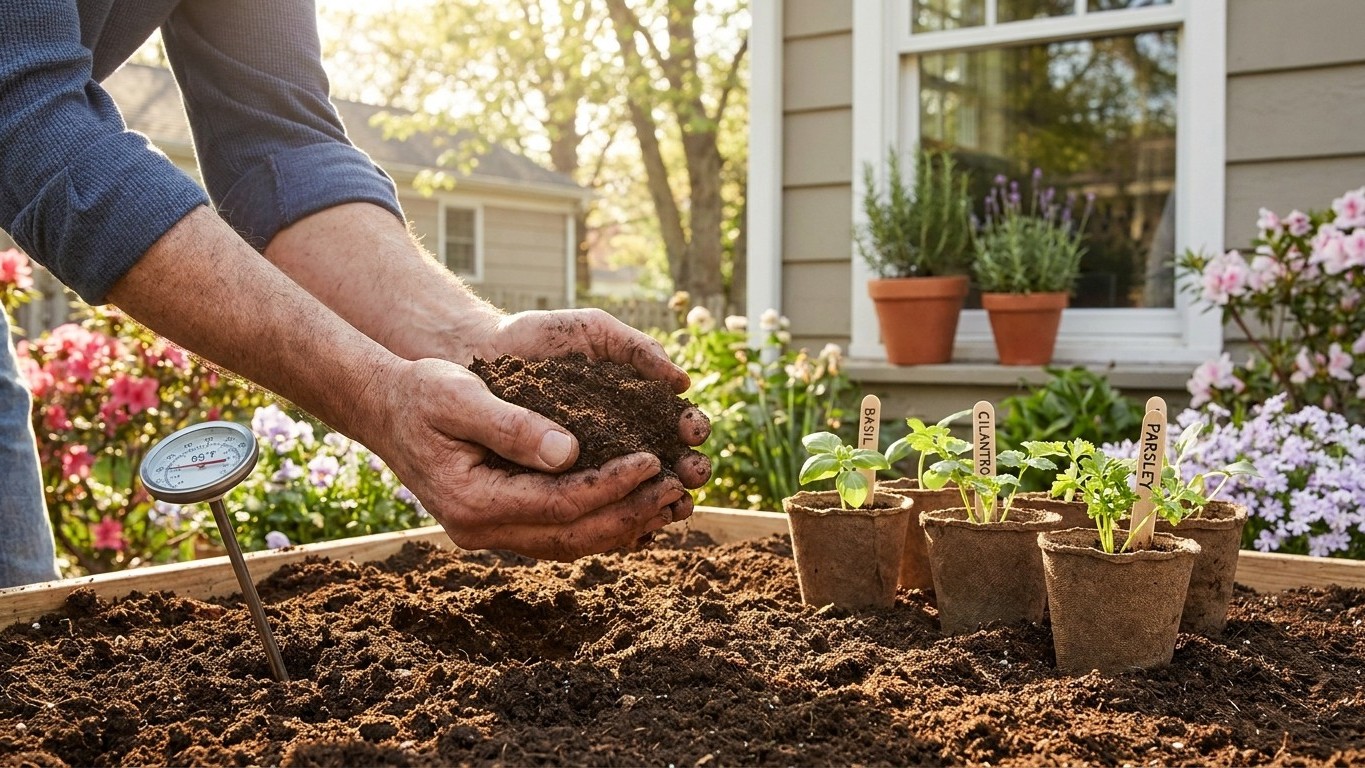

Missouri gardeners can start hardy herbs outdoors once the soil has warmed past the last frost window, typically mid-to-late April, and keep both hardy perennials and tender annuals producing well into October. The real planning work, though, comes down to two numbers: how long the frost-free window runs, and how cold the coldest month gets, since that second figure decides which herbs live outside year-round and which need a pot and a windowsill.
When the soil is warm enough in Missouri

The question every Missouri gardener asks in March is simple: when can I actually put something in the ground? NOAA’s 1991-2020 Climate Normals, drawn from the Kansas City station (USW00003947), put the last spring frost in a band running from April 6 to April 20. That’s a 30-70% probability window, not a single circled date on a calendar, and it applies to the airport station specifically. The station itself sits well north of the city core, so downtown Kansas City tends to clear its last frost about five days earlier, and gardens in southern Missouri, down toward the Ozarks and the Bootheel, run milder still.
Frost dates get treated as gospel, but they’re really a stand-in for something else: soil temperature. Herbs don’t check a calendar. Basil, in particular, sulks and yellows if it goes into cold ground even after the air has stopped freezing, because soil lags behind air temperature by a couple of weeks in most springs. A frost-free night doesn’t mean warm soil; it means the air won’t kill the plant that night. The dirt six inches down is a different story, and it takes longer to catch up, especially in a clay-heavy Missouri yard that holds winter cold longer than a sandy one would.
That gap matters more for some herbs than others. Parsley, chives, and cilantro tolerate cool soil and can go in near the early end of that frost window, sometimes even before it closes, since a light frost won’t finish them off. Basil, and most other tender annual herbs, want soil that’s been reliably warm for a week or two, which usually pushes safe planting past the later end of the window, into early May in a typical year. The difference between “frost is over” and “soil is warm” is exactly the gap that determines whether a tray of transplants thrives or just sits there, stunted, for three weeks.
None of this is a guarantee. A 30-70% probability band means exactly what it says: even at the safest end of that range, a late frost still shows up in some years. Gardeners who push transplants out early are making a bet against those odds, not defying them. Keep a frost cloth or an old sheet handy through the first half of that window regardless of what the ground feels like underfoot.
How long the season lasts here
Line up the two frost dates from the same station and the growing window comes into focus. Using the earliest last spring frost (April 6) against the latest first fall frost (October 29) gives a season stretching past 206 days. Using the more conservative ends of each range, the latest spring frost (April 20) against the earliest fall frost (October 18), narrows that down to roughly 181 days. Either way, that’s a season long enough to matter for planning, not just for planting once and hoping.
A window over six months long changes the math on succession sowing. Fast-maturing herbs like cilantro or dill, which bolt and finish quickly once summer heat sets in, can go in a second time in mid-to-late summer for a fall crop, rather than leaving the bed empty after the first planting fades. A season this length also makes the case for staggering plantings of the same herb two or three weeks apart, so the kitchen isn’t flooded with one giant cilantro harvest and then nothing. For the mechanics of timing those follow-up plantings, the succession sowing guide on this site walks through spacing intervals crop by crop.
Length of season also decides how much transplanting is worth doing versus direct-seeding. In a short window, every week counts, so starting seedlings indoors and setting out established transplants at the earliest safe date makes sense, since it buys back time the calendar won’t give. With a season running 180 to 200-plus days, there’s more room to direct-seed slower herbs and still get a full crop before fall frost, which saves the extra step of checking transplants for pot-bound, circling roots before they go in the ground. That root check matters more with a compressed timeline, where a transplant that sulks for two weeks while its roots sort themselves out has eaten into a season that didn’t have slack to spare.
The practical takeaway: treat the frost-free window as a planning tool, not a single planting day. Herbs that finish fast are candidates for a second round; herbs that take the whole season, most perennial types included, get one shot and need every week of that 180-to-206-day stretch to reach a useful size before the cold returns.
Heat and water in Missouri

Missouri summers run hot and muggy, the kind of stretch where basil and other Mediterranean herbs grow fast but also fade fast if the air around them stays still and wet. That combination, heat paired with humidity, is the setup for fungal trouble: powdery mildew on sage, downy mildew on basil, root rot on anything planted where water pools after a storm. Airflow between plants and a spot that doesn’t stay soggy matter as much here as sun exposure does.
But summer heat isn’t actually the number that reorganizes a Missouri herb bed. Winter is. The hardiness zone across the state runs 5b to 7b under the USDA Plant Hardiness Zone Map (2023 edition, built from 1991-2020 normals), a range wide enough that a herb perennial in the Bootheel might not survive a winter in the northern counties. And the number underneath that zone rating, the one that actually decides who lives and who dies, is the mean daily minimum temperature in the coldest month: 19.5°F, using Kansas City as the reference station. That’s not a record cold snap; it’s the average low on an ordinary night in January.
That single figure is what separates a herb that’s a permanent fixture in the yard from one that’s really a container plant wearing a garden bed as a summer costume. Rosemary, for instance, has a reputation for struggling badly once nights drop into the high teens for any stretch, which is close to what a typical Missouri January delivers. Herbs rated hardy well into the single digits, several of the woody perennial types among them, shrug off that same 19.5°F average without much drama. The gap between those two groups is the whole reason “grow rosemary outside” and “grow rosemary in a pot you bring in for winter” are two completely different projects in this state, even though the plant itself doesn’t care what zip code it’s in.
None of this changes the summer strategy much, since heat-tolerant annual herbs don’t need winter hardiness at all, they just need to finish their life cycle before the first fall frost shows up. It’s the perennial herbs, the ones a gardener plants once and expects to see again next spring, where that 19.5°F number decides the outcome before a single seed goes in the ground.
Which herbs suit Missouri
Sort the choice by what this territory’s numbers actually demand, not by a list of plant names copied from a seed catalog. A season of 180 to slightly over 200 days rewards herb types that mature quickly or that tolerate cool soil early, since they can go in near the front edge of that frost window and still finish before fall cold arrives. Slower, heat-loving annual types need the fuller end of that season and benefit from the later, safer planting date once soil has genuinely warmed.
Given the humidity that comes with a Missouri summer, disease resistance moves to the top of the list for any herb, especially within families prone to mildew. Airflow does real work here too: wider spacing than a catalog tag suggests, and a raised bed or well-drained container over heavy clay, does more to prevent root rot than any product applied after symptoms show up.
Winter hardiness is the last filter, and it’s the one that decides whether a herb is a bed fixture or a seasonal guest. Types rated hardy to the coldest end of the state’s 5b-to-7b range can stay in the ground year-round in most Missouri locations; types rated for milder zones need either a sheltered microclimate, a heavy winter mulch, or a pot that comes indoors before the coldest month sets in.
What this page won’t do is hand over a specific variety name. Plant breeders release new selections every year with different disease resistance, different vigor, different tolerance for a wet spring or a scorching August, and the only trial data that means anything for a Missouri backyard comes from Missouri trials, not from a national seed catalog written for every zone at once. That’s exactly the job of a state extension service: University of Missouri Extension publishes locally trialled variety recommendations and updates them as new selections prove themselves, or fail to, under this state’s specific mix of heat, humidity, and winter cold. A page that named a cultivar here would be guessing at something a local extension office actually measures.