
Whether herbs thrive here depends less on the calendar and more on which side of the Cascades you’re standing. Western Washington’s mild, wet maritime climate and eastern Washington’s high desert produce two entirely different growing realities. The real deciding factor for herbs isn’t spring planting dates at all: it’s winter, and whether a plant can survive it as a permanent resident of your garden or needs to come indoors in a pot.
When the soil is warm enough in Washington
At the Seattle-area reference station (USW00024233), NOAA’s 1991-2020 climate normals put the last spring frost somewhere between February 27 and March 18, based on the 30-70% probability band for a 32F freeze. That’s the western Washington window, and it applies to the mild, marine-influenced corridor around Puget Sound. Eastern Washington, once you cross the Cascades into the high desert, runs on a shorter, harsher script, and this date should not be stretched across the whole state.
A frost date is a probability, not a promise. Somewhere between 30 and 70 percent of years, the last freeze falls inside that February 27 to March 18 window, which means plenty of years break the pattern in both directions.
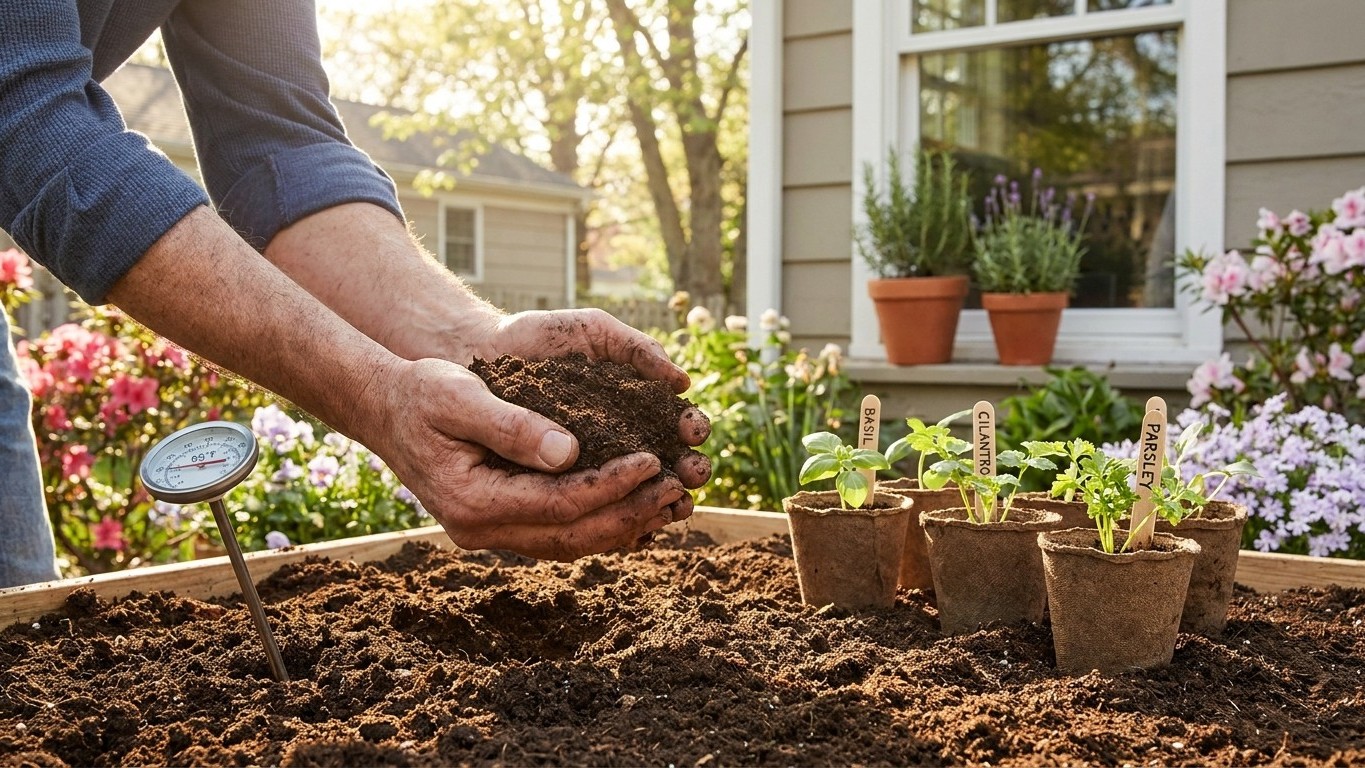
Here’s the part gardeners in this region learn the hard way: that frost date is only a proxy. Herbs don’t actually care what the thermometer says on a given morning. They care whether the soil itself has warmed enough to support root growth and, for tender types, whether there’s enough light to push new growth along. Western Washington’s late-winter soil sits cold and saturated from months of rain, and it stays that way well past the point when frost risk has technically passed. Low light levels in March add another delay. So even though the frost calendar clears by mid-March in a typical year, sowing tender herbs into unwarmed ground and gray skies at that point usually means slow, stalled growth rather than an early harvest.
This matters differently depending on the herb type. Cool-season, frost-tolerant types (think parsley, chives, cilantro) can go into the ground close to that frost window because they don’t mind cool soil the way heat-loving types do. Warm-season herbs like basil need both the frost risk gone and the soil genuinely warm, which in this climate often means waiting weeks beyond the official frost-free date rather than rushing in the moment it arrives.
One herb worth flagging without dwelling on it: several herbs commonly grown here, including some in the mint and lavender families, carry long-standing medicinal reputations. This page doesn’t evaluate those claims one way or the other. It’s a growing guide, not a health resource, and it treats every herb here strictly as a culinary and garden plant.
It’s also worth being direct about something these pages generally avoid: never use unfamiliar wild plants as a stand-in for a garden herb. A number of toxic plants closely resemble common kitchen herbs, and the stakes are too high for casual identification advice from any single source, including this one.
How long the season lasts here
Run the two ends of the frost calendar together and western Washington’s frost-free season stretches somewhere between 240 and 276 days, depending on which edge of each probability band you use. Take the earliest plausible start (February 27) against the latest plausible fall frost (November 30) and you get a season pushing 276 days. Take the more cautious pairing, a March 18 start against a November 13 fall frost, and you’re closer to 240 days. Either way, that’s a long window by national standards, and it changes how you plan the herb bed.
A season this long does two things for herb growers. First, it makes a second sowing realistic for fast-cycling herbs like cilantro, dill, or basil, which tend to bolt or fade partway through summer anyway. Rather than treating the spring planting as the only shot, gardeners here can plan a follow-up sowing in early-to-mid summer and still expect it to mature before fall frost arrives. Second, a long, mild season reduces the pressure to transplant everything early. Where a short-season territory forces gardeners to start seedlings indoors and get them into the ground the moment risk passes, this climate gives more flexibility to direct-sow certain herbs and skip the root-disturbance question that comes with transplanting altogether.
That flexibility is exactly what makes succession planning worthwhile here rather than optional. For a full breakdown of how to time repeat sowings against a specific frost calendar, the succession sowing guide on this site walks through the spacing and timing logic in more depth.
The caution about western versus eastern Washington applies again here. East of the Cascades, the frost-free window shrinks considerably in the high desert climate, and a gardener there planning around a 250-plus day season based on Seattle numbers will be setting up for disappointment. Anyone gardening outside the western corridor should pull local frost data for their specific area rather than borrowing the coastal numbers used in this section.
Heat and water in Washington
Summer heat isn’t really the story for herbs in this climate, and that’s worth saying plainly rather than forcing a hot-climate narrative onto a territory that doesn’t have one. Western Washington’s marine air keeps summer highs moderate most years, and the region simply doesn’t rack up the kind of sustained 90-degree stretches that push gardeners elsewhere toward shade cloth and afternoon watering triage. What replaces heat stress here is the opposite problem: cool, damp conditions that favor mildew, slow ripening on sun-loving herbs, and fungal disease pressure on anything planted too densely.
Basil in particular struggles with this pattern. It wants heat and dry air to really take off, and a cool, humid Puget Sound summer often leaves it lagging compared to the same plant grown in a hotter inland climate. Airflow between plants and a spot with maximum sun exposure matter more here than shade management does.
The number that actually decides the shape of a Washington herb garden is winter, not summer. The coldest month’s average daily minimum at the Seattle reference station is 37.1F, a relatively mild figure that keeps a surprising number of herbs alive outdoors year-round in the milder parts of the state. Layer that against the USDA hardiness zone range for Washington, 4a to 9a under the current USDA Plant Hardiness Zone Map, and the picture sharpens: this is a state with an enormous internal range, from the near-arctic conditions of high mountain zones to the comparatively gentle 8b-9a pocket around Puget Sound cities like Seattle.
That gap changes the whole conversation around which herbs are permanent plants and which are container plants brought indoors for winter. In the milder coastal zones, several perennial herbs can stay in the ground year-round, treated as permanent garden residents rather than annual replacements. In the colder interior and mountain zones further from the coast, those same herbs need to be grown as annuals or moved into pots and overwintered indoors, because the coldest month’s minimum temperature there drops well below what those roots can tolerate. Anyone gardening outside the immediate Seattle corridor should treat the 37.1F figure as a coastal reference point, not a statewide guarantee, and check hardiness zone data for their specific location before betting a perennial herb bed on it.
Which herbs suit Washington
None of this page’s guidance points to a specific variety, and that’s a deliberate choice rather than an oversight. Variety trials run by university extension programs test dozens of named cultivars against local disease pressure, local daylight patterns, and local soil conditions every season, and the results shift from year to year and from one part of a state to another. A general guide like this one has no way to responsibly recommend “this cultivar” when the real answer depends on trial data this page doesn’t have. What it can do is point toward the herb types that make sense given the facts already laid out.
Given the length of the frost-free season here, fast-cycling annual herbs (cilantro, dill, basil) fit well into a two-sowing plan rather than a single spring planting. Given the cool, damp summer pattern, disease resistance and airflow matter more than heat tolerance when choosing among types within a species, particularly for basil and other herbs prone to fungal issues in humid air. And given the wide hardiness-zone spread across the state, the perennial-versus-annual question needs to be answered locally: an herb that survives outdoors year-round in a Puget Sound backyard may need container treatment in a colder inland zone.
Herb types worth considering by category, without naming cultivars:
- Cool-tolerant, early-season herbs suited to the region’s damp spring soil, like parsley, chives, and cilantro
- Perennial woody herbs that often handle the milder coastal winter minimums well, though hardiness varies sharply by zone across the state
- Warm-season annuals like basil, which need airflow, full sun, and dry conditions to perform against the region’s cool, humid summer pattern
- Herbs with documented long-standing medicinal reputations, which this page treats purely as garden and culinary plants without evaluating those claims
For the specific varieties trialled against this state’s actual growing conditions, the Washington State University Extension service (extension.wsu.edu) publishes regionally tested recommendations that carry more weight than any general list could. Local extension data accounts for the zone-to-zone differences this page can only describe in broad strokes, and it’s the resource that turns “which type of herb” into “which specific variety for my county.”