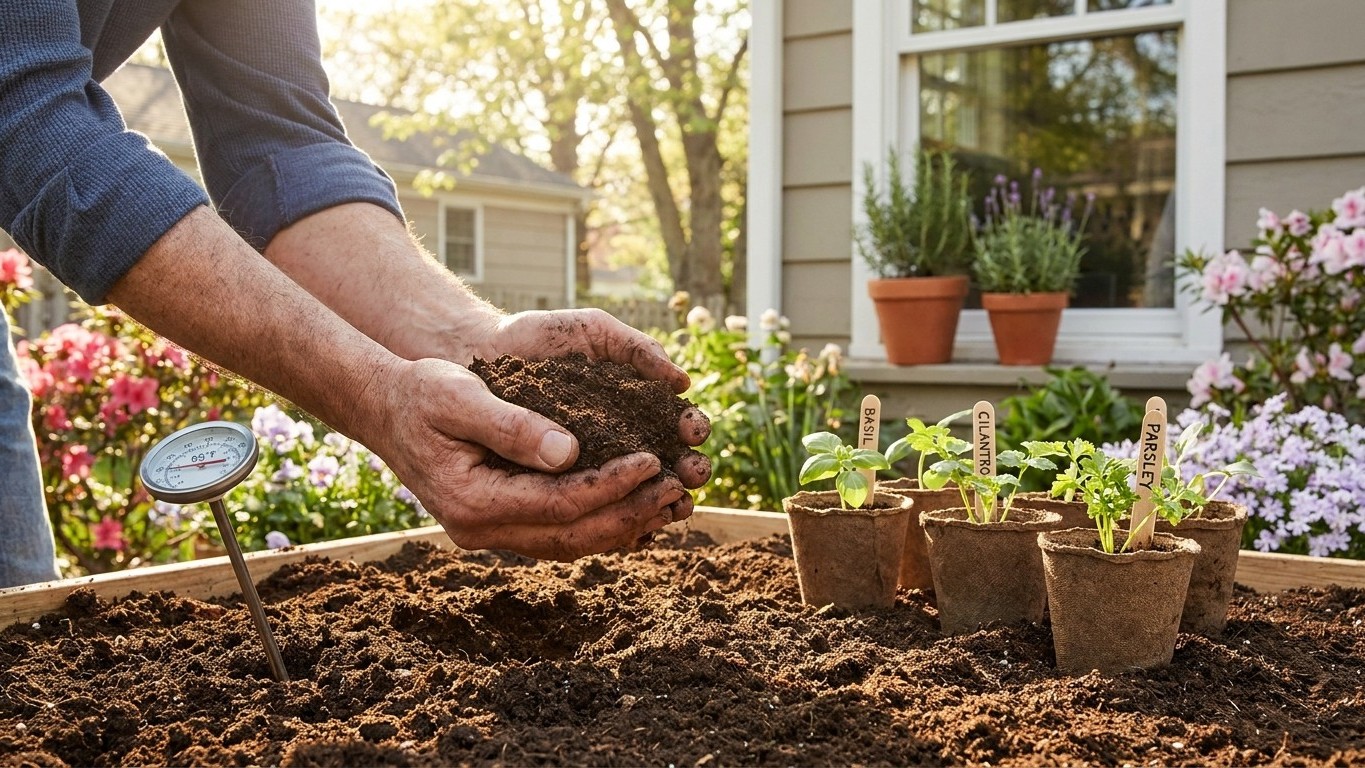

Herbs go into New Jersey gardens once the frost risk has passed and the soil has actually warmed, which for most of the state lands somewhere in the second half of April into May. The exact date shifts by species: hardy perennials tolerate a much earlier start than tender annuals like basil.
When the soil is warm enough in New Jersey
The number gardeners actually want is the last spring frost date, and for the Newark reference station that falls between March 29 and April 6, according to NOAA’s 1991-2020 Climate Normals (32°F freeze probabilities, 30-70% band). That’s a real, sourced figure, but it’s worth being honest about what it measures: it’s a probability window, not a promise. Some years the last frost lands earlier, some years later, and the date says nothing about whether the soil itself is ready.
That gap between “frost is statistically over” and “soil is warm enough” matters more for herbs than the calendar does. Air temperature can climb into the 60s while six inches down the ground is still cold and slow to release moisture, which is exactly the condition that stalls tender seedlings and invites rot before they ever get going. Soil warms on its own schedule, generally a week or two behind the frost-free date, and that lag is the real gatekeeper for anything in the basil, cilantro, or dill family.
Hardy perennial herbs don’t play by the same rules. Types like thyme, sage, oregano, and chives tolerate a light frost and can go into the ground, or stay in the ground from the year before, well ahead of that late-March-to-early-April window. Tender annual herbs are the ones that need the extra patience: waiting until soil has had real time to warm, often two to three weeks past the last frost date, is the safer bet given that the date itself is only a 30-70% probability estimate, not a guarantee tied to any single year.
One more caution worth repeating here: the Newark station sits at an airport, and suburban and rural gardens across the state typically see their own last frost later and first fall frost earlier than this figure, sometimes by one to two weeks, more at elevation or in low-lying frost pockets. Treat March 29 to April 6 as a reference point for the Newark area specifically, then check your own county’s typical pattern before setting a planting date. This page won’t name specific herb varieties to plant on a given date, because a variety that performs well near the coast may not be the one your county extension office recommends inland.
How long the season lasts here
Pair the two NOAA-sourced frost dates and you get the working length of New Jersey’s frost-free season. Spring frost clears between March 29 and April 6; fall frost typically arrives between November 4 and November 16, per the same NOAA NCEI 1991-2020 Climate Normals dataset for the Newark station. Depending on where your particular year falls within each window, that stretches the growing season anywhere from roughly 212 days (April 6 to November 4) up to about 232 days (March 29 to November 16), call it somewhere between seven and seven and a half months.
That’s a meaningfully long window, and it changes what’s worth attempting with herbs specifically. A season this length isn’t just enough for one planting of fast annual herbs like cilantro or dill; it’s long enough to get a second sowing in after the first bolts or gets harvested hard, especially for anything that matures quickly and doesn’t mind a mid-summer restart. Gardeners working with a shorter window elsewhere might treat their single spring planting as the only shot of the year. New Jersey’s season generally doesn’t force that compromise.
The length also affects a decision that’s easy to overlook: whether it’s worth digging up and checking the root systems of potted perennial herbs before deciding if they go back in the ground or get held over in containers. With seven-plus months of open season, there’s real time for a divided or transplanted perennial herb to reestablish before the next cold stretch arrives, which isn’t always true in Territories with a compressed frost-free period. If you’re planning a second round of quick-growing herbs to fill in after an early harvest, this site’s succession sowing guide walks through the timing logic in more detail.
Keep the caution from the frost-date discussion in mind here too: these are Newark-area figures. Gardens further from the coast, at higher elevation, or in known frost pockets should expect a somewhat shorter practical window than the raw subtraction suggests.
Heat and water in New Jersey
For a lot of vegetable crops, the summer heat-day count and rainfall totals are the headline numbers. For herbs grown in New Jersey, the more decisive figure sits at the other end of the year: winter. The USDA Plant Hardiness Zone Map (2023 edition, built on 1991-2020 normals) places New Jersey across zones 6a to 7b, a range wide enough that a herb bed in the northwest corner of the state and one near the shore are working with genuinely different winters.
The number that actually predicts survival is the average daily minimum temperature of the coldest month, and for the Newark reference station that’s 25.5°F, per NOAA NCEI Climate Normals. That’s not a record low and not a monthly average; it’s the typical low point most nights hit during the coldest stretch of winter. It’s the figure that separates herbs that can live outdoors as permanent plants here from herbs that need to come inside or get treated as an annual.
This single number reorganizes how a New Jersey herb bed gets planned. Hardy perennial types built for cold winters shrug off a coldest-month minimum in the mid-20s without protection. Herbs with a more marginal cold tolerance sit right on the edge of that 6a-7b range: they might survive a mild winter near the coast in zone 7b and die back to the roots or fail outright in a colder 6a pocket further inland. That’s not a summer problem to solve with irrigation or afternoon shade; it’s a winter problem solved by choosing pots that can be moved indoors, or by accepting that certain herbs are a one-season planting here regardless of how they perform through July and August.
This page doesn’t have a sourced figure for New Jersey’s summer days above 90°F or its summer rainfall totals, so it won’t invent one. What the verified data does support is this: winter, not summer heat, is the variable that decides which herbs become permanent residents of a New Jersey garden and which ones live in containers that migrate indoors each fall.
Which herbs suit New Jersey
Run the three facts together, a roughly seven-month season, a 6a-7b hardiness range, and a coldest-month minimum around 25.5°F, and a reasonable shape for a New Jersey herb bed starts to emerge, organized by type rather than by named variety.
Cold-hardy perennial herbs generally handle a coldest-month minimum in that range without special winter protection, which makes them candidates for a permanent spot in the ground rather than a pot that has to be hauled indoors every fall:
- Thyme and oregano, both low-growing and generally tolerant of winter cold across this hardiness range
- Chives, which die back in winter and return from the roots in spring
- Sage, a shrubby perennial that typically tolerates the cold end of this zone range
- Mint, which spreads aggressively and survives winter easily but is worth containing so it doesn’t take over a bed
Herbs with a more marginal cold tolerance, including some rosemary types and bay laurel, sit closer to the edge of what a 25.5°F coldest-month minimum allows, especially in the colder 6a pockets of the state. Growing these in containers that can be moved to a garage or indoor spot for winter is generally the safer approach than betting on an in-ground planting surviving every year.
Fast annual herbs, basil, cilantro, dill, and similar types, aren’t affected by winter hardiness at all since they complete their life cycle in one season. For these, the frost-date and season-length reasoning from the earlier sections does the real work: they go in once soil has genuinely warmed, and the seven-month window leaves room for a second sowing if the first one bolts or gets harvested out.
What this page won’t do is name a specific cultivar as “the one to plant” in New Jersey. Variety trials that actually test performance against local pests, disease pressure, and microclimate are done at the county level, and Rutgers Cooperative Extension publishes exactly that kind of tested, location-specific recommendation. A general page covering the whole state can responsibly point to types and species; it can’t responsibly hand out a variety name that was trialled somewhere else entirely.