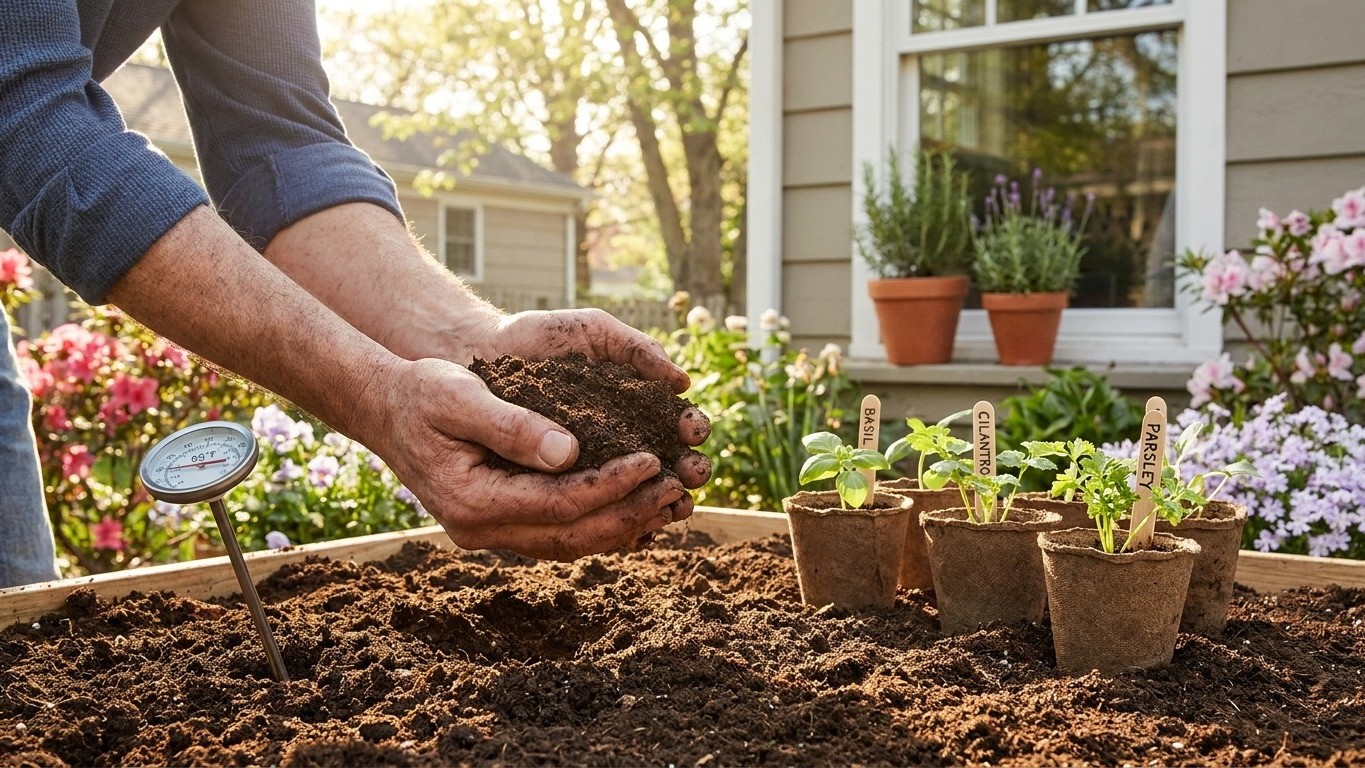

Most of Ohio sits in USDA hardiness zone 5b-6b, with the last spring frost falling between May 5 and May 15 depending on where you garden. That date is a starting point, not the whole answer: what actually decides whether your herbs thrive here is soil temperature in spring, winter minimums that will or won’t kill a perennial, and summer humidity that can undo a plant frost never touched.
When the soil is warm enough in Ohio

The Ohio State University Extension’s Ohio Gardening Calendar puts the last spring frost at May 5 to May 15 across zone 6a, and that range is worth taking seriously rather than rounding to “mid-May” and moving on. But a frost date answers one question only: when the air stops dropping to 32°F often enough to matter. It says nothing about the soil, and herbs germinate and root according to soil temperature, not the calendar.
Soil warms slower than air. In a typical Ohio spring, the ground can sit ten degrees cooler than the daytime high well into May, especially in clay-heavy soils that hold moisture and take longer to shed winter cold. That lag is why gardeners who plant warm-season herb types the same week as the last frost date often watch seeds sit and rot rather than sprout, the air said go, the soil hadn’t caught up yet.
Cool-tolerant types versus heat-lovers
Some herb types don’t wait for that soil warm-up at all. Parsley, cilantro, and chives tolerate cool, even chilly soil and can go in as transplants before the frost date has fully passed, since a light frost rarely kills them outright. Basil sits at the other end: it wants soil that’s genuinely warm, not just frost-free, and a cold snap that doesn’t touch the thermometer’s freezing mark can still stunt or blacken it. Treat the frost date as the earliest safe point for the tender types, not the target date.
Keep in mind that May 5 to May 15 is a probability window, not a guarantee, a late frost outside that range isn’t rare in a cool spring, and gardeners who push transplants out on the first mild afternoon sometimes lose them to a frost that arrives after the “average” date has passed. Waiting a week past the earliest date costs little; replacing frost-killed transplants costs a full growing cycle.
A few herb types carry medicinal reputations alongside their culinary uses, this page doesn’t evaluate those claims, culinary and garden use is the scope here.
How long the season lasts here
Run the numbers from OSU Extension’s own dates and the frost-free window in Ohio comes out to roughly 153 days, whether you measure from the early end of the range (May 5 to October 5) or the late end (May 15 to October 15), the span holds steady at about five months because both dates shift together. That’s a moderate season by national standards: long enough to matter for planning, short enough that timing decisions early in spring pay off all summer.
A 153-day window changes what’s worth doing with transplants versus direct seed. For quick-cycling herb types like cilantro or dill, a season this length allows more than one sowing, an early planting that finishes before summer heat pushes it to bolt, and a second one in late summer that matures in the cooler, more forgiving days of September. For slower herb types, or for anything started from seed indoors, the same window makes the first sowing effectively the only shot, which is exactly why transplanting timing and root health matter more here than in a longer-season territory.
Where succession sowing fits
Deciding which herbs get a second round and which get one careful shot is really a succession-planning question, and it’s worth working through with the actual calendar in hand rather than guessing. The site’s succession sowing guide walks through how to stagger plantings so something is always at its best rather than everything bolting or fading at once, a real advantage in a season this length, where five months sounds like plenty until the first two weeks get eaten by a late cold snap.
The practical takeaway: don’t treat October 5 to October 15 as a hard wall either. It’s the average first fall frost, and tender herb types should be harvested, potted, or accepted as finished before that window arrives, not after.
Heat and water in Ohio

For herbs, the number that actually decides what stays in the ground year after year isn’t a summer heat count. It’s the coldest month’s average daily minimum, and at the Columbus reference station that figure is 22.0°F, per NOAA’s 1991-2020 Climate Normals. That’s not the record low for the coldest night of the decade; it’s the average low across the coldest month, which is the number that tells you whether a plant merely survives an unusual cold snap or comfortably lives through a normal Ohio winter.
Paired with the USDA hardiness zone of 5b-6b for the state, that 22°F average reframes the whole herb bed. Hardiness zone is built on one variable, the average annual extreme minimum, and it’s a range across Ohio rather than a single number, gardeners near the Ohio River sit closer to 6b, while northern counties run closer to 5b, so a plant rated as borderline-hardy in Columbus may need more protection further north.
Why winter, not summer heat, does the sorting
This matters more than a hot afternoon in July, because the herbs most people want to keep as permanent garden fixtures, rosemary and bay among them, are only reliably hardy in much milder winters than Ohio delivers. A 22°F average minimum in the coldest month will kill an unprotected rosemary plant in an open bed most years, which is why it gets grown as a container plant here, brought indoors or into a garage for winter, rather than left in the ground and hoped for.
Summer in Ohio brings its own separate issue, and it’s a humidity one rather than a heat one for most herb types: warm, muggy stretches with regular rainfall create the exact conditions that favor powdery mildew and other fungal problems on herbs like basil and mint, more than they create drought stress. Airflow between plants and morning watering that lets foliage dry by afternoon matter more here than shade cloth or extra irrigation would in a drier climate.
Which herbs suit Ohio
Sort by type rather than by variety name, and the choices in zone 5b-6b line up fairly clearly around that one hard fact: what survives the winter versus what needs a pot or a fresh start each spring.
| Herb type | Winter pattern in Ohio | Main seasonal issue |
|---|---|---|
| Chives, thyme, sage, oregano, mint | Reliably hardy in ground | Mint spreads aggressively; needs containment |
| Rosemary, bay | Not reliably hardy in ground | Best grown in containers, moved indoors for winter |
| Parsley, cilantro, dill | Cool-season annuals, replanted yearly | Bolt quickly once summer heat and humidity arrive |
| Basil | Warm-season annual, killed by first frost | Prone to fungal disease in humid stretches |
A short frost-free window on the front end favors starting the earliest cool-season types, parsley and cilantro among them, as soon as soil conditions allow rather than waiting for the frost date to fully clear. A humid Ohio summer makes disease resistance the real deciding factor for basil and mint, more than flavor or size ever will, since a plant that mildews out in August never gets to prove either. And the winter minimum of 22°F settles the rest of the question for anything marketed as a Mediterranean perennial: expect to grow it in a pot, not a permanent bed, unless you’re prepared to protect it heavily each winter.
None of this points to a specific variety, and that’s deliberate. Seed companies and nurseries trial herb varieties regionally, and the ones that hold up to Ohio’s particular mix of humid summers and cold winters are the ones your county extension office actually tracks. Ohio State University Extension is the source worth checking before buying seed or transplants, since a variety recommendation without local trial data behind it isn’t really a recommendation at all.