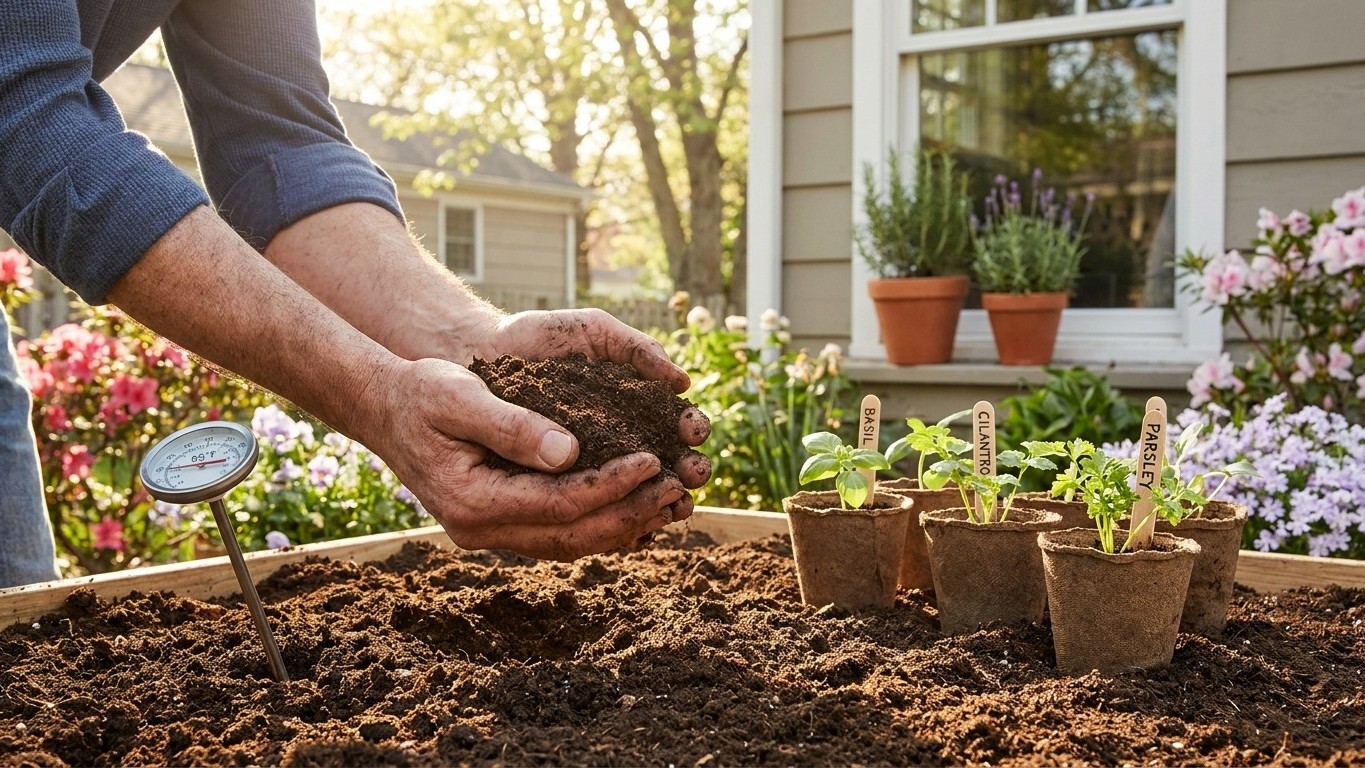

Pennsylvania herb gardeners face two separate calendars: a planting calendar tied to spring soil temperature, and a survival calendar tied to winter cold. The first tells you when to put transplants in the ground. The second decides whether a herb comes back next year or needs a container and a spot indoors. Both matter more here than they would in a milder or shorter-season state.
When the soil is warm enough in Pennsylvania

At Philadelphia, the reference station for this state’s climate normals, the last spring frost falls between March 29 and April 6, based on the 30-70% freeze-probability band in NOAA’s 1991-2020 Climate Normals. That’s a probability window, not a guarantee, and it comes from one station in the mildest corner of the state. The northern tier and the Alleghenies typically run two to four weeks later in spring, so a gardener in Erie County or up near the New York border should treat late April, not late March, as the realistic marker.
Frost date matters, but it’s a proxy for something else: soil temperature. Air can clear of frost risk while the ground underneath is still cold and slow, and herb roots respond to soil warmth, not to the calendar. This is where herbs split into two behavioral groups worth knowing before you plan a bed.
Hardy types versus tender types
Cold-tolerant herbs, the kind that can handle a light frost or even snow cover without dying back, include several from the mint and allium families, along with parsley and cilantro types. These can go into the ground close to the frost date itself, sometimes a little before it, because a stray cold night won’t finish them.
Tender herbs, basil types above all, are a different story. They don’t just dislike frost, they sulk in cold soil even when the air is frost-free, showing stunted growth or yellowing leaves if planted too early. For these, waiting one to two weeks past the local last-frost date, until night soil temperatures have climbed, produces sturdier plants than rushing the transplant.
A few herbs carry long-standing medicinal reputations. This page doesn’t evaluate those claims one way or another. What follows is about where these plants grow, not what they’re said to treat, and it stays in the realm of garden species and types rather than specific cultivar names, since variety performance is a local-trial question this page can’t answer responsibly.
How long the season lasts here
Pair the spring frost window with the fall one. First fall frost at the Philadelphia reference station arrives between November 5 and November 16, per the same NOAA 1991-2020 normals. Doing the arithmetic honestly, using the later spring date against the earlier fall date, gives a frost-free stretch of about 213 days. Using the earlier spring date against the later fall date stretches it to roughly 232 days. Either way, that’s somewhere between seven and seven and a half months of workable growing time in the Philadelphia area, a window that shrinks meaningfully in the higher, colder parts of the state.
A window that long changes the math on what’s worth planting once, versus what’s worth planting twice. Quick annual herbs, the leafy kinds that bolt or fade after a few months of cutting, have enough season left after an early planting to support a second sowing in mid-summer for a fresh fall crop. That’s a real option in the milder half of Pennsylvania, less so in the shorter northern-tier season where a single planting has to carry the whole year.
Length of season also changes whether transplanting versus direct-seeding makes sense. In a long window, there’s room to start slow-germinating herbs indoors, transplant them out once soil has warmed, and still get a full harvest arc. In a compressed window, every week spent waiting on a transplant to establish is a week not spent producing, which tilts the decision toward direct-seeding the herbs that tolerate it. For the mechanics of staggering plantings through a Pennsylvania season, the site’s succession sowing guide walks through timing intervals in more detail than fits here.
Heat and water in Pennsylvania

This page doesn’t have a verified count of days above 90°F or a summer rainfall figure for Pennsylvania to cite responsibly, so none is offered here. What the state’s climate data does establish clearly is the number that actually governs herb planning in this territory: winter cold, not summer heat.
The mean daily minimum temperature in the coldest month at the Philadelphia reference station is 26.0°F, and the USDA Plant Hardiness Zone Map (2023 edition, built on the 1991-2020 normals) places Pennsylvania across zones 5a to 7b. That’s a wide range for one state, spanning the milder Philadelphia and southeastern corner down near 7b, out to the higher terrain of the Alleghenies and the northern tier closer to 5a. A recommendation calibrated to Philadelphia’s zone will overstate what survives outdoors in Bradford or Somerset County.
Why winter, not summer, sorts the herb bed
For herbs specifically, the coldest-month minimum decides which species are permanent residents of the garden and which are pot plants that need to come indoors or into an unheated but frost-protected space before the ground freezes hard. Woody Mediterranean herbs, the types native to warm, dry hillsides, generally need a milder zone than much of Pennsylvania offers to survive outdoors year-round; in the colder end of the state’s range they function as annuals or container plants moved under cover. Herbaceous perennial herbs from cooler native ranges tend to shrug off a 26°F average minimum without trouble, dying back to the roots and returning each spring.
Where summer does show up in the herb conversation here, it’s less about heat stress and more about the humidity that comes with a mid-Atlantic growing season: still air and damp foliage favor fungal issues like powdery mildew and various leaf rusts on herbs planted too densely. Spacing for airflow does more work in this territory than shading for heat protection.
Which herbs suit Pennsylvania
Sorted by the two factors this state actually hands a gardener, winter cold and a mid-length season, the picture by type looks like this:
- Herbaceous perennials built for cold — types in the mint, allium, and fennel families generally handle a 26°F coldest-month minimum without protection and return reliably across most of the state’s hardiness range.
- Woody Mediterranean perennials — types adapted to warm, dry origins usually need zone 7b or milder to overwinter outdoors reliably, which limits them to the state’s southeastern edge; elsewhere they’re best treated as container plants brought in before hard frost.
- Cool-season annuals and biennials — parsley and cilantro types tolerate the cooler ends of the frost window and can go in near the last-frost date itself, then bolt once summer heat sets in.
- Tender annuals — basil types need warmed soil and no frost risk at all, making them the group most worth waiting on past the official last-frost date.
A short season in the higher parts of the state favors the earliest-maturing types within each of these groups. A humid mid-Atlantic summer makes disease resistance, not flavor or size, the first thing worth checking on a seed packet or plant tag. And a hot, damp week rewards whichever herbs got planted with real space between them rather than crowded for a fuller-looking bed.
None of this page names a specific variety, and that’s deliberate rather than an oversight. Which basil or which thyme performs best against Pennsylvania’s disease pressure and frost timing is a question local trial data answers far better than a general guide can, and that data lives with Penn State Extension, the land-grant service that runs Pennsylvania’s regional variety trials and county-level planting advice. A gardener in Erie has a genuinely different answer than one in Chester County, and the extension office covering each county is built to know the difference.