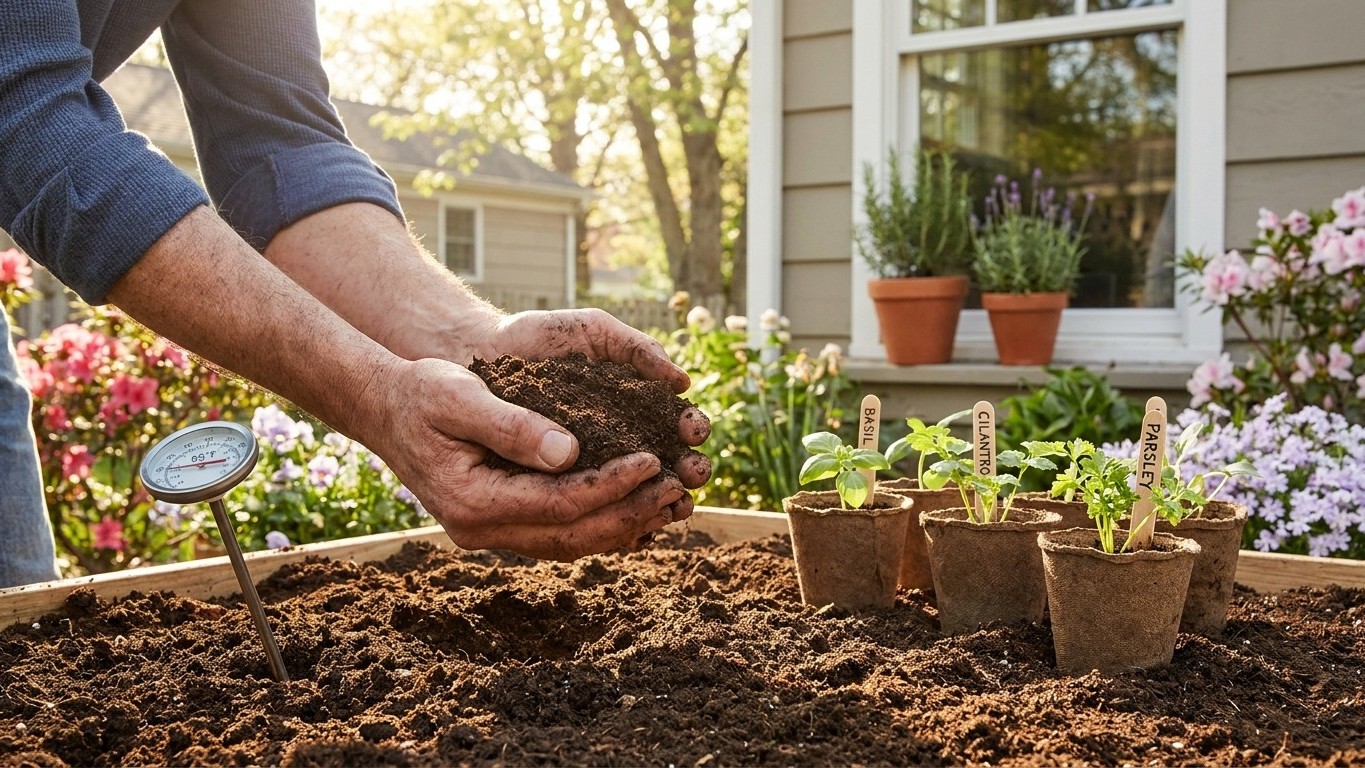

Herbs go in the ground here once the soil itself has warmed, not simply once the last frost has passed. In Portland and the Willamette Valley that usually means mid-to-late April for tender herbs, earlier for hardy perennial types. East of the Cascades, the high desert runs a shorter, colder script entirely.
When the soil is warm enough in Oregon

The question every Oregon gardener asks in late winter is a simple one: when. NOAA’s 1991-2020 Climate Normals put the last spring frost for the Portland reference station (USW00024229) somewhere between March 6 and March 21, the window during which the odds of a 32°F freeze fall from 70 percent down to 30 percent. That is the number most seed packets and planting charts point to. It is also, on its own, not quite the right number for herbs.
Frost date is a proxy, and a rough one. Air temperature can climb into the 50s while the soil six inches down is still sitting in the low 40s, cold and slow to release nutrients. Tender annual herbs, the basil types especially, sulk or simply stall in cold soil even if no frost touches their leaves. They want soil that has held steady warmth for a week or two, which in western Oregon’s clay-heavy valley ground usually lands three to four weeks after that March frost window closes, not on the frost date itself.
Hardy perennial herb types read the calendar differently. Rosemary, thyme, sage, and oregano types tolerate cool soil far better and can go into the ground as soon as it can be worked, often well before the last frost date has passed. Their risk isn’t a late frost nipping new growth back a little; it’s waterlogged roots sitting in Oregon’s slow-draining spring clay. Raised beds or amended, well-drained rows matter more for these types than timing does.
One caution worth repeating just once: a frost date is a probability, not a guarantee. The March 6-to-21 window describes odds, not a switch that flips. Gardeners who plant tender herbs right at the early edge of that window are accepting real risk of a setback, not eliminating it.
Central and eastern Oregon’s high desert doesn’t share this timeline at all. Elevation and the absence of the Pacific’s moderating influence push both the last spring frost and the first fall frost toward dates that squeeze the whole season, sometimes by a month or more compared to the valley. A planting calendar built on Portland’s numbers will mislead a gardener in Bend or Burns.
How long the season lasts here
Take the two frost windows NOAA provides for the Portland station and the shape of the season becomes clear. Last spring frost falls between March 6 and March 21; first fall frost arrives between November 11 and November 27. Using the conservative ends of each window, the last day of spring risk (March 21) to the first day of fall risk (November 11), the reliably frost-free stretch runs roughly 235 days, close to seven and a half months.
That is a long season by American standards, and it changes what’s worth doing in a herb bed. A window this generous supports more than one sowing of fast-cycling herb types. Cilantro and dill types, which bolt and finish quickly in warm soil, can go in a second time in mid-to-late summer for a fall crop instead of being treated as a one-shot spring planting. Parsley types, slower but steady, have enough runway to be started from seed directly rather than relying on transplants bought already several weeks old.
A season this long also loosens the pressure around transplanting. Where the frost-free window is short, every week matters, and starting seedlings indoors to get a head start becomes close to mandatory for anything slow. In western Oregon’s stretched-out window, direct-sowing many herb types is genuinely competitive with transplanting, and a gardener has room to check root health on a purchased transplant, teasing apart a pot-bound rootball or passing on a leggy, stressed seedling, without the season punishing that extra minute of care.
The math changes fast east of the Cascades. Shorter, colder-edged frost windows there compress the growing calendar enough that a second sowing of anything but the very quickest herb types simply doesn’t have time to mature before fall frost risk returns. For a full walkthrough of staggering plantings to make the most of whatever window a given spot allows, the site’s succession sowing guide covers timing and spacing in more depth than fits here.
Heat and water in Oregon

Summer in the Willamette Valley and along most of western Oregon runs mild and dry, the wet season having largely emptied itself out by June. That combination, mild days and low summer rainfall, is close to ideal for most culinary herbs, which generally prefer to dry out somewhat between waterings rather than sit in damp soil. Mediterranean types especially, rosemary, thyme, sage, oregano, lavender types, evolved for exactly this rhythm: hot, dry summers and wet winters.
Where western Oregon summers do cause trouble is on the humidity side in shadier, tighter plantings, not on raw heat. Crowded basil types or dense mint patches can develop powdery mildew when morning fog or irrigation keeps foliage damp into midday, even without genuinely oppressive heat. Airflow between plants, and watering the soil rather than the leaves, matters more here than shade cloth does.
But the number that actually reorganizes an Oregon herb bed isn’t a summer figure at all. It’s winter. NOAA’s Climate Normals put the mean daily minimum temperature for Portland’s coldest month at 36.2°F, a comfortably mild figure that keeps many perennial herb types alive outdoors year-round without special protection. The USDA Plant Hardiness Zone Map (2023, built on 1991-2020 normals) places Oregon across an enormous statewide range, zone 4a through zone 9b, built from average annual extreme minimum temperatures. Western valleys like Portland’s sit toward the mild end of that range; the central and eastern high desert sits toward the cold end, sometimes by four or five zones’ worth of difference.
| Region | Winter character (per USDA zone range) | What it means for herbs |
|---|---|---|
| Willamette Valley / western Oregon | Toward the milder end of the 4a-9b statewide range | Many perennial herb types survive outdoors year-round |
| Central and eastern high desert | Toward the colder end of the 4a-9b statewide range | Perennial herb types often need pots brought indoors or heavy winter protection |
That single winter question, will a given herb survive outdoors here or not, decides far more about how an Oregon herb bed is organized than any summer heat count does. Gardeners in the milder valleys can plant a rosemary type once and treat it as a permanent shrub; gardeners in the high desert, or anyone gardening in a cold pocket, often grow the same herb in a container specifically so it can be moved indoors before the hard freezes set in.
Which herbs suit Oregon
Western Oregon’s profile, a long frost-free window, dry mild summers, and wet but not brutally cold winters, favors a fairly wide range of herb types rather than forcing a narrow choice. Perennial Mediterranean types (rosemary, thyme, sage, oregano) generally handle the winter fine in the valleys and reward good drainage more than anything else. Annual and biennial types (basil, cilantro, dill, parsley) fit comfortably inside the long season, with room for a second sowing of the quickest ones. Mint types thrive here almost too well, given the summer moisture that lingers in shadier spots, and are usually best confined to a container to keep them from spreading through a bed.
Humidity, not raw heat, is the deciding factor for disease resistance in this territory. In a wetter garden or a shadier corner, choosing herb types and planting arrangements that favor airflow matters more than choosing for heat tolerance, since Oregon summers rarely push into extended stretches of extreme heat the way the interior West does.
East of the Cascades, the shorter season pushes the priority toward the earliest-maturing types within each herb group, since there’s simply less time for a slow one to finish before fall frost risk returns, and toward container culture for anything expected to survive winter outdoors in the valley but not in the high desert’s colder zone range.
This page won’t name a specific variety within any of these herb types, and that’s a deliberate choice, not an oversight. Variety trials, the kind that test which basil or which rosemary selection actually performs best against local disease pressure and local winter minimums, are done at the state level for a reason: they account for soil, elevation, and microclimate in a way a general territory page cannot. Oregon State University’s Extension Service runs exactly that kind of trial work and publishes recommendations built on it, and it’s the resource worth checking before choosing between specific varieties within any of these herb types: Oregon State University Extension Service.