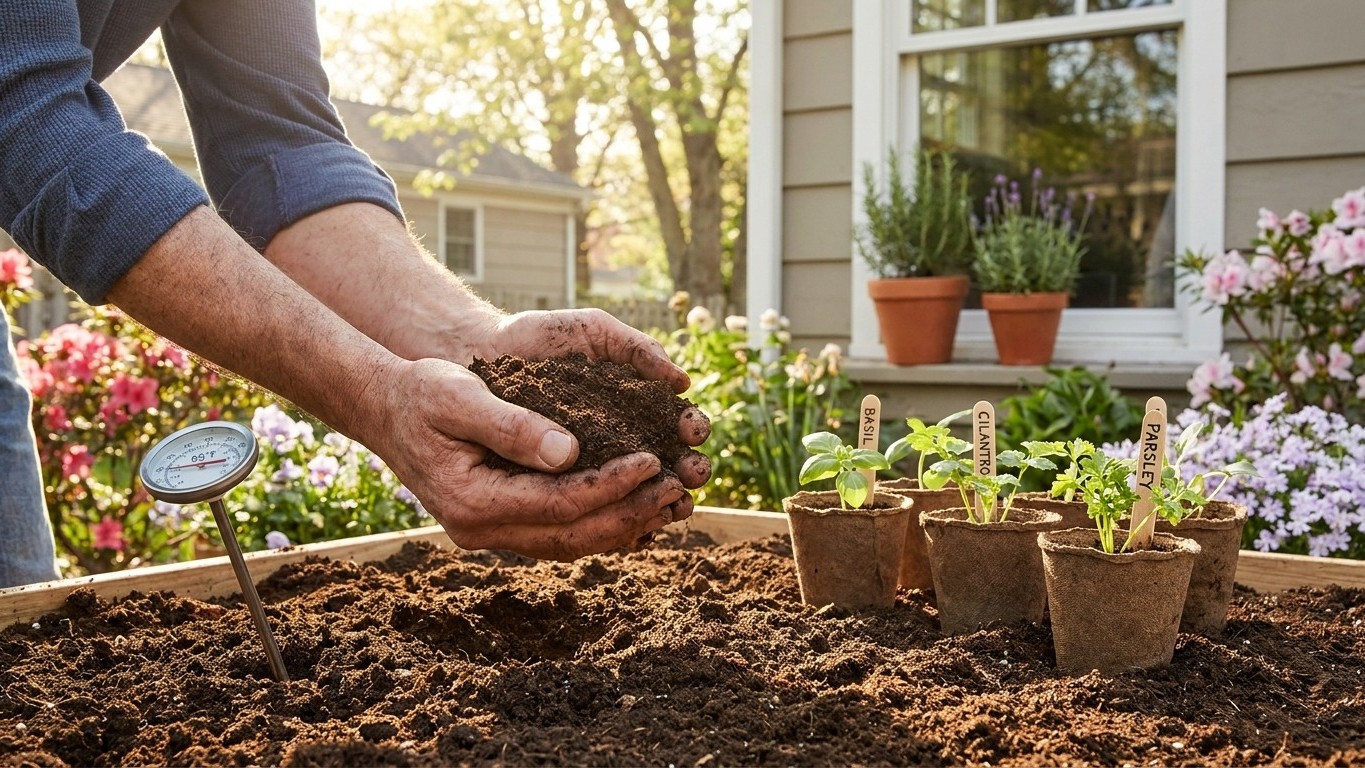

Quebec gardeners can start warm-season herbs outdoors only after the soil itself warms, which happens later than the average last frost of May 6. Cold-hardy herbs go in weeks earlier, and the whole planting calendar bends around a growing season of roughly five months bracketed by two mean frost dates that are never guarantees.
When the soil is warm enough in Quebec

The number gardeners actually want is May 6. That’s the average last spring frost recorded at the MONTREAL/ST-HUBERT A station, based on Environment and Climate Change Canada’s 1981-2010 climate normals. It’s a useful anchor, but it’s a mean, not a schedule: in roughly half of all years, frost arrives after that date. Treat May 6 as the midpoint of a window that can stretch later, especially away from the St-Hubert reference station. Quebec is a large province, and districts north of Montreal or at higher elevation run behind this figure by days or weeks.
Here’s where the frost date and the planting date split apart. Frost is a measure of air temperature. Herbs don’t respond to air, they respond to soil. Cold, wet soil in early May can sit well below the range most herb roots need to grow, even on a morning when the thermometer says the frost risk has passed. That gap between “no more frost” and “soil is actually warm” is often a week or two, sometimes more in a spring with a slow, wet thaw.
Cool-tolerant types versus heat-loving types
This is why herbs split into two very different planting groups here. Parsley, chives, and cilantro tolerate cool soil and can go in the ground close to the average frost date, sometimes a little before it under cover. Basil, tarragon, and other warm-season herbs want soil that has had real time to warm, and pushing them out too early usually means stalled growth rather than a head start. Some herbs, sage among them, carry a long-standing medicinal reputation; this page sticks to garden and kitchen use and doesn’t evaluate those claims one way or the other.
None of this is a cue to forage local look-alikes to fill gaps in a herb bed. Several wild plants resemble common culinary herbs closely enough to fool an experienced eye, and a handful of those look-alikes are dangerous. Buy transplants or start from seed with a known source, and leave wild identification out of the herb garden entirely.
How long the season lasts here
Run the two mean dates together and the frost-free window at the St-Hubert station comes to roughly 152 days, from the average last spring frost on May 6 to the average first fall frost on October 5. Both figures come from the same source and the same station, so the subtraction holds together as one consistent picture, even though each date is still a midpoint rather than a promise.
A season of that length changes what’s realistic to plant and how. It’s long enough to justify a second sowing of quick annual herbs like dill or cilantro once the first round bolts or gets harvested hard in midsummer, rather than treating the spring planting as the only shot at those crops. It’s also long enough that transplanting from indoor seed starts genuinely pays off for slower herbs, because there’s enough calendar left after the last frost to let a transplant recover from root disturbance and still put on real growth before fall.
That said, 152 days is not a wide margin the way it would be farther south. Herbs that need a long, hot stretch to finish strong, rather than simply to survive, are working against the calendar even inside this window. Gardeners who want to stretch the harvest, or who lost early plantings to a late cold spell, should look at how succession sowing is timed and spaced rather than guessing at a second planting date; the site’s succession sowing guide walks through that timing in more detail.
The practical takeaway is that Quebec’s season rewards a plan with two checkpoints: an early, cool-tolerant round right around the last frost, and a second wave of fast annuals sown in early-to-mid summer, both aimed at finishing well before the average October 5 frost closes things down.
Heat and water in Quebec

This page doesn’t have a station-level count of days above 90°F or a summer rainfall total for Quebec, so it won’t invent one. What the available data does show, clearly, is that summer heat isn’t the variable that decides what survives here. Winter is.
The coldest month in the Montreal reference area has a mean daily minimum of 6.7°F, according to ECCC’s 1981-2010 normals. That single figure, more than any summer stat, sorts Quebec’s herb options into two camps: plants built to sit outside through that kind of cold, and plants that have to be treated as pots brought indoors before the ground freezes hard.
What the hardiness zone actually tells you
Natural Resources Canada places the reference city in this territory at zone 5b, using the Canadian hardiness system, per the 1991-2020 normals. That’s worth flagging clearly: the Canadian zone system is built from seven climate variables, not the single minimum-temperature figure the USDA system uses, and NRCan itself says the two scales don’t convert cleanly. A Canadian zone 4a, for instance, can overlap nine different USDA zones. So 5b here should be read as a description of this specific location under the Canadian framework, not translated into a US zone number, and not assumed to apply evenly across the whole province.
What 5b combined with that 6.7°F winter minimum means in practice: woody Mediterranean herbs like rosemary and bay laurel are not reliable outdoor perennials in most of Quebec. They’re better managed as container plants that spend the growing season outside and the winter indoors near a bright window. Hardier perennial herbs, on the other hand, generally take this winter in stride outdoors with normal mulch and siting.
On the summer side, without a local rainfall figure to cite, the safer general point is this: much of Quebec runs cooler and damper through the growing season than the Mediterranean climates many culinary herbs originally come from. That combination favors fungal problems, slower ripening of fruiting herbs, and a real need for airflow between plants rather than a tight, crowded bed. It’s a different set of problems than drought stress, and it changes spacing and pruning decisions more than it changes what gets planted.
Which herbs suit Quebec
Reasoning from the territory’s own numbers narrows the field without needing a single cultivar name. A roughly five-month frost-free window favors annual herbs that mature quickly or that tolerate cool soil at both ends of the season: parsley, cilantro, dill, and chives all fit that pattern, whether started from seed after the soil has warmed or sown a second time in midsummer for a fall harvest.
The zone 5b Canadian rating and that 6.7°F winter minimum point toward hardy perennial types, mint, oregano, thyme, and chives among them, as the backbone of a herb bed meant to come back on its own each spring. Woody, Mediterranean-climate herbs like rosemary and bay laurel sit on the other side of that line: they’re realistic here as container plants brought indoors for winter, not as permanent fixtures in open ground.
Because summers here tend toward cool and damp rather than hot and dry, disease resistance and airflow matter more than heat tolerance when choosing among types within a species. Basil, in particular, is prone to fungal trouble in a wet, humid stretch, which argues for generous spacing and good drainage over cramming plants into a small bed.
What this page won’t do is name a specific variety. Local trial results, the kind that tell a Quebec gardener which strains of a given herb actually held up against last year’s blight or coped best with a wet June, live with the people who run those trials, not with a general climate guide. Quebec’s own agriculture ministry, MAPAQ, is the right source for that level of detail, and it’s worth checking before buying seed for anything beyond the most forgiving, widely grown types.