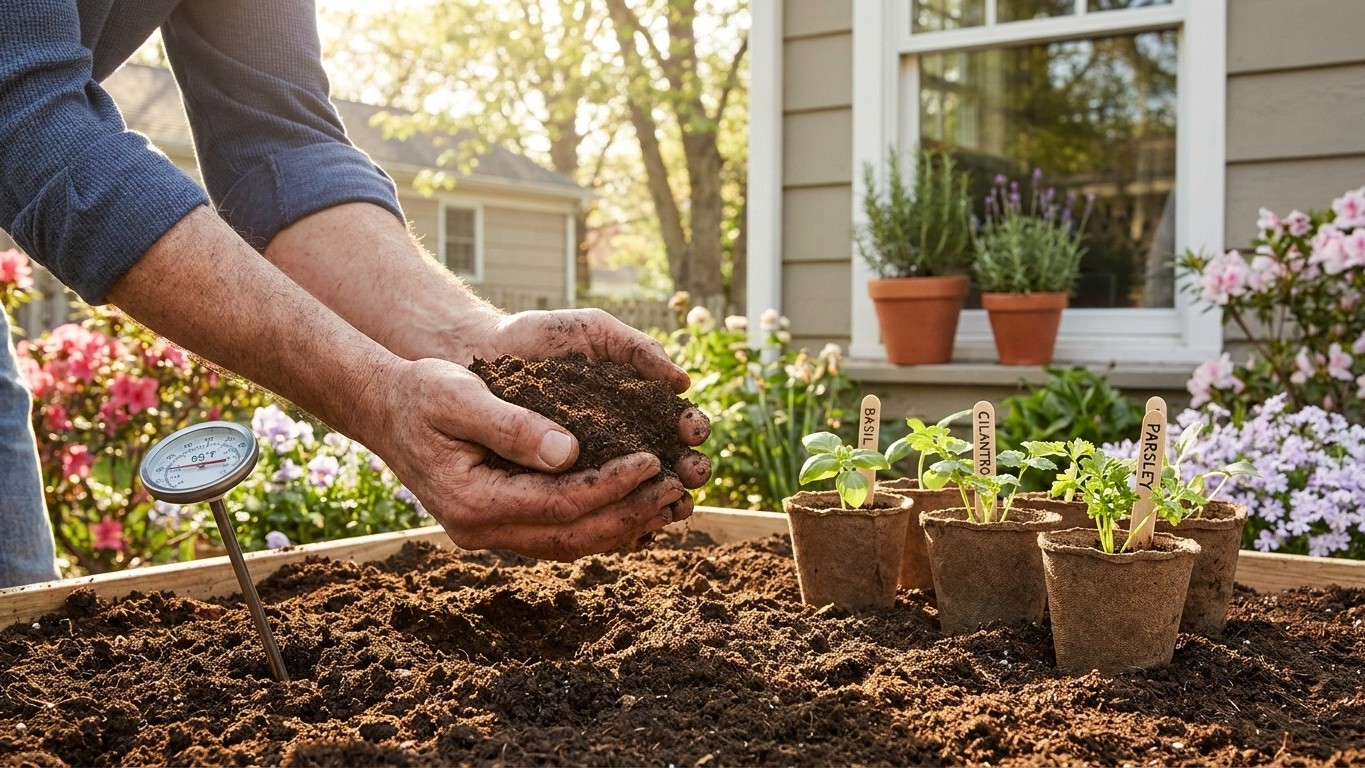

South Carolina gives herb gardeners one of the longest outdoor windows on the East Coast, but the real work here isn’t beating spring frost. It’s picking which herbs can survive a mild, damp winter as permanent plants and which ones need a pot brought indoors before the first hard cold snap. That single decision shapes everything else in the bed.
When the soil is warm enough in South Carolina

The date question comes first for a reason: nobody wants to set out young herb plants only to watch them sit and sulk in cold ground. According to NOAA NCEI’s 1991-2020 Climate Normals for station USW00013880, the last spring frost in this part of South Carolina falls somewhere between February 28 and March 17, based on the 30-70% probability band for a 32°F freeze. That’s a wide window, and it’s worth reading it as exactly that: a probability, not a promise. Some years the risk clears early, some years it lingers into mid-March, and no single date on a calendar changes that reality.
Frost itself is only a proxy for what herbs actually need, which is warm soil. Air temperature can climb into the 60s on a sunny February afternoon while the ground six inches down is still cold and slow. Roots don’t take up nutrients well in cold soil, and seeds germinate unevenly or not at all. So the practical move is to treat the NOAA window as the outer edge of risk, then wait an extra stretch beyond it before committing tender herb starts to open ground. Hardier types tolerate an earlier start; heat-loving ones do better waiting.
Location inside the state matters more than the state-level number suggests. Peninsular Charleston runs noticeably milder than the airport station these normals are drawn from, so gardeners close to the coast often see safer conditions arrive a bit sooner. Upstate South Carolina, by contrast, runs several weeks tighter at both ends of the frost calendar, meaning both the last spring frost and the first fall frost land closer together than they do downstate. A gardener in Greenville is working with a meaningfully shorter and later spring than one in Charleston or Beaufort, even though both are technically the same state.
None of this is about matching a specific variety to a specific week. It’s about species-level timing: cold-tolerant herbs can go in earlier, tender ones wait, and the exact date shifts by region rather than by a fixed rule.
How long the season lasts here
Put the two NOAA frost windows next to each other and the length of the growing season becomes clear. The last spring frost falls between February 28 and March 17, and the first fall frost arrives between November 20 and December 5, both drawn from the same 1991-2020 Climate Normals at station USW00013880. Doing the subtraction honestly, using the earliest spring date against the earliest fall date and the latest against the latest, the frost-free stretch runs somewhere in the neighborhood of 260 to 265 days. That’s not a rounding trick, just what the two ranges actually produce when set against each other.
Almost nine months of frost-free ground is a rare luxury in most of the country, and it changes the math on how a herb bed gets planned. A short-season territory forces a single planting and makes every week of delay costly. South Carolina’s window is long enough to support more than one sowing of many quick-cycling herbs, with real room for a spring planting, a summer refresh once the first round fades in the heat, and sometimes a fall round that carries into early winter before frost finally shuts things down. Anyone working through the logistics of staggering plantings through a season this long should look at a dedicated succession sowing guide, since the timing math changes depending on how many weeks separate each round.
The season length also affects a smaller decision that gets overlooked: whether transplanting is worth the trouble. In a short-season climate, starting seed indoors and transplanting is often the only way to squeeze a full-size harvest out of a narrow window. Here, with frost-free stretches running most of the year, direct-sowing many herbs outdoors is a realistic option rather than a gamble, since there’s enough time left even if a first attempt at direct sowing fails and needs a second try. Transplanting still has its place for herbs that are slow to establish from seed, but it’s a choice rather than a necessity for most of them.
Heat and water in South Carolina

Summers in this part of the country run hot and stay humid for months at a stretch, and that combination shapes herb health more than any single heat spike does. Muggy air that lingers overnight keeps foliage damp far longer than a dry climate would, and that dampness is exactly what fungal disease needs to take hold in dense, leafy herbs. Basil, in particular, tends to show stress and disease pressure faster here than it would in a drier territory, and airflow around plants matters as much as sun exposure.
But heat isn’t actually the variable that decides the shape of a South Carolina herb garden. Winter is. The coldest month here has a mean daily minimum temperature of 38.9°F at the Charleston reference station, per NOAA NCEI’s 1991-2020 Climate Normals, and that number is the one that decides whether a given herb survives the winter outdoors as a permanent plant or needs to come inside. It’s not the record low and not a monthly average; it’s the typical coldest reading of an average night in the coldest month, and it sits well above freezing.
Layered on top of that is the USDA Plant Hardiness Zone Map, which places this territory across a 7a-9a range based on the average annual extreme minimum temperature. That’s a wide span for one state, and it matters which end of it a garden sits on. A woody, cold-tolerant perennial herb that shrugs off winter in zone 7a inland may behave as a true year-round perennial closer to zone 9a along the coast, while a tender, frost-sensitive herb has no realistic path to surviving outdoors anywhere in the range without protection.
That’s the reorganizing fact for this territory: instead of asking which herbs can handle a hot July, the better question is which ones can handle a South Carolina January. Answer that first, and the rest of the planting plan falls into place.
Which herbs suit South Carolina
Reasoning from the facts above, three qualities matter more than any specific name: cold tolerance for winter survival, airflow and root-zone shade tolerance for summer humidity, and disease resistance as a baseline requirement rather than a bonus.
Woody Mediterranean-type herbs, the kind that evolved in dry, rocky, sun-baked conditions, tend to handle the milder end of this state’s winters well once established, particularly toward the coast where the hardiness zone runs warmer. Their challenge here isn’t cold, it’s humidity and heavy clay soil holding water around their roots through a wet summer. Raised beds, sandy amendments, and spacing that lets air move between plants matter more for this group than winter protection does.
Leafy, fast-cycling annual types are a different story. They’re well suited to this territory’s long frost-free window and can go through more than one planting a year, but they’re also the group most exposed to the fungal pressure that comes with humid summer nights. Choosing disease-resistant types within a species, and giving them room to dry out between waterings, does more for their success here than any other single practice.
Some herbs carry a long-standing medicinal reputation. That reputation exists in folk and historical use, but evaluating whether any of it holds up is outside what this page covers; treat this as a page about growing herbs for the kitchen and the garden, not about their traditional or claimed effects.
No cultivar gets named here on purpose. Variety trials run by Clemson University’s Cooperative Extension Service are the only source that tests specific herb varieties against this state’s actual soil, humidity, and pest pressure, region by region. A name picked from a national seed catalog or a general gardening article carries none of that local testing, and in a state where the coast and the Upstate can differ by several weeks of frost risk and multiple zones of winter cold, that local data is the difference between a recommendation that means something and one that’s just a guess dressed up as advice.