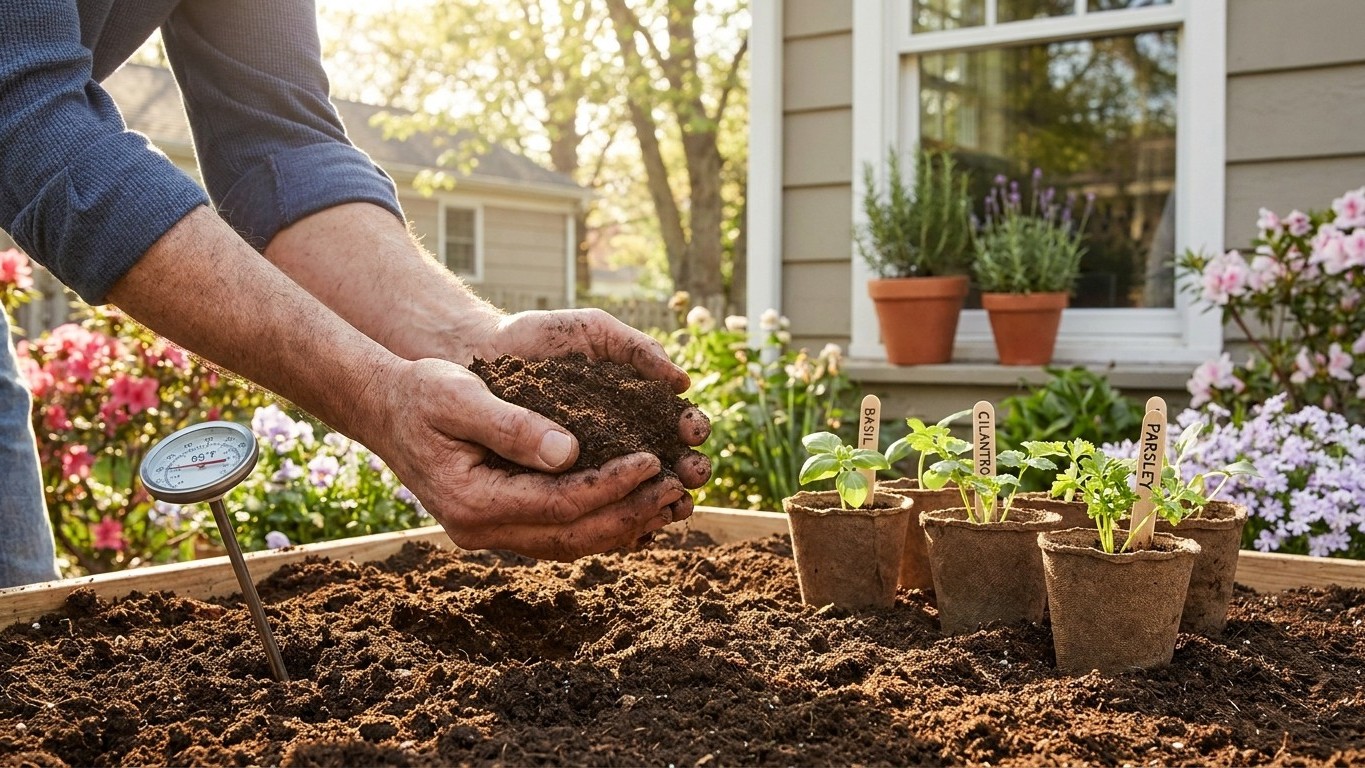

South Louisiana barely freezes at all, and that single fact changes everything about how herbs behave here. The soil warms early, frost risk fades to almost nothing most winters, and the real limit on an herb bed isn’t the last cold snap but the long, damp heat that follows it.
When the soil is warm enough in Louisiana

The question every gardener asks first is when to put transplants or seed in the ground. At the New Orleans reference station, NOAA’s 1991-2020 Climate Normals put the last spring frost between January 18 and February 8. That’s not a typo and it’s not a Northern-style planting calendar shifted a few weeks earlier. It reflects a coastal climate where a 32-degree freeze only shows up in 86.8 percent of years, meaning roughly one winter in seven skips frost entirely.
That date is a probability, not a promise, and it’s worth saying just once so it sticks: some years will freeze after February 8, most won’t. But frost timing is only half the story, and honestly the less useful half. Herbs don’t germinate or root because a calendar square says the freeze risk has passed. They wait for the soil itself to warm, and soil temperature lags behind air temperature by days or weeks depending on how wet and shaded the bed is. A raised bed in full sun can warm well ahead of the frost-free date; a low, shaded, clay-heavy plot can stay cool and slow to root new plantings even after the frost odds have dropped to near zero.
This matters more in south Louisiana than almost anywhere else in the country, because the frost window is already so narrow and unreliable that gardeners are tempted to treat “frost-free” as the only signal that counts. It isn’t. Cool, wet soil in February can rot seed and stall transplants just as effectively as a late freeze would have. The practical move is to treat the frost date range as the outer boundary of risk, then check the bed itself: is the soil crumbly and workable, or still cold and waterlogged from winter rain? Herbs that root shallowly and grow fast in warmth respond to soil warmth almost immediately once it arrives; slower, woodier types take longer regardless of the date on the seed packet.
None of this is a case for guessing at a fixed number. The freeze data is a range for a reason, gathered across thirty years at one weather station, and every yard in the region sits a little differently relative to that station depending on distance from the coast, elevation, and tree cover. Treat the January 18 to February 8 window as the point where frost risk becomes unlikely, not the point where the garden is guaranteed safe, and let the soil itself confirm the rest.
How long the season lasts here
Subtracting the two frost dates in the NOAA record tells a story most of the country doesn’t get to hear. Using the later edge of the spring range, February 8, and the earlier edge of the fall range, December 17, the gap between them runs to roughly ten months, well over 300 days without meaningful frost risk. Even using the tighter ends of each range, the frost-free stretch still spans the better part of a year. That’s an unusually long growing window by national standards, and it comes with a catch worth naming: the fall frost range itself straddles the New Year, sliding from mid-December into early January, which means the “off season” here is really just a few cold weeks in the dead of winter rather than a defined spring-to-fall arc.
A window that long changes the math on succession sowing. Where a short-season territory gets one real shot at an herb crop before frost shuts it down, south Louisiana’s gardeners can realistically plan a spring planting and a second round later in the year, staggering harvest instead of gambling on a single sowing date. That’s the entire logic behind succession planting, and this site’s succession sowing guide walks through how to space those plantings so one round isn’t still crowding the bed when the next one goes in.
The long window also changes how transplants are handled. In a short-season climate, checking the root ball before setting a transplant matters because there’s no time to recover from a stunted start. Here, with months of frost-free growing on either side of any single planting date, a slow or rootbound transplant has more room to recover before the season closes. That doesn’t make root checks pointless, it just lowers the stakes.
North Louisiana doesn’t share this pattern. Freeze events there are far more reliable and the frost season behaves more like a conventional winter, with a defined start and end rather than a narrow, unpredictable dip. Anyone gardening in the northern part of the state should treat the New Orleans-anchored numbers here as describing the coastal and southern parishes, not the whole state, and lean on colder, more typical frost expectations further north.
Heat and water in Louisiana

Frost isn’t the factor that shapes an herb bed in this territory. Heat is. Louisiana summers run long, humid, and hot enough that stretches of 90-degree-plus days are routine rather than exceptional, and that heat arrives paired with heavy, humid air rather than the dry heat of the Southwest. For herbs, that combination does two things at once: it accelerates growth and bolting in the same breath, and it creates exactly the damp, still conditions that fungal disease thrives in. A basil plant that would take its time in a drier climate can bolt to seed within weeks here, and the same humidity that keeps plants hydrated also keeps foliage wet longer after rain or morning dew, which is when mildew and leaf spot get their foothold.
But the more consequential number for planning an herb bed isn’t the summer heat count at all, it’s the coldest month’s mean daily minimum: 46.1 degrees Fahrenheit at the New Orleans reference station. That’s mild by national standards, and it’s the figure that actually decides which herbs behave as permanent, multi-year plants here and which ones need to come indoors or get replaced annually. Combined with a USDA Plant Hardiness Zone range of 8a to 10a across the state (a system built on one variable, the average annual extreme minimum temperature), it puts much of southern and central Louisiana in territory where woody, perennial herb types can often stay in the ground year-round, while other regions closer to zone 8a’s colder edge see occasional dips that damage or kill less cold-tolerant types.
That’s the real planning decision in this climate, and it reorganizes the whole herb bed around one question: which herbs are permanent residents here, and which are pots that get moved to shelter when a cold snap is forecast? Getting that answer right matters more than any summer heat management, because a herb lost to an unexpected winter dip is a bigger setback than one that bolted early in July.
Which herbs suit Louisiana
None of this points to a single variety, and it shouldn’t. What the territory’s own numbers point to is a set of traits worth shopping for, by type and by species, rather than by name. A frost-free window stretching close to ten months rewards herb types that can be planted more than once a year and that tolerate a fast run to maturity in warm soil. A humid, disease-prone summer rewards types and growing setups that favor airflow around the foliage and well-drained soil at the root, since standing moisture around the crown is often what turns a minor mildew issue into a lost plant. And a winter that rarely drops the mean minimum below the mid-40s means many woody, perennial herb types have a real shot at surviving outdoors year-round in the warmer parts of the hardiness range, while colder pockets closer to zone 8a still call for container growing and winter shelter.
Some herbs carry long-standing medicinal reputations in folk use. That reputation exists, and this page isn’t the place to evaluate it. What follows here is culinary and garden guidance only.
Naming a specific cultivar for this territory would be a disservice, not a shortcut. Variety trial results, the kind that actually tell you which strain resists local disease pressure or handles the coastal humidity best, come from testing done in this climate specifically, and that data lives with the LSU AgCenter, Louisiana’s land-grant extension service. Refusing to hand out a name here is the accurate answer, because a variety proven in a different state’s trials carries no guarantee it performs the same way against Louisiana’s particular mix of heat, humidity, and mild winters. The extension service’s current recommendations, updated as new trial data comes in, are the only variety guidance actually built on this territory’s conditions.