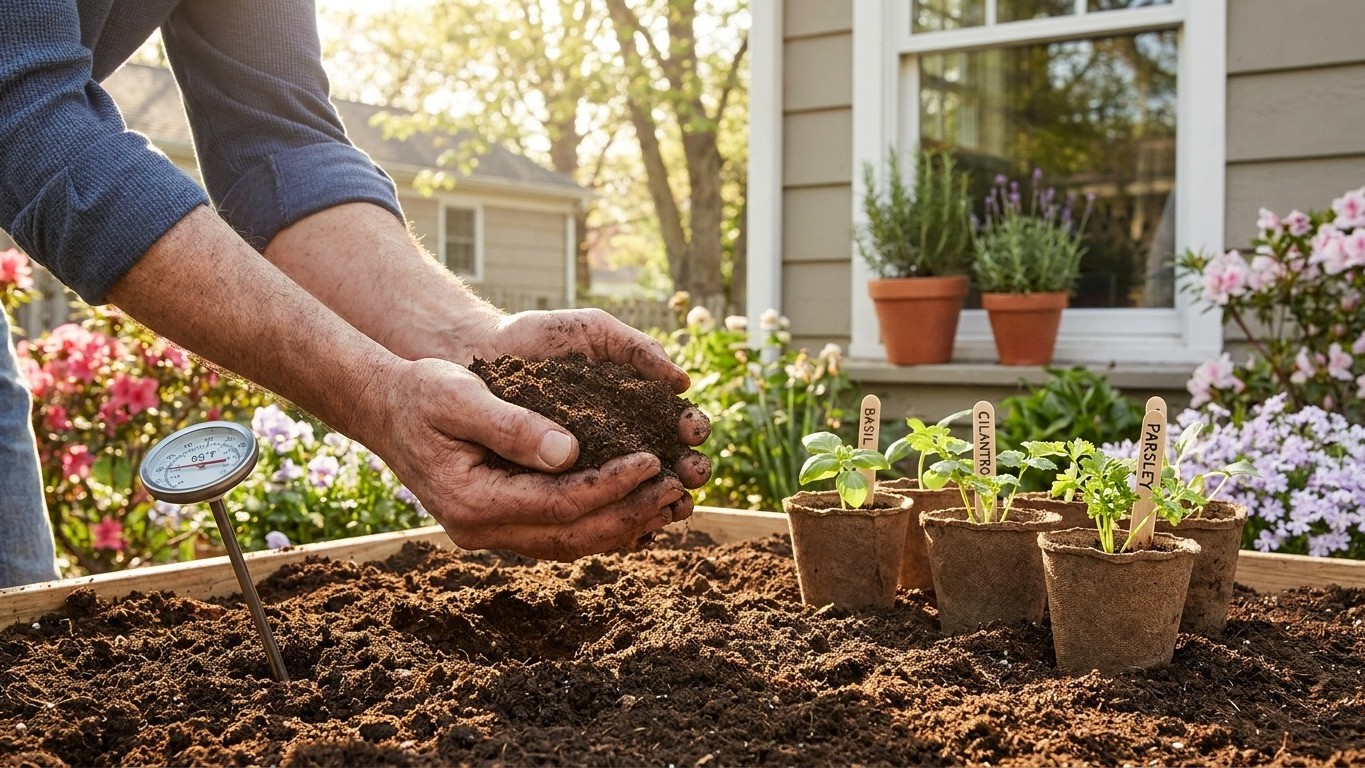

Herbs grow well across nearly all of Texas, but the state is so large that “when” and “how” depend heavily on where you garden. Near Houston, the frost-free season stretches close to ten months. In the Panhandle, winter closes that window months earlier and reopens it months later. The answer starts with which part of Texas you’re standing in.
When the soil is warm enough in Texas

Start with the number NOAA actually tracks: at Houston’s Bush Intercontinental Airport station (USW00012960), the 30-70% probability band for a 32°F freeze runs from February 4 to March 1, based on the 1991-2020 Climate Normals. That’s the window during which a hard freeze becomes progressively less likely as the calendar moves forward, not a single date to circle on the wall calendar. Even a few miles away, at Houston’s Hobby Airport, the same probability band runs roughly two weeks milder, which tells you something important before you even get to planting: frost dates are local to the station that measured them, not to “Houston” as a whole, and certainly not to “Texas” as a whole.
That distinction matters more here than almost anywhere else in the country. Texas spans four USDA hardiness zones, from the cold end of the Panhandle to the warm, humid Gulf Coast. A frost date pulled from Amarillo or Lubbock has nothing to do with a frost date pulled from Houston or Corpus Christi, and using one for the other will either get your seedlings killed or waste six weeks of good growing time. Everything in this article uses the Houston station as its reference point because that’s where the sourced data comes from. If you garden in North Texas, the Hill Country, or the Panhandle, treat these dates as illustrative of how the method works, not as your actual planting calendar.
Frost dates are also a proxy, not the real target. Herbs don’t respond to air temperature on a given morning; they respond to soil temperature, which lags behind air temperature by days or weeks depending on how wet and shaded the ground is. The last-frost window tells you when the risk of a killing freeze has dropped low enough that soil temperature is likely trending upward for good. It does not tell you the soil is already warm enough for a warm-season herb’s roots to get going. A cool, damp early March in Houston can leave soil noticeably colder than the air above it.
In practice, this splits Texas herbs into two rough groups. Cool-season types, the annual herbs that actually prefer to grow before real heat arrives, tolerate soil in the 40s and 50s and can go in well before that late-window date passes. Warm-season annual herbs and young perennial transplants want soil that has been reliably above 60°F for a stretch, which for the Houston reference area usually means waiting until at least the tail end of the frost window, sometimes later if the spring runs cool and wet. And one caveat worth repeating: that 30-70% band is a probability, not a promise. A freeze after March 1 in Houston is less likely than one before it, but it isn’t impossible.
How long the season lasts here
Run the subtraction using both sourced dates and the length of the frost-free window at the Houston reference station comes out to somewhere between 293 and 300 days, depending on which end of each probability band you use: from a February 4 last frost to a December 1 first frost is 300 days; from a March 1 last frost to a December 19 first frost is 293 days. Either way, that’s close to ten months of growing time in a single year, measured against a first fall frost that itself only reaches 30-70% probability between December 1 and December 19.
A window that long changes the math on almost every herb decision. In territories where the frost-free season runs twelve or fourteen weeks, gardeners get one real shot at a warm-season crop and have to make it count. Around Houston, a season nearly ten months long means there’s room for more than one sowing of fast-growing annual herbs, and room to recover from a slow or failed first attempt without losing the year. It also changes whether transplanting versus direct-seeding is worth the trouble: with this much runway, the extra few weeks gained by starting transplants indoors matter less than they would in a short-season territory, though many gardeners still transplant herbs with fussy germination to get a more even stand.
The long window also opens the door to succession sowing, staggering plantings of quick-maturing annual herbs every few weeks instead of putting in a single batch and hoping it lasts. That approach is covered in more depth in this site’s succession sowing guide, which walks through spacing out sowings so you’re not stuck with a single, all-at-once harvest window. For herb gardeners near the Gulf Coast, that guide is more useful than it would be in a shorter-season territory, simply because there’s enough calendar here to make two or three staggered plantings realistic in a single year.
One more practical note: a season this long doesn’t mean every month inside it is good for growing. The window measures frost risk, not growing conditions. Mid-summer in the Houston area brings heat and humidity that slow or stall many herbs even though there’s no frost anywhere near the forecast, which is really a separate question from the one this section answers.
Heat and water in Texas

Summers near the Gulf Coast run long, hot, and heavy with humidity, the kind of stretch where afternoon storms roll in reliably and the air stays thick even after the sun goes down. That combination brings its own herb problems: fungal disease, mildew on tender foliage, and rot at the base of plants that don’t get enough airflow or drainage. It’s a different failure mode than the classic “not enough water” story that dominates hot, dry Western territories. Here the risk usually isn’t drought, it’s the opposite: too much moisture sitting around roots and leaves for too long.
But for herbs specifically, the more decisive number isn’t a summer figure at all. It’s winter. The mean daily minimum temperature during Houston’s coldest month sits at 43.7°F, according to NOAA’s 1991-2020 Climate Normals. That’s the average low on a typical night in the coldest stretch of the year, not the record low and not a monthly average temperature, and it’s well above freezing. That single figure does more to shape a Texas herb garden than any summer statistic, because it’s the number that decides which herbs can live outdoors as permanent plants and which need to spend winter in a pot on a porch or indoors near a window.
Texas’s hardiness zones, using the USDA’s 2023 Plant Hardiness Zone Map, run from 6a to 10a across the state, built entirely on the average annual extreme minimum temperature. Houston sits toward the mild end of that range; the Panhandle sits toward the cold end, and the two are not close. A woody perennial herb that overwinters outdoors without any protection near Houston may need to come indoors or get heavy mulching every year in North Texas or the Panhandle. That’s the real dividing line for herb gardening in this state, and it has almost nothing to do with how hot July gets.
The practical upshot: near the Gulf Coast, plan the herb bed around humidity management first, winter hardiness second, and summer heat a distant third. Raised beds, wider plant spacing for airflow, and well-drained soil do more for herb survival here than shade cloth does. Farther inland and north, that priority order flips, and winter protection becomes the main event.
Which herbs suit Texas
None of this points to a single named variety, and that’s on purpose. Which cultivar performs best in a given county depends on trials that this page doesn’t have and can’t responsibly guess at. What the sourced facts do support is a way of sorting herbs by type, which travels much better across a state this size than any specific brand or variety name would.
| Herb group | What favors it here | Main risk to manage |
|---|---|---|
| Cool-season annuals (parsley, cilantro, dill family) | Can go in before the last-frost window closes; finish before peak summer heat | Bolting once heat arrives |
| Warm-season annuals (basil types) | Long frost-free window allows more than one sowing | Humidity-driven fungal disease; needs airflow |
| Woody Mediterranean perennials (rosemary, thyme, oregano, sage) | Can often stay in the ground year-round near the mild Gulf end | Root rot in humid, poorly drained soil |
| Tender perennials (some sages, bay laurel types) | Survive outdoors where winters stay mild | Need pot culture or winter protection farther inland |
The season length worked out earlier, close to ten months near Houston, favors the warm-season annual group more than it would in a shorter-season territory, since there’s enough calendar for repeated sowings. The humidity discussed above makes disease resistance and airflow the first filter for any woody perennial, ahead of flavor or appearance. And the winter figures make clear that “perennial” is a location-dependent label in Texas: a herb that lives outdoors year-round near the coast may need to be treated as an annual, or moved into a container each fall, once you’re far enough north or west.
For the actual variety-level decisions, the reliable source is Texas A&M AgriLife Extension, which runs the trials and regional recommendations that reflect real local performance rather than a general national list. Their county-by-county guidance, available at agrilifeextension.tamu.edu, is built for exactly this kind of state, where a recommendation that works in Houston can fail entirely two hundred miles north. That’s not a gap in this page, it’s the honest answer: the herbs that will actually do well on your specific lot are a local question, and Extension is where that question gets answered properly.