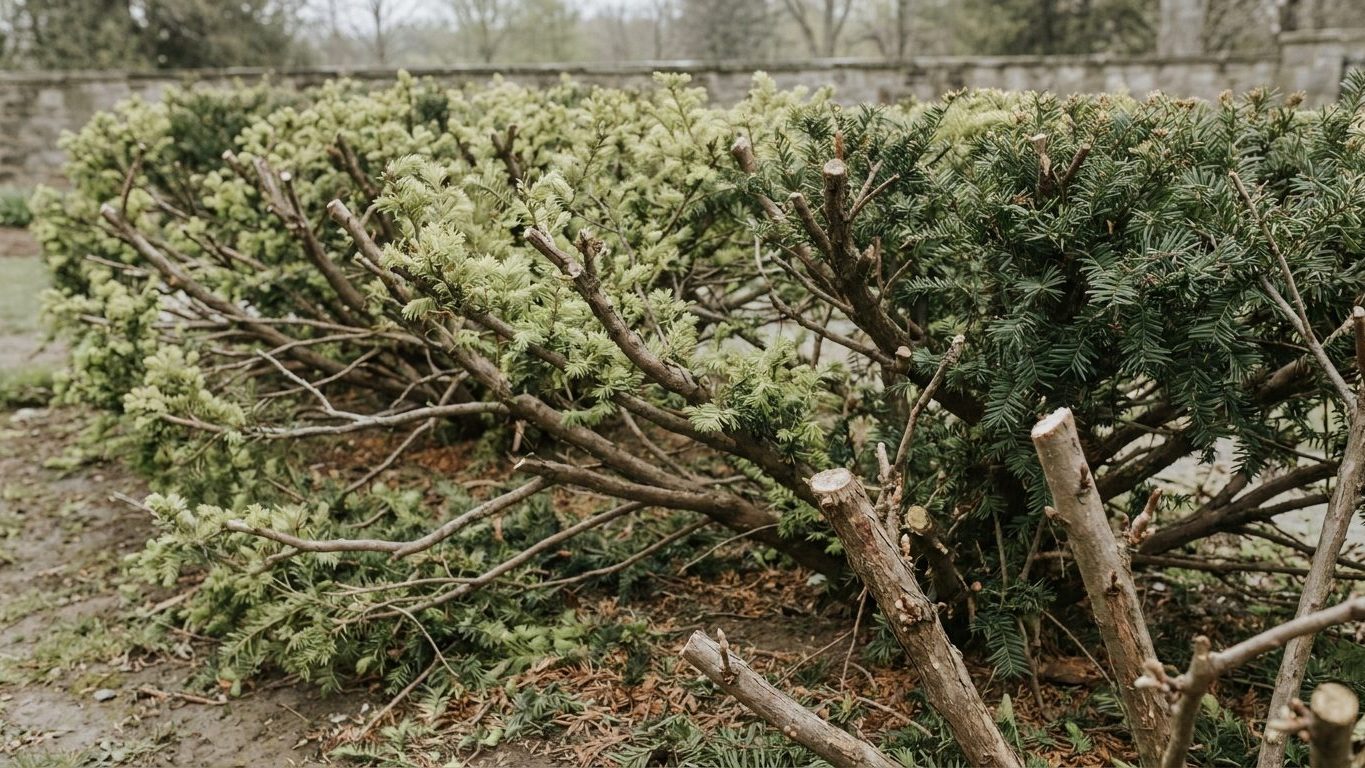

Yew takes pruning in late spring, once the season’s new growth has firmed up and lost its soft, pale color. That single detail decides everything else on this page: how far back you can cut, how a bald hedge comes back, and why a plant that looks dead after a hard cut usually isn’t.
When to prune yew
The window isn’t a date on a calendar. It’s a signal the plant gives off. Once the spring flush of new needles has hardened, meaning the bright yellow-green tips have darkened and stiffened into mature foliage, the plant has finished its main growth push for the season and has energy left to seal a cut. Prune before that point and you’re cutting into soft tissue that hasn’t built up the resin and bark structure it needs to close cleanly. Prune well after it, heading into fall, and the cut sits open through winter with no fresh growth left to cover it before cold weather sets in.
That’s the mechanism behind the timing, and it’s why extension horticulturists talk about a stage of growth rather than a month. A yew in coastal Virginia hardens its spring flush weeks before one in Vermont. Both are in the same window relative to their own growing season, just not the same week on paper.
Why the timing changes the outcome
A cut made right as the hardened flush appears gets covered fast. New buds along the cut edge push out sideways growth within a few weeks, and by midsummer the pruning line has already started to disappear under fresh foliage. That’s the whole goal with a formal hedge: cuts that vanish instead of sitting there as a visible scar all season.
Cut in September or October instead, after growth has stopped for the year, and there’s nothing left to cover the wound. The plant sits with an open cut through freezing temperatures, snow load, and whatever winter throws at it, with no active growth to protect the tissue underneath. It’s not usually fatal on its own, but it’s a needless risk on a plant that would heal fine if the timing shifted a few weeks earlier.
Yew grows at a modest 6 to 12 inches a year, so a hedge kept in shape with one late-spring cut rarely needs a second pass. Faster growers demand a midsummer touch-up. Yew mostly doesn’t, which is one more reason to get the single cut right rather than plan around multiple sessions.
How hard you can cut it back
This is where yew breaks from almost everything else in the conifer world, and it’s worth being direct about it: yew regrows from bare, brown wood that has no green needles left on it at all. Most needled evergreens (spruce, fir, most junipers) can’t do this. Cut them back past their green growth and that branch is done for good, permanently bare. Yew carries dormant buds tucked under the bark along its older wood, and those buds wake up and push new shoots even from a stump that looks completely dead.
That single trait is why yew is the go-to answer for a hedge that’s gotten away from someone. A row of yew that’s ballooned to twice its intended width, or grown leggy and thin after years of light shearing, can be brought back hard. A boxwood or arborvitae in the same state usually can’t.
The renovation sequence
The method that extension horticulturists recommend spreads the hard cutting over more than one season, so the plant isn’t stripped of all its foliage at once and left with nothing to photosynthesize with.
- Season one: cut one face of the hedge back hard, all the way to old wood if needed, while leaving the other side and the top mostly intact so the plant still has enough green growth to function.
- Growing season that follows: let that cut side push new shoots from the dormant buds along the bare wood, without touching it again.
- Season two: once the first side has filled back in with fresh growth, cut the second face back hard the same way.
- Season three, if needed: bring the top down to its final height once both sides have recovered enough foliage to support the plant.
Skipping that staging and cutting a badly overgrown hedge to bare wood on every side in a single pass isn’t usually fatal, but it costs the plant a full season or more of bare, twiggy appearance while it tries to regrow foliage everywhere at once with none left to draw on. Splitting the job over two to three seasons keeps the hedge functional and green throughout the process instead of leaving it looking abandoned in the yard.
The shape that keeps the bottom alive
A hedge sheared with straight vertical sides, or worse, sides that lean inward toward the top, shades its own lower branches all summer. Needles need light to stay alive, and a bottom branch sitting in permanent shadow from the growth above it eventually stops producing foliage altogether. That’s the mechanism behind a hedge that’s gone bald at the base while the top stays thick and green, and it’s one of the most common complaints extension offices field about overgrown hedges.
The fix is a taper. Cut the hedge so it’s noticeably wider at the base than at the top, roughly in an A-frame profile rather than a straight-sided box. A hedge that’s a couple feet wider at ground level than at its crown lets sunlight reach the lower branches at an angle all season, which keeps them producing foliage instead of thinning out and going bare.
How much to take off at once
Even with the right shape, there’s a limit to how much foliage should come off in a single pruning. The standard guideline is the one-third rule: never remove more than about a third of the plant’s total green growth in one session. Yew tolerates far more than that when it’s a planned, staged renovation cutting into old bare wood over multiple seasons, as described above. But for routine shaping cuts into live foliage, going past that third at once strips more leaf surface than the plant can recover from quickly, slowing its ability to rebuild and leaving it thin and stressed for the following year.
Combine the taper with that limit and a hedge stays full from ground to crown for the growth height it’s suited to, generally somewhere in the 3 to 8 foot range as a maintained hedge.
What actually kills yew
Pruning habits don’t usually kill this plant outright. What does is root rot in wet, poorly drained ground, the single most common cause of death in yew according to university extension horticulture guidance. Yew tolerates a lot: shade, dry spells, hard pruning. What it doesn’t tolerate is standing water around its roots for extended stretches, which suffocates root tissue and opens the door to the fungal pathogens that cause the rot.
A dense, unthinned hedge makes that worse. Foliage packed tight against itself holds moisture on branches and at the soil line longer after rain or irrigation, creating the damp conditions fungal disease needs to take hold and spread. Opening up a hedge through routine pruning, including the staged renovation and taper described above, lets air move through the plant and dries foliage faster, which is a real disease-prevention benefit on top of the cosmetic one.
One more fact worth knowing before planting or pruning near livestock: all parts of yew are toxic to livestock and horses. Clippings left where animals can reach them, including over a fence line into a pasture, present a real hazard and should be cleared away rather than left in a pile. For a planting or pruning date specific to a local frost pattern, checking with a state land-grant extension office such as Penn State Extension is the reliable way to confirm timing for a given area.
Common questions
Can yew be cut back to bare stumps and still recover?
Yes, because it carries dormant buds under the bark of its older wood. A hard renovation cut into bare brown wood typically pushes new green shoots within the following growing season, something most needled conifers can’t do.
What happens if yew is pruned too late in the year?
A cut made after the growing season has ended leaves an open wound with no new growth left to cover it before winter. It’s not usually fatal, but it’s an avoidable risk compared to pruning once the spring flush has hardened off.
Why is the bottom of my yew hedge thinning out?
Straight or inward-leaning sides shade the lower branches all season, and needles that don’t get light eventually stop growing. Tapering the hedge wider at the base than the top lets light reach the bottom and keeps it filled in.
Does yew need well-drained soil?
Yes. Root rot in wet ground is the leading cause of death for this species, and it matters more than pruning habits do. Sites that hold water after rain aren’t a good match for yew regardless of how it’s pruned.