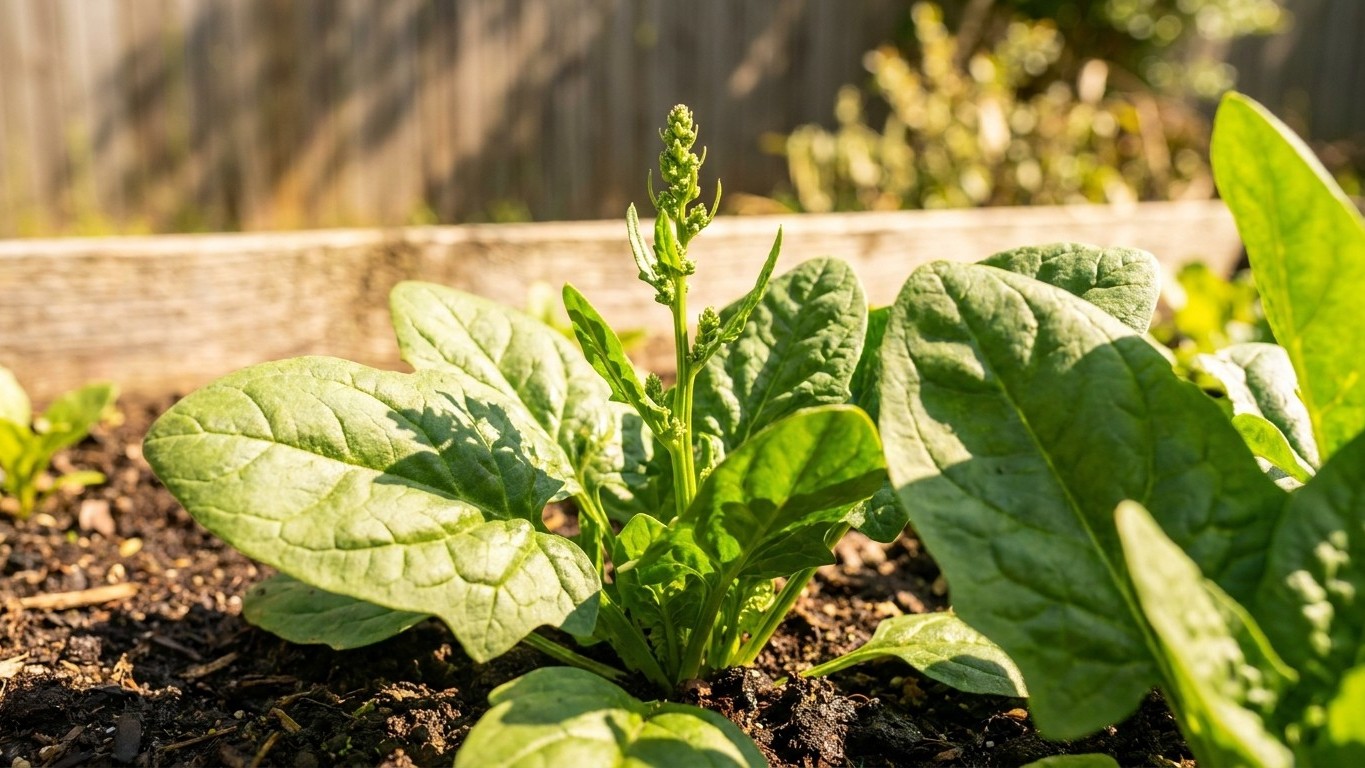

Grasshoppers are the only documented pest in Iowa that actually treats spinach leaves as food. Iowa State University Extension tracks nine garden and landscape insects for the state, and eight of them belong to other plants entirely: irises, lilies, squash vines, tree fruit. Spinach’s real threat on most seasons isn’t an insect at all. It’s the plant’s own bolting clock, which can end the harvest before any bug shows up.
Which pests attack spinach in Iowa
Iowa State University Extension documents nine insects for Iowa gardens: Common stalk borer, Grasshoppers, Iris borer (Macronoctua onusta), Japanese beetle (Popillia japonica), Lily leaf beetle, Spotted cucumber beetle, Squash bug, Squash vine borer, and Striped cucumber beetle. That’s the full list this service publishes here, and it isn’t padded out for this page.
Most of that roster has nothing to do with a spinach bed. Iris borer feeds exclusively on iris rhizomes and foliage. Lily leaf beetle is a lily specialist, full stop. Squash bug, squash vine borer, and striped cucumber beetle all target cucurbit vines, squash, cucumbers, melons, with mouthparts and life cycles built around those hosts. Spotted cucumber beetle leans the same direction, favoring cucurbit foliage and blossoms over a thin-leafed green like spinach. Common stalk borer tunnels into thick, pithy stalks, corn, giant ragweed, coarse-stemmed vegetables, and spinach’s slender leaf stems simply don’t offer that kind of tunnel. Japanese beetle skeletonizes foliage on roses, grapes, and fruit trees during its summer flight, a window that mostly falls outside spinach’s cool-season growing dates.
That leaves grasshoppers. They’re generalist feeders, meaning they’ll chew on almost any green leaf in reach, spinach included, rather than specializing on one plant family the way the other eight species do. That’s the mechanical reason grasshoppers make this list and the rest don’t: host range. A pest that only eats iris rhizomes can’t damage a spinach leaf no matter how close the two plants sit in the same garden bed.
None of this means a spinach patch in Iowa is pest-free by default. It means that when something is chewing on spinach leaves specifically, and the damage looks like feeding rather than disease or environmental stress, grasshoppers are the pest this service documents for the state that fits the pattern. Everything else on the list belongs to a different plant, in a different part of the yard.
When each one shows up, and what it does first
Spinach in Iowa runs on two windows, and grasshopper pressure lines up with them unevenly. A spring crop typically goes in right after the last spring frost, April 12 to April 24 at the reference station, and needs to finish before the days grow long and hot enough to trigger bolting. Grasshopper nymphs are still small and scattered early in that window, so a spring spinach crop often gets harvested and cleared before populations build to anything noticeable. The first visible problem in a spring planting is more often the plant itself: leaves that go from broad and tender to narrow, pointed, and bitter as the season turns.
The fall window works differently, and it’s where grasshoppers matter more. Spinach seed needs to go into soil that has cooled, since germination drops once soil runs above 80°F, and the source recommends planting 50 to 75 days before the date you want to harvest. Counting back from the first fall frost, October 14 to October 25, that sowing window falls squarely in late summer, the same stretch when grasshopper numbers are typically at their highest for the year and stay active right up until a killing frost ends them.
What that means for a fall bed: young seedlings and early true leaves are what’s exposed to the heaviest grasshopper pressure a spinach crop in Iowa is likely to see. The first sign isn’t usually a full skeletonized leaf. It’s ragged notches along the leaf margin, irregular holes chewed inward from the edge, and sometimes a seedling stripped down before it has more than two or three true leaves. Heavier populations move to full leaf area, leaving lace-like skeletonizing when pressure is high and the planting is small enough that a few insects can do visible damage fast.
Spring plantings, by contrast, more often finish or bolt before grasshopper numbers reach that late-summer peak, which is part of why the two windows produce such different pest experiences on the same plant in the same yard.
Telling the damage apart from everything else
Spinach fails for reasons that have nothing to do with insects far more often than gardeners expect, and grasshopper feeding gets blamed for some of it. The clearest tell for insect chewing is the shape of the damage: ragged, irregular holes and notched margins, versus the smoother, more uniform changes that heat, water stress, or disease produce.
Bolting is the biggest source of confusion because it changes the leaf itself. Spinach grows best where temperatures stay under 75°F, and that same number is the point where leaves start turning bitter and tough as the plant shifts into flowering. That’s a heat and day-length response, not chewing, and it shows up as narrower, more pointed new leaves and a central stalk elongating upward, not as holes.
| What you see | Likely cause | What sets it apart |
|---|---|---|
| Ragged holes, chewed leaf margins | Insect feeding, grasshoppers included | Irregular edges, uneven bite marks, often worse near the leaf edge inward |
| Leaves turning narrow, pointed, bitter | Bolting from heat or long days | No holes, plant sends up a central seed stalk |
| Yellowing between leaf veins | Nutrient deficiency | Uniform, spreads evenly, no chew marks or holes |
| Wilting, crisp browning at edges | Water stress or heat scorch | Affects whole leaf, not isolated to bite-shaped gaps |
| Irregular holes with slime trails | Slugs, not insects | Silvery slime residue, damage worse after rain or overnight |
Any of these can overlap in a single bed, which is exactly why a table like this only narrows the possibilities. It doesn’t replace a look from someone trained to tell them apart. A county extension office can examine a sample or a clear photo and rule in or out what a general symptom list can’t settle on its own.
What actually works here, and what is a waste of time
Given how short Iowa’s spinach windows already are, the calendar does more work than any product would. The single most useful move is timing the fall sowing so seedlings aren’t emerging right at the peak of late-summer grasshopper activity, since young plants with only a few leaves take proportionally more damage from the same number of insects than an established bed does. Where that timing can’t be adjusted, a physical barrier, floating row cover laid over the bed at seeding and secured at the edges, keeps grasshoppers off without needing any product decision at all.
Removing tall grass and weedy margins around the bed also helps, since that’s where grasshopper egg-laying and early nymph development happen; a cleaner border gives them fewer places to build up before moving into the vegetables.
What doesn’t help: watering more, which does nothing to grasshopper numbers and can actually worsen disease pressure on spinach foliage. Trying to wait out bolting by planting later in spring doesn’t work either, since day length and heat rise together regardless of when seed goes in, and a later spring planting just meets that ceiling with a shorter harvest window, not a longer one. And reaching for a pesticide without checking what’s registered for a home vegetable garden in Iowa isn’t a shortcut worth taking. Product choice, timing, and rates for anything applied to a food crop are exactly the kind of decision a county extension office is equipped to walk through, and this isn’t the place to guess at that answer.
Where to check this for your own county
Everything above comes from Iowa State University Extension, and it’s a statewide list, not a household one. A pest documented for Iowa doesn’t mean it’s present in every county, or every garden, in the same numbers, and a state-level list can’t tell a gardener what’s actually feeding on the spinach in front of them.
The county extension office is the next step for anything that doesn’t match cleanly to the symptoms above, or for confirming which of the causes in that table actually fits a specific bed. Most Iowa counties have a Iowa State University Extension office that takes questions directly, and many accept a photo or a physical sample for a closer look than a general guide can offer.
That local check matters more for a fast-moving crop like spinach than it would for something that sits in the ground for months. With a harvest window measured in weeks rather than a full season, there’s little room to guess wrong and try again. A quick call or a dropped-off sample early, while the bed still has time left in it, is worth more than waiting to see how the damage plays out.
Common questions
Do Japanese beetles eat spinach in Iowa?
Iowa State University Extension documents Japanese beetle for the state, but it favors roses, grapes, and tree fruit foliage, and its main flight period falls outside spinach’s cool-season growing windows. It isn’t the pest to look for on spinach leaves specifically.
Why does my spinach look chewed but I don’t see any bugs?
Grasshoppers feed and move on, and slugs feed mostly overnight, so the insect responsible is often gone by the time the damage is noticed. Check for a slime trail to rule slugs in or out, and look at the shape of the holes; ragged and irregular points to feeding rather than disease.
Is bolting spinach a pest problem?
No. Bolting is triggered by long days and by temperatures pushing past 75°F, and it shows up as narrower, more pointed leaves and a rising seed stalk, not chewed foliage. It’s a plant response, not insect damage.
When should fall spinach go in the ground in Iowa?
The source recommends sowing 50 to 75 days before the target harvest date, timed against soil that has cooled enough for germination, since germination drops once soil runs above 80°F. Counting back from the first fall frost, October 14 to October 25, sets that sowing window in late summer.