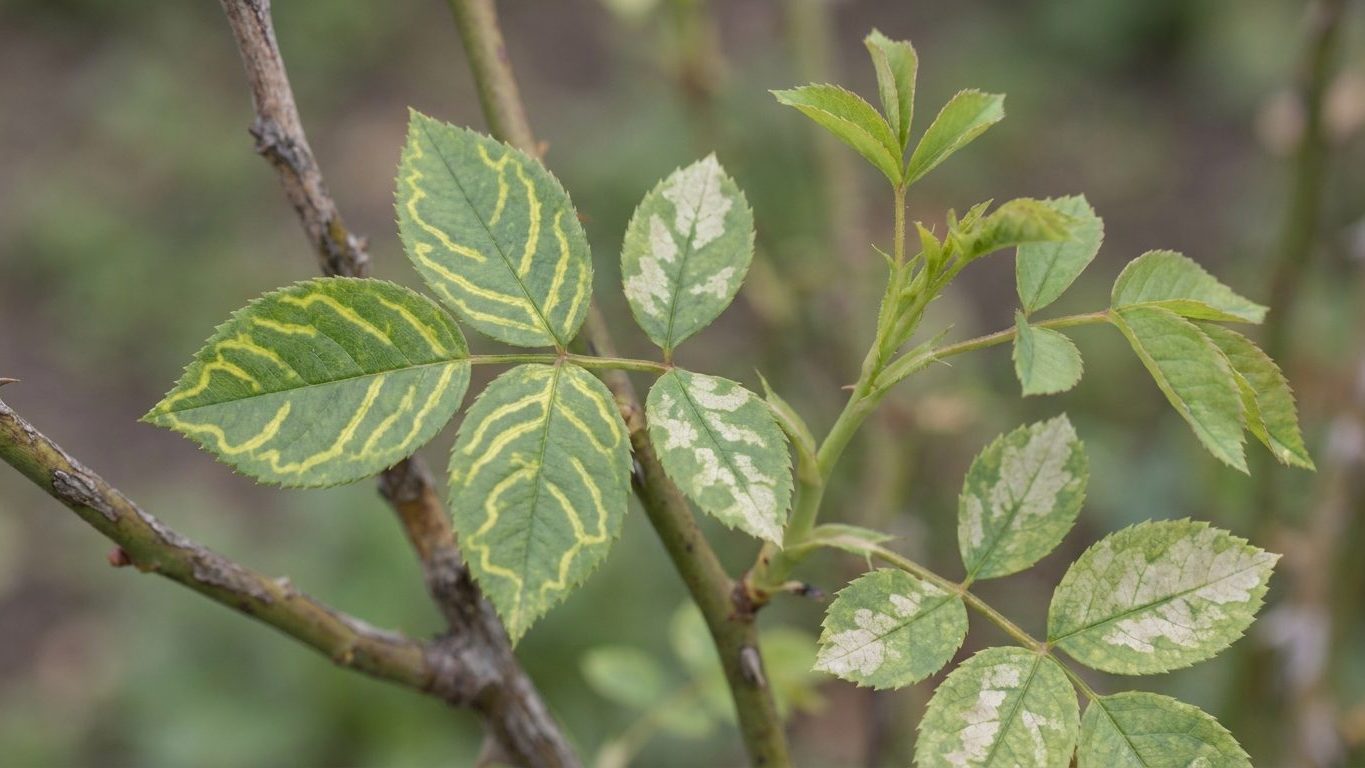

Yellow line patterns, wavy mottling, or oak-leaf shapes stamped across rose foliage usually mean rose mosaic virus. It’s not something that developed in your yard this year. It came grafted or budded into the plant at the nursery, and no spray or soil treatment will remove it now. The good news: it rarely kills a rose outright.
What you are looking at
This is not an emergency, and it does not spread further through your rose bed this season the way a fungus would. The virus is already fixed in the plant’s tissue, expressed through the leaves rather than advancing across a bed. What changes from week to week is not the infection itself but how visible it is, since temperature swings turn the pattern on and off like a switch.
Wavy yellow line patterns
The clearest sign is a bright yellow line, often wavy or zigzagged, running along or between the leaf veins. It looks etched rather than blotchy, with a hard edge instead of a fading halo. New growth in spring usually shows it first and most sharply, on the older, established canes as much as on young shoots.
Oak-leaf mottling
A second pattern resembles the lobed outline of an oak leaf stamped in pale yellow onto the green leaflet. It can appear on the same plant as the line pattern, sometimes on the same leaf, and it does not follow any single vein. That randomness is part of what separates it from a nutrient problem, which tends to follow a consistent vein-to-margin logic leaf after leaf.
Chlorotic ring and mosaic mottling
A third form shows up as pale rings or blotchy mosaic mottling scattered across the leaflet surface, sometimes described as a mosaic of light and dark green patches rather than a distinct line. Flowers and canes on an infected plant usually look otherwise normal, though vigor and winter hardiness can be reduced over time.
Seasonal masking
Symptoms are most visible on the cool, tender flush of spring growth and often fade or disappear once summer heat sets in, only to return the following spring. A rose that looked clean in July can show the same yellow lines again in April. That masking, not a cure, is why some gardeners think the problem went away.
What it is not
Three conditions get mistaken for rose mosaic virus often enough that the mix-up is worth walking through, because the fix for one does nothing for another and can waste a season chasing the wrong cause.
Iron deficiency chlorosis
Iron deficiency produces yellowing between the veins while the veins themselves stay distinctly green, usually starting on the newest leaves at the shoot tips and spreading evenly across the whole leaflet rather than in a line or ring pattern. It responds to a soil pH correction or iron chelate application within a few weeks. Rose mosaic virus symptoms do not fade with any fertilizer or soil amendment, because there is no nutrient shortfall to correct. Treating a virus-infected plant with iron supplements just delays the real diagnosis.
Herbicide drift damage
Drift from a broadleaf herbicide applied nearby, even days earlier and yards away, twists new leaves into a cupped or strapped shape and can bleach or streak them with a pattern that superficially resembles mosaic yellowing. The giveaway is the shape of the leaf itself: herbicide damage distorts the leaf’s growth, while virus symptoms leave the leaf’s shape normal and only alter its coloring. Herbicide injury also tends to hit every broadleaf plant in the affected zone, not just the rose, and calling it a virus means overlooking a spray problem that could recur on other plants in the yard.
Spider mite stippling
Spider mites cause a fine, dusty stippling on the upper leaf surface, a speckled bronze-to-gray look rather than a clean yellow line or ring, and fine webbing is usually visible on the leaf underside on close inspection. Mite damage worsens through a hot, dry summer and responds to miticide treatment or a strong hose-down. Mosaic virus symptoms do the opposite, often fading in summer heat and returning the next spring regardless of any pest treatment applied.
Where it comes from and when it strikes
Rose mosaic disease is caused by a small group of viruses, most commonly Prunus necrotic ringspot virus and apple mosaic virus, that infect roses through the nursery propagation process rather than through anything happening in a home garden. A rootstock or budwood already carrying the virus passes it directly into every plant grafted or budded from it, which is why an entire batch from one propagation run can show identical symptoms.
Unlike many plant viruses, these are not spread by aphids or other sap-feeding insects moving from plant to plant in the landscape. There is no confirmed insect vector for rose mosaic virus, which is the single most important fact for understanding why it behaves so differently from an insect-borne infection. It arrives with the plant, not through the season’s weather or pest pressure.
Symptom expression, not infection, is what tracks with the weather. The line and mottling patterns show up most clearly during the cool, moderate temperatures of spring growth flushes and become harder to see once sustained summer heat arrives, then return with the next spring flush. That cycle repeats year after year in an infected plant, since the virus itself never leaves the tissue once established.
What to do about it now
There is no cure for rose mosaic virus once a plant is infected, and no fungicide, insecticide, or soil drench changes that. Saying so plainly matters more than offering a false fix, because a gardener who keeps spraying a virus-infected rose is spending money and time on something that cannot work.
Removal is a judgment call rather than a requirement. Because the disease is rarely fatal and does not spread to neighboring roses through insects or soil contact, many infected plants can simply stay in the landscape for years, sometimes their whole lives, with reduced vigor and a slightly weaker tolerance for hard winters but without collapsing. Cutting flowers for indoor arrangements is entirely fine, and if the rose sets hips, those are unaffected for tea or garnish use; the virus lives in leaf and stem tissue and creates no food safety concern.
The one thing worth stopping immediately is propagation. Do not take cuttings or budwood from a plant showing these symptoms to start new roses, since that directly transmits the virus into the new plant, the same pathway that caused the original infection at the nursery. General garden hygiene, like disinfecting pruning shears between plants, is good practice but is not the primary route this particular virus travels, so it will not by itself prevent spread the way it does for many fungal and bacterial diseases.
Improving the plant’s overall vigor through consistent watering, balanced fertilizing, and good sun exposure won’t remove the virus, but it does help an infected rose perform closer to its potential and tolerate winter stress better, since the plant is fighting a permanent low-grade drain on its resources.
Keeping it out next season
Because rose mosaic virus is not soil-borne, crop rotation and soil treatments that work against fungal pathogens have no bearing here. The entire prevention strategy comes down to the source of the plant material rather than anything in the garden bed itself.
The single most effective step is buying certified virus-indexed rose stock from nurseries that test their propagation material through recognized certification programs designed to screen out these viruses before budding and grafting. That certification, when available on the tag or in the catalogue description, is worth more than any in-garden practice, since it addresses the disease at its actual entry point.
There is no genetic resistance to look for here the way there is with some fungal rose diseases; this is not a trait bred into specific cultivars, so no letter code on a plant tag marks resistance to it. Symptom visibility does vary by variety, with some roses expressing the yellow patterns strongly and others carrying the same virus with barely noticeable symptoms, but that variation reflects how the plant displays the infection, not whether it resists catching it.
Sanitizing grafting tools between plants during any home propagation attempt, sourcing budwood only from tested, certified stock, and avoiding cuttings from any rose showing line patterns or mottling are the practical habits that keep the virus out of new plants going forward.
Common questions
Will rose mosaic virus kill my rose?
Rarely. Most infected roses live for years with reduced vigor and somewhat weaker winter hardiness, but outright death from the virus alone is uncommon.
Can rose mosaic virus spread to other plants in my garden?
Not through insects or soil contact, since no insect vector has been confirmed for this virus in roses. The real risk is propagation, taking cuttings or budwood from an infected plant to start a new one.
Should I remove a rose with mosaic virus?
Only if you choose to, based on how much the reduced vigor and cosmetic yellowing bother you. It’s a preference decision, not a plant-health emergency requiring removal.
Can I still use flowers or hips from an infected rose?
Yes. The virus affects leaf and stem tissue and creates no food safety concern for cut flowers or hips harvested for tea or garnish.