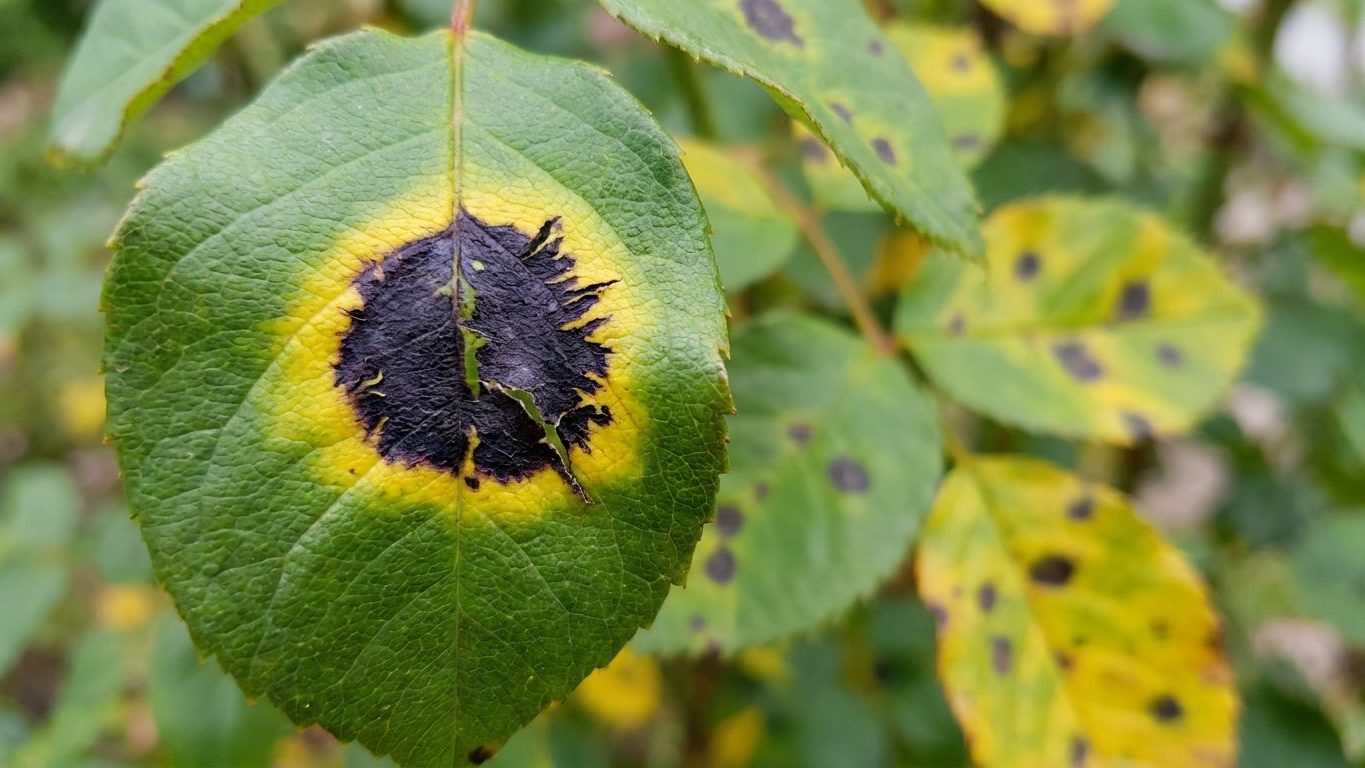

That feathered, almost sooty-edged black circle on a rose leaf is black spot, caused by the fungus Diplocarpon rosae. It’s serious in the sense that it weakens the plant year after year and strips leaves from the bottom up, but it rarely kills a rose outright. Left alone, it just gets worse every season.
What you are looking at
Black spot moves at a walking pace, not a sprint. A single infected leaf can go from a pinpoint speck to full yellowing and drop in seven to ten days, but it takes weeks of repeated infection cycles for a whole bush to look ragged. The lesions start small and multiply outward across the plant rather than exploding overnight the way some fungal blights do.
The lesion itself
Look for a circular, black to purplish-black spot on the upper surface of the leaflet, usually a quarter inch to half an inch across. The edge is not smooth. Under a hand lens it looks torn or fringed, like the fibers have been pulled outward from the center, which is the single most reliable field mark for this disease.
The yellow halo
A ring of yellow tissue often surrounds the black lesion before the rest of the leaf turns color. That halo is the plant’s own chlorophyll breaking down around the infection site, and it’s usually visible before the leaflet as a whole goes uniformly yellow.
Leaf drop pattern
Lower, older leaves go first, since they’ve been exposed to splashing water the longest. Defoliation then climbs the cane toward the newer growth at the top. A rose that’s lost its bottom third of foliage while the crown still looks green and healthy is showing textbook black spot progression.
Canes and stems
Canes themselves are rarely spotted the way leaves are, though heavily infected plants sometimes show dark, slightly raised blotches on young green stems. Flowers and hips are not directly attacked by this fungus, which is a useful distinction from diseases that move into stems and fruit.
What it is not
Three other rose problems get mistaken for black spot often enough that a wrong guess leads to the wrong treatment, and the wrong treatment wastes a season.
Downy mildew
Downy mildew lesions are angular, not circular, because they’re bounded by the leaf veins rather than spreading outward in a round pattern. Color runs purplish-red to dark brown, and there’s no feathered fringe at all, just a clean vein-bounded edge. The giveaway is on the underside of the leaf on a cool, damp morning: a grayish, almost fuzzy sporulation layer that black spot never produces. Downy mildew is also far faster. It can strip an entire bush of foliage within days rather than weeks, and because it’s caused by an oomycete rather than a true fungus, standard black spot fungicides often don’t touch it. Treating a downy mildew outbreak on a black spot schedule means losing the plant’s leaves while you wait for a product that was never going to work.
Cercospora leaf spot
Cercospora spots are smaller, usually pinhead to eighth-inch size, with tan or gray centers and a narrow dark reddish-purple border. The edge is smooth and defined, not feathered, and the yellow halo that surrounds black spot lesions is usually faint or absent here. Cercospora is more of a cosmetic nuisance on most garden roses; it rarely causes the aggressive defoliation black spot does, so spraying a full fungicide rotation for it is often more effort than the problem deserves.
Anthracnose
Anthracnose starts as small reddish-purple spots that later develop tan or gray centers, and as the disease progresses those centers can dry out and fall away entirely, leaving a shot-hole appearance in the leaf. The margin stays angular and sharp rather than fringed. Anthracnose can also form small sunken cankers directly on canes, something true black spot essentially never does. Mistaking cane cankers for black spot means missing the pruning cuts that would actually stop the spread.
Where it comes from and when it strikes
Diplocarpon rosae overwinters in fallen leaves left on the ground and in lesions on infected canes. Come spring, spores form on that old infected tissue and are splashed onto new leaves by rain or overhead irrigation, not carried on the wind over long distances the way some other fungal diseases travel. That makes black spot a local, splash-driven problem rather than something that blows in from a neighbor’s yard miles away.
Infection needs the leaf surface to stay wet for an extended stretch, generally described in plant pathology as several consecutive hours of continuous moisture, paired with warm, humid conditions. A rose that gets watered at the base early in the day and dries off by mid-morning has far fewer infection windows than one that sits damp under overhead sprinklers or in a shaded, still corner of the yard with poor air movement. Once temperatures warm into the growing season and humidity stays high, repeated infection cycles can occur every couple of weeks as long as wet foliage keeps happening.
What to do about it now
Pick up and destroy every fallen leaf around the base of the plant, and don’t put them in the compost pile. That single step removes a huge share of next season’s spore source, since the fungus survives right there in the dead tissue over winter.
Prune out any canes with visible lesions, and open up the center of the bush so air moves through it. Stagnant, humid air inside a dense rose is exactly what this fungus wants. Switch from overhead watering to drip or soaker hoses at the base of the plant, and if you must use a sprinkler, run it early enough that leaves dry well before evening.
A layer of mulch two to three inches deep under the plant acts as a physical splash barrier, catching rain before it bounces spore-laden soil and debris up onto the lowest leaves. Fungicide programs using products such as chlorothalonil, myclobutanil, or sulfur-based sprays protect new, uninfected growth going forward, but they won’t reverse the black spots already on a leaf. That leaf is going to drop regardless. The honest expectation is damage control on future growth, not a cure for what’s already there.
If your rose produces hips you plan to use, the fungus stays confined to leaf and occasionally stem tissue and doesn’t move into the hips themselves, so hips from an otherwise black-spotted plant are still fine to harvest. A heavily defoliated bush will simply produce fewer of them.
Keeping it out next season
Roses are perennial, so classic crop rotation doesn’t apply, but sanitation does the same job over time. Clear fallen leaves every fall without exception, refresh mulch each spring, and sanitize pruners between cuts on different plants so you’re not moving infected tissue from a sick bush to a healthy one.
Cultivar choice matters more here than almost any other single decision. Shrub roses bred specifically for disease resistance, including the Knock Out series and its relatives, along with many rugosa types and a number of David Austin English roses, hold up noticeably better against black spot pressure than older hybrid tea lines. Two catalogue-level credentials worth checking on a plant tag are the ADR rating from Germany’s rose trial system, which certifies varieties for disease tolerance under field conditions, and the Earth-Kind designation from Texas A&M AgriLife Extension, which is awarded to roses that perform well with minimal fungicide input.
Space new plantings for airflow rather than crowding them for a fuller look in year one, and buy bare-root or container stock from reputable nurseries, inspecting canes for existing lesions or cankers before you plant. A clean start does more for the next several seasons than any spray schedule applied after the fact.
Common questions
Does black spot kill a rose?
Rarely on its own. It weakens the plant through repeated defoliation, reducing vigor, bloom, and winter hardiness over successive seasons, but a mature rose usually survives even a bad infection year if the underlying disease pressure is eventually managed.
Can I still use rose hips from an infected plant?
Yes. The fungus stays confined to leaf tissue and occasionally young stems; it doesn’t infect the hips, so they remain fine to use even on a bush that’s lost a lot of its leaves.
How long do the spores survive in fallen leaves?
The fungus overwinters in leaf litter and infected canes and remains viable through the dormant season, which is exactly why removing and destroying fallen leaves each fall is the single most effective sanitation step available.
Can black spot spread from my roses to tomatoes or apple trees?
No. Diplocarpon rosae is specific to roses. Other plants have their own distinct fungal diseases that produce superficially similar dark spots, such as apple scab, caused by an entirely different fungus, but there’s no cross-infection between roses and unrelated garden or orchard plants.