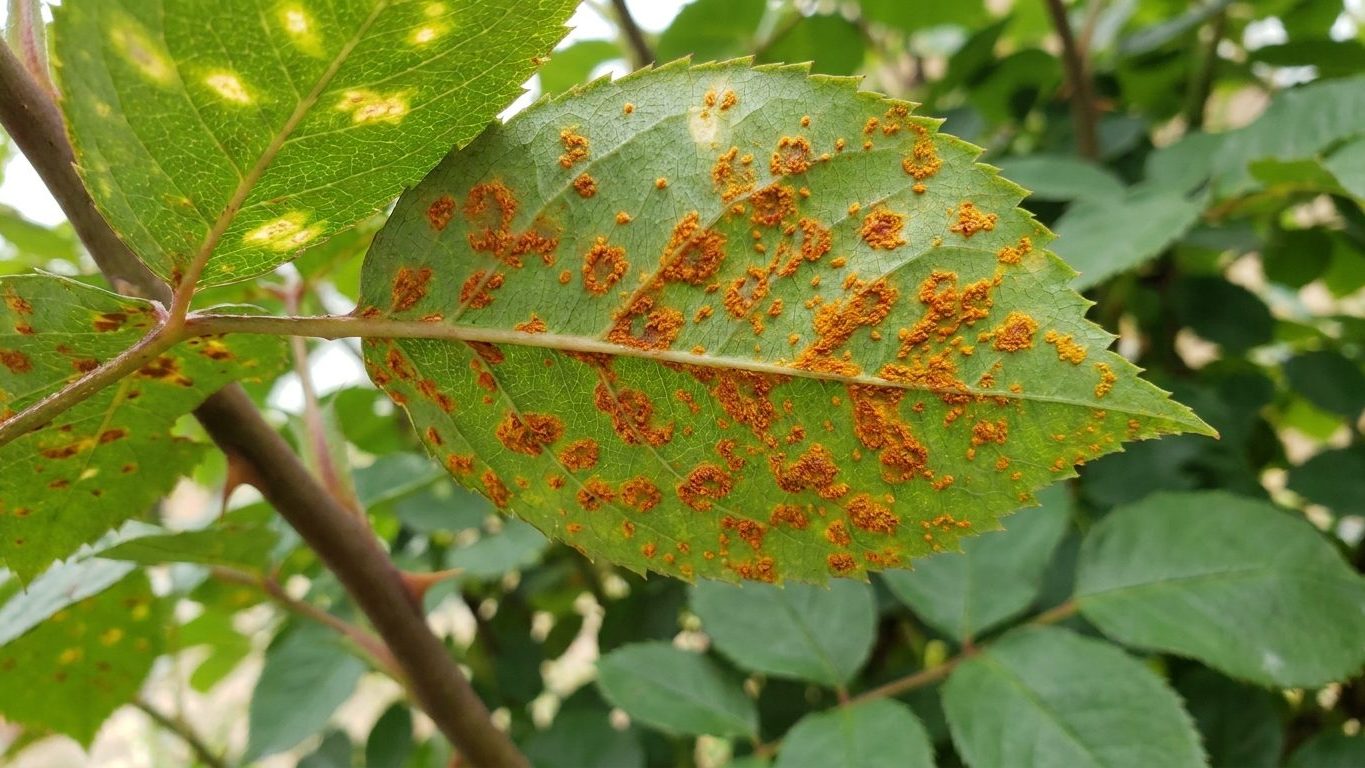

Orange dust on the underside of a rose leaf, arranged in tidy rings or scattered clusters, is rose rust. It’s a fungal disease, and it means the plant is under real stress but not necessarily dying. Left alone, it weakens the bush over a season or two by stripping leaves early; it rarely kills a mature rose outright.
What you are looking at
Rose rust moves fast in the sense that it produces spores within days once conditions favor it, but it moves slowly in the sense that a single infection won’t take down a bush in a week. The disease starts low, usually on the oldest leaves near the base of the plant, and works upward as spores splash and blow onto new growth. That upward progression is one of the clues that separates rust from several other rose problems.
Orange pustules on the leaf underside
Flip a suspect leaf over and look for small, raised bumps in orange to bright rust-red, often arranged in a rough ring or scattered in patches. Each pustule is a cluster of spores breaking through the leaf tissue, and they feel slightly rough or powdery if you rub a finger across them. On the top side of the same leaf, you’ll usually see a matching yellow or pale spot directly above each pustule cluster.
Yellow spotting on the upper leaf surface
Before the orange pustules are obvious, the top of the leaf develops small yellow or chlorotic spots that look almost like nutrient deficiency. This stage is easy to miss because it doesn’t scream disease. The giveaway is checking the underside for the matching orange dust; nutrient deficiencies don’t produce that.
Late-season black or dark pustules
As the season winds down, some pustules turn black or dark brown. This is the overwintering stage of the fungus, and it means spores are being produced that can survive through winter on fallen leaves and canes. Stems generally stay firm and unaffected; rust is a leaf disease first, and it rarely shows on the canes or affects the blooms directly, though a heavily infected bush may produce fewer, smaller flowers.
What it is not
Three other rose problems get confused with rust often enough that misdiagnosis is common, and each mistake leads a gardener down the wrong path, sometimes wasting a season of effort or, worse, missing something that spreads to other plants.
Black spot
Black spot produces circular black lesions with feathered, irregular edges on the top of the leaf, usually surrounded by a yellow halo. There’s no orange dust on the underside, ever. The confusion happens because both diseases cause yellowing and leaf drop, but black spot lesions are dark and fringed, not orange and raised. Treating black spot as rust means using the wrong timing for removal and possibly the wrong fungicide class, since some products target one organism better than the other.
Powdery mildew
Powdery mildew coats leaves, buds, and sometimes stems with a white to gray powdery film, most visible on new growth and often worse in shaded or crowded plantings. It sits on top of the tissue rather than erupting from beneath it, and there’s no ring pattern. Mistaking mildew for rust matters because mildew responds well to improved airflow and light pruning, while rust needs the infected leaves physically removed to cut down spore load.
Spider mite damage
Spider mites cause a stippled, bronzy or bleached look across the leaf surface, and fine webbing shows up on the underside and between leaflets under heavy infestation. There are no pustules, orange or otherwise, just tiny moving dots if you tap a leaf over white paper. Treating mite damage as a fungal disease means reaching for a fungicide that does nothing against an arachnid, while the actual mite population keeps building.
Where it comes from and when it strikes
Phragmidium species are the fungi behind rose rust, and they survive winter as tough, dark spores on fallen leaves, infected canes, and plant debris left in the bed. Come spring, those spores release and splash up onto new leaves during wet weather, starting the next round of infection. Wind can carry spores over longer distances too, which is why rust sometimes shows up in a garden with no obvious source nearby.
The fungus needs a film of water on the leaf surface to germinate and infect, so extended leaf wetness (a heavy morning dew that doesn’t burn off, a stretch of drizzly days, overhead irrigation that keeps foliage damp overnight) is the single biggest driver of an outbreak. Mild, humid conditions favor it more than hot, dry stretches; the fungus slows down considerably once things turn hot and arid, and a hard freeze in fall knocks back the active infection, though the overwintering spores persist in debris regardless.
Once established in a garden, rust tends to return year after year because the fungus doesn’t need to be reintroduced. It’s already sitting in the mulch and the fallen leaves from last season, waiting for the right stretch of wet weather.
What to do about it now
Start by removing every infected leaf you can find and bagging or burning it rather than composting it, since home compost piles rarely get hot enough to kill the spores. This single step does more to slow the spread than anything else available to a home gardener, because it directly reduces the number of spores available to splash onto healthy tissue.
Stop overhead watering if that’s how the bed is currently irrigated, and switch to soaker hoses or drip line so foliage stays dry. Water in the morning if hand-watering is the only option, so any wet leaves dry out well before evening. Improve airflow by thinning crowded canes and giving each bush more breathing room; stagnant, humid air around dense foliage is exactly what the fungus wants.
Fungicides labeled for rust on roses can help protect new growth if applied before infection takes hold, but they won’t cure leaves that already show pustules. Once a leaf is infected, it stays infected until it drops or is removed; no product reverses that. A fungicide program is realistically a preventive tool for the rest of the season and for next year’s new growth, not a rescue for the current outbreak.
There’s no food safety concern here since roses aren’t a food crop in the way tomatoes or beans are, so the question of whether harvest is “safe to eat” doesn’t really apply. The practical question is whether the bush survives and blooms well, and a rust infection that’s caught early and managed with sanitation rarely threatens a mature, otherwise healthy rose.
Keeping it out next season
Rotation isn’t really the tool here the way it is for a vegetable bed, since roses are woody perennials that stay put, but sanitation does the equivalent job. Clear all fallen leaves and debris from around the base of every rose in fall and again in early spring before new growth pushes out, since that’s where the overwintering spores are sitting.
Some rose cultivars carry genuine resistance to rust, and catalogues and tags will sometimes note this directly, though the letter-code disease-resistance system common on tomato and pepper packets (codes like VFN) doesn’t have a standardized equivalent across rose breeders the way it does for vegetables. Check cultivar descriptions for explicit mentions of rust tolerance or resistance rather than relying on a coded shorthand.
Give plants proper spacing when planting new roses, wide enough that foliage doesn’t stay damp and shaded by neighboring bushes. Prune to open up the center of each plant, removing crossing or crowded canes so air moves through freely. A layer of mulch under the plants acts as a splash barrier, catching rain that would otherwise bounce spore-laden soil and debris up onto the lowest leaves.
Source new roses from a reputable nursery and inspect the leaves closely before buying, checking the undersides for any sign of orange pustules. An infected transplant is one of the more direct ways rust gets introduced into a garden that didn’t have it before.
Common questions
Can rose rust spread to other plants in the garden, like vegetables?
No. Phragmidium rust fungi that infect roses are host-specific to roses and their close relatives; they don’t cross over to unrelated plants like tomatoes, peppers, or ornamentals outside the rose family.
Will my rose bush die from rust?
A mature, established rose rarely dies from rust alone. The bigger risk is a weakened plant going into winter with less energy stored, which can make it more vulnerable to winter injury or other stresses the following year.
Should I remove an entire rose bush that has rust?
Usually not. Removing and destroying infected leaves, along with fallen debris, is generally enough. Full removal of the plant is rarely necessary unless the infection is severe and recurring year after year despite consistent sanitation.
Does rain wash rust spores away, or make it worse?
It makes it worse. Splashing rain and overhead water are exactly how spores move from infected debris and lower leaves up onto healthy new growth, which is why switching to drip irrigation and clearing debris matters so much.