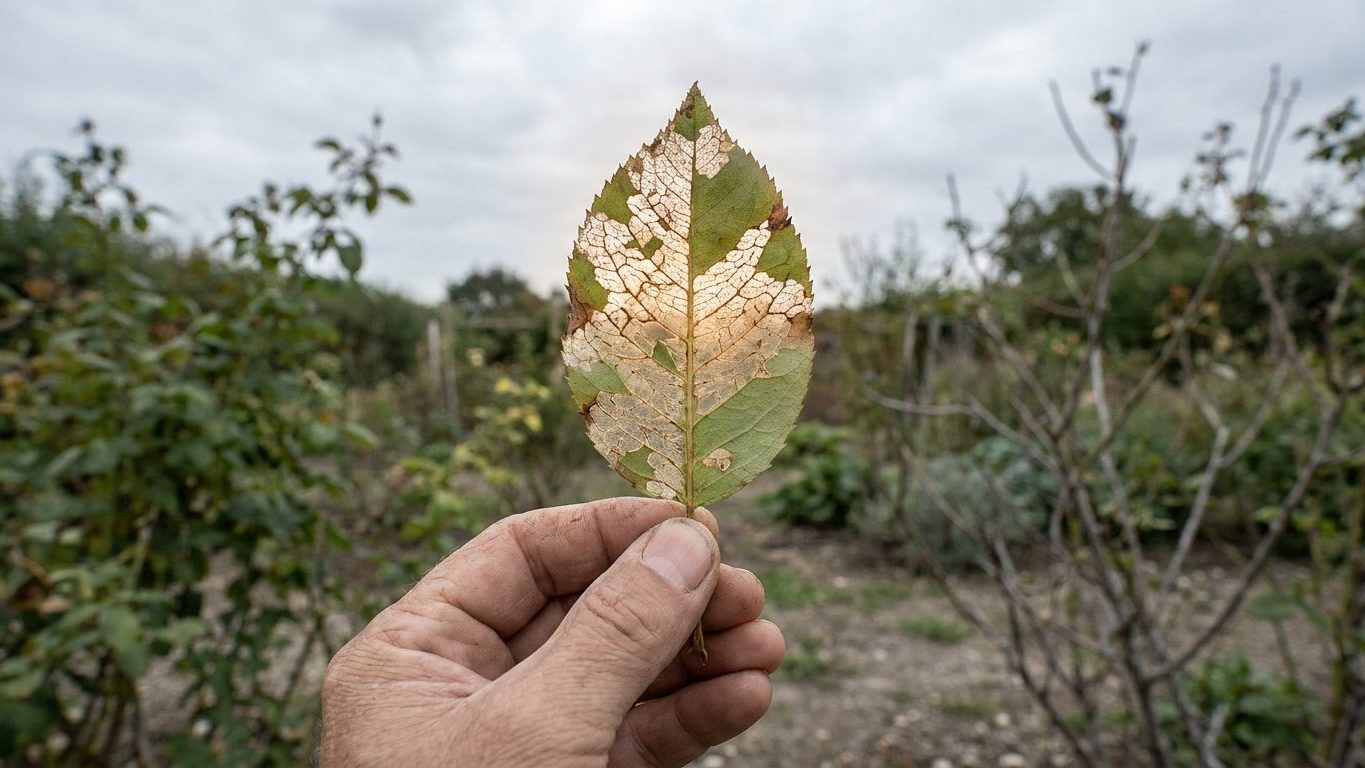

Translucent, papery patches on rose leaves that let light through like a windowpane are the calling card of roseslugs, the larvae of a small sawfly. On an established rose bush, this is almost always cosmetic damage that looks worse than it is. On a young or newly planted rose, repeated feeding can weaken the plant enough to matter, so the response depends on which situation is in front of you.
What the damage looks like
Hold a damaged leaf up to the sun before you look for the culprit. That’s the detail that separates roseslug damage from almost everything else on a rose bush: the leaf tissue between the veins has been scraped away from one side only, leaving a thin, papery layer that glows amber or pale green when backlit. Chewed holes with ragged edges mean something else is at work. A translucent “skeleton” of veins with intact tissue on the far side is the roseslug signature.
Early feeding starts on the lower leaves and on the underside of the foliage, which is why gardeners often miss it for a week or two. The larvae rasp away the green layer, leaving the upper leaf surface intact but bleached and brittle. As feeding continues, the damaged patches expand and eventually the tissue dries out and falls away, punching actual holes through leaves that were windowpanes just days earlier. On a heavily infested bush, entire lower branches can look scorched or lace-like while the top growth stays green and full.
The larvae themselves are easy to overlook. They’re small, pale green, slug-shaped, and slow-moving, usually under half an inch long, and they tend to curl along the leaf underside rather than out in the open. Despite the name, a roseslug isn’t a slug at all. It’s the larval stage of a sawfly, a wasp relative, and it has a proper head and legs if you look closely with a hand lens. No slime trail, no shell fragments, nothing that would point you toward a mollusk.
Three species show up on roses in different parts of the country, and they don’t always overlap in how they feed. The bristly roseslug skeletonizes leaves in patches, the curled rose sawfly rolls or curls leaf edges as it feeds, and the European rose sawfly (sometimes just called roseslug in the trade) does the classic window-pane skeletonizing most gardeners report. For a home garden, the distinction matters less than confirming you’re dealing with a sawfly larva at all rather than a true caterpillar or beetle.
Making sure it is this and not something else
A handful of other rose problems produce leaf damage that gets mistaken for roseslugs at a glance. The fix is almost always a close look at the larva or the feeding pattern rather than guesswork from across the yard.
Japanese beetles
Japanese beetles skeletonize leaves too, but they eat from the top down, leave both leaf surfaces chewed through (no papery window), and the adults are visible metallic green-and-copper beetles clustered on the foliage in daylight. Roseslug larvae feed mostly from below and leave one intact leaf surface behind. If you see actual beetles on the plant, that’s your answer.
True slugs and snails
Actual garden slugs and snails leave ragged holes with irregular edges and, critically, a silvery slime trail on the leaf and surrounding soil. Roseslug larvae leave no slime at all. Check for a trail in early morning light; its presence or absence settles the question in seconds.
Rose leaf-rolling sawfly and other sawfly species
Some sawfly relatives roll leaves into tight tubes rather than skeletonizing the surface. If the leaves are curled into cylinders with larvae feeding inside, you’re looking at a different species with the same family tree, and the same low-toxicity controls generally apply.
Thrips and spider mites
Thrips cause silvery stippling and distorted buds rather than skeletonized patches, and spider mites produce fine speckling with webbing under magnification. Neither leaves the papery, hole-free window that roseslugs create. A magnifying glass and a white sheet of paper tapped under the leaf will reveal thrips or mites moving around; roseslug larvae are large enough to spot with the naked eye and don’t scatter when disturbed.
When it shows up
Roseslug larvae appear on the first flush of new spring foliage, right as leaves fully expand and before the first bloom cycle finishes. That tender, fully unfurled leaf tissue is what the larvae need to feed on; they can’t do much damage to old, toughened leaves from the previous season. A second, usually lighter generation can follow once the plant pushes new growth after deadheading or a hard pruning, since that flush of soft foliage is just as attractive to the next batch of larvae.
Cool, humid stretches early in the growing season tend to favor heavier populations, since the adult sawflies (small, non-stinging wasps) are most active when temperatures are mild and lay their eggs into slits they cut along leaf edges. A stretch of unusually warm, dry weather right after that egg-laying window tends to knock populations back before they do much damage. Watching the plant rather than the calendar is the more reliable approach: check the newest fully open leaves on lower branches whenever you notice the first flush of spring growth, and check again after any pruning that triggers a fresh round of tender leaves.
Established, vigorous rose bushes tolerate this timing well since they have plenty of older, tougher foliage to fall back on while the new leaves take a hit. A rose planted within the last year, or one still building its root system, has less leaf area to spare, and that’s the scenario where the timing actually matters enough to act quickly rather than wait and watch.
What to do now
- Look under the leaves and hand-pick. Because the larvae are slow, exposed, and don’t drop or flee when disturbed, picking them off by hand (or knocking them into a bucket of soapy water) is the single most effective first move on a small to medium planting. Check the undersides of lower leaves every few days once you spot early window damage.
- Blast them off with a strong jet of water. A firm spray from a garden hose dislodges larvae from the leaf surface, and because they can’t climb back up quickly, most won’t survive the fall or will be picked off by ground predators. This works best on smaller infestations caught early.
- Prune out heavily skeletonized leaves. Removing and discarding (not composting) the worst leaves reduces the larval population directly and tidies up the plant’s appearance without any product application.
- Apply insecticidal soap if hand-picking isn’t keeping up. Insecticidal soap sprays, sold at most garden centers, kill larvae on contact through direct exposure and break down quickly, leaving minimal residue. Coverage on the leaf undersides is what makes or breaks this option, since the larvae feed there.
- Use horticultural oil as an alternative contact option. Like soap sprays, horticultural oil works by smothering larvae on contact and has little lasting effect on the garden once it dries, making it a reasonable next step if soap alone isn’t enough.
- Reach for spinosad only if the infestation is heavy and widespread. Spinosad-based products, available to home gardeners at most retailers, target chewing insect larvae and break down in sunlight within a few days. It’s a step up in strength from soap or oil and should be treated as such rather than a routine first response.
- Avoid broad-spectrum insecticides where possible. Products labeled for general garden insect control kill the parasitic wasps and other natural predators that keep sawfly populations in check season over season, which tends to make future outbreaks worse rather than better. Save any broad-spectrum product, where legal in your state, as a genuine last resort on a severely infested planting.
Stopping it coming back
- Check the undersides of the first fully expanded spring leaves on lower branches every few days, since catching a small population early is far easier than treating a large one later.
- Rake up and dispose of fallen leaves and dropped larvae at the end of the season rather than leaving them under the bush, since sawfly larvae often pupate in the soil or leaf litter nearby.
- Avoid heavy nitrogen fertilization that pushes a flush of soft, tender new growth all at once, since that’s exactly the tissue larvae prefer.
- Leave a buffer of undisturbed soil or mulch nearby rather than tilling repeatedly around the base of the plant, since ground-dwelling predators and parasitic wasps that attack sawfly eggs and larvae need that habitat to survive winter.
- Skip preventive insecticide sprays on a schedule; treating only when you actually see leaf damage protects the beneficial insects that provide free, ongoing control.
- Inspect new roses closely before planting them near existing bushes, since larvae or eggs on nursery stock can introduce a population to an otherwise clean garden bed.
Common questions
Will roseslugs kill my rose bush?
Rarely, on an established plant. The damage is almost always cosmetic since the bush has enough older foliage to keep photosynthesizing while new leaves get skeletonized. A young rose with limited leaf area is more vulnerable and deserves quicker attention.
Are roseslugs actual slugs?
No. They’re the larval stage of a small sawfly, a wasp relative, and they leave no slime trail behind, which is the quickest way to rule out true slugs or snails.
Do roseslugs sting or bite people?
No. Neither the larvae nor the adult sawflies sting or bite humans; the adults resemble small, harmless wasps and spend their brief life laying eggs rather than defending territory.
Can I just leave the damage alone?
On a healthy, established bush, yes, in most cases the plant recovers on its own once the larvae finish feeding and drop to pupate. Intervention matters more on a young plant or when the infestation is heavy enough to strip most of the lower foliage in a single season.