
K-State Research and Extension documents ten insect pests for Kansas gardens, but only two of them are general feeders likely to touch a spinach bed: grasshoppers and blister beetles. The rest target squash, potatoes, cabbage-family crops, or trees, not leafy greens. Timing matters more than the species list, since spinach only occupies Kansas soil during two short, pest-relevant windows a year.
Which pests attack spinach in Kansas
K-State Research and Extension lists ten species documented in this territory: bagworm, blister beetle, Colorado potato beetle, grasshopper, harlequin bug, pine sawyer beetle, spotted cucumber beetle, squash bug, squash vine borer, and striped cucumber beetle. That’s the full roster for the state, and it’s worth naming in full before sorting, because half of it has nothing to do with a spinach bed.
Bagworm feeds on conifers and junipers, a shrub pest, not a vegetable pest, so it never reaches a garden row of greens. Pine sawyer beetle attacks pine trees, again woody tissue, with no interest in leafy vegetables. Colorado potato beetle is tied to the nightshade family (potato, eggplant, tomato) and won’t cross over to spinach. Harlequin bug is a specialist on cole crops, cabbage, broccoli, kale, and stays on that family. Squash bug, squash vine borer, spotted cucumber beetle, and striped cucumber beetle are all cucurbit feeders, built around squash, pumpkin, and cucumber vines. None of these six species has a documented reason to land on a spinach leaf.
That leaves grasshoppers and blister beetles, both generalist feeders that move through a garden and eat whatever green tissue is available when their populations build. Grasshoppers chew almost any foliage once numbers get high enough, spinach included. Blister beetles feed in clusters on a wide range of garden plants, and a bed of tender greens is well within their range. The takeaway is a short one: **the extension service documents ten garden pests for this state, and only two of them are realistic threats to spinach.** That is not a gap in the research, it just reflects what spinach actually shares a season with.
When each one shows up, and what it does first
Spinach in Kansas runs on two separate calendars. The spring crop goes in ahead of or right around the **last spring frost window of April 4 to April 18**, and it has to finish before long days push it into bolting. The fall crop can’t go in until soil temperature drops, since germination falls off above 80°F soil, and it’s sown roughly 50 to 75 days before the target harvest date, working backward from the **first fall frost window of October 23 to November 2**.
Grasshopper populations build through the warm season and peak as nymphs mature into adults later in summer, right when Kansas is racking up its average of 57.6 days a year at 90°F or hotter. That means the spring spinach crop is usually finishing up, or already pulled for bolting, before grasshopper pressure gets serious. The fall crop is a different story: seedlings go into the ground during the tail end of that heat load, exactly when grasshopper numbers are at their highest for the year, and young spinach leaves are the softest, most attractive tissue in the row.
What shows up first with grasshoppers is ragged notching along the leaf edge, working inward, often on several plants at once rather than one isolated leaf. On seedlings, a few grasshoppers can strip a stand overnight.
Blister beetles tend to appear later in spring into early summer, often in tight clusters that move as a group and can defoliate a short row in a single visit. On a spring spinach bed nearing its bolt date, that timing can overlap with the last few weeks of harvest. On fall spinach sown after soil has cooled, blister beetle activity is usually tapering off, so the fall window mostly escapes them. What shows up first is a swarm rather than scattered damage, chunks of leaf tissue disappearing fast, sometimes down to the veins, with the beetles still visible and often numerous on the plant.
Telling the damage apart from everything else
Chewed leaves get blamed on insects by default, but spinach in Kansas fails for plenty of reasons that have nothing to do with grasshoppers or beetles. Sorting the symptom before assuming the cause saves a wasted trip to buy anything.
| What you see | Likely cause | What separates it |
|---|---|---|
| Ragged notches from the leaf edge inward | Grasshopper feeding | Insects usually visible on or near the plant; damage spreads across several plants at once |
| Rapid stripping, leaves down to veins | Blister beetle | Beetles cluster in groups, feeding fast enough to notice a change within a day |
| Pale yellowing between veins on older leaves | Nutrient deficiency | No chewed or torn tissue, just discoloration |
| Wilting, crisp edges despite regular water | Heat stress | Leaf tissue intact, no feeding marks; **75°F is both the growth ceiling and the point where bitterness sets in**, so this often shows up alongside a bitter taste rather than holes |
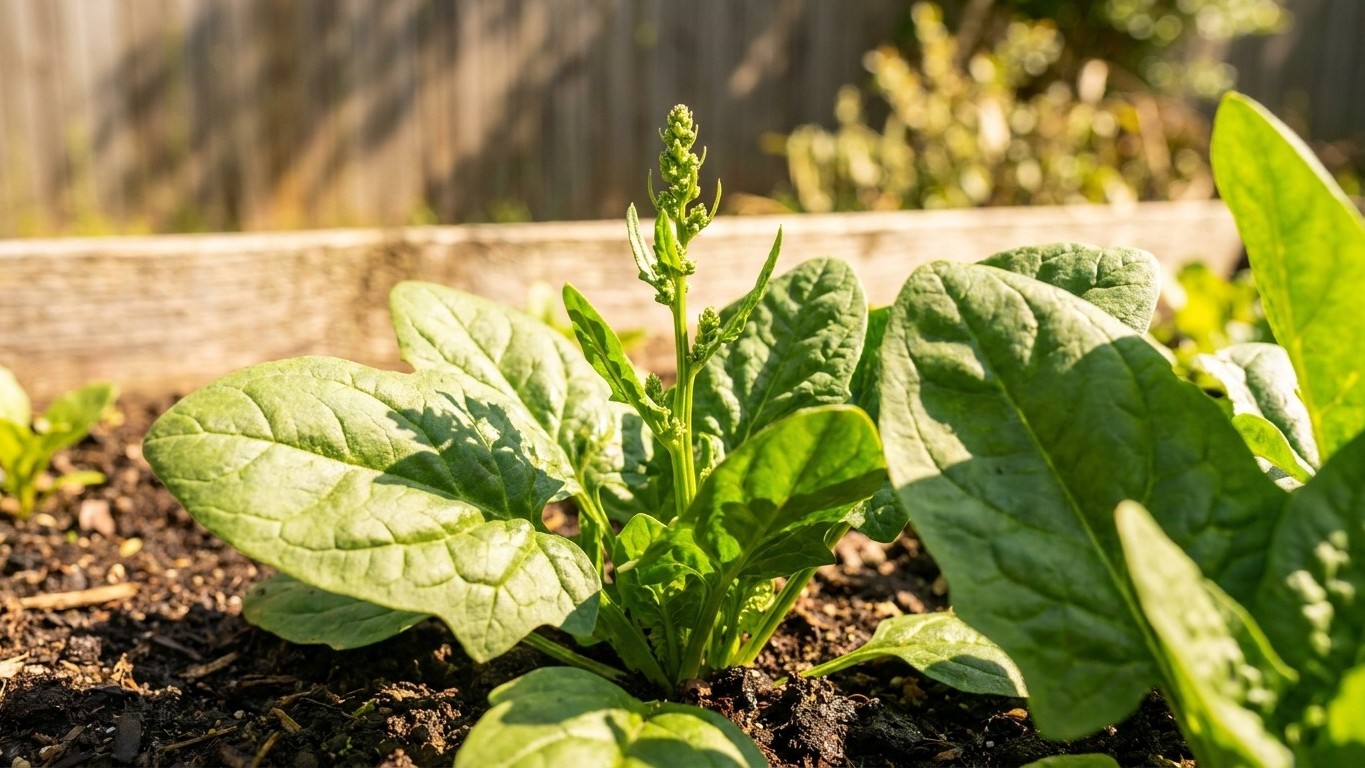
| A central stalk rising from the crown | Bolting triggered by long days | No insect activity involved; the plant is simply flowering, a normal response to long daylight rather than damage |
| Torn, crushed, or bruised leaves in a straight line | Mechanical or weather damage | Edges look torn rather than chewed, often follows hail, foot traffic, or tool contact |
None of this is a substitute for a look at the actual plant. When the symptom doesn’t fit cleanly into one of these categories, or when several show up together, that’s the moment to send a photo to the local extension office rather than guess.
What actually works here, and what is a waste of time
Spinach’s Kansas growing window is short in both directions, spring ends when day length triggers bolting, and fall depends on soil cooling below the germination threshold, so timing a physical barrier matters more than reacting after damage appears. **A floating row cover put down at planting, before grasshoppers or blister beetles arrive, keeps both off the bed without touching the crop at all.** That single step covers both pests with one method, since neither can fly or crawl through a properly secured cover.
Once beetles or grasshoppers are already established in a bed, cover alone won’t remove them, and pulling a cover off to hand-pick blister beetles calls for gloves, since the group is known for the reaction their body fluids can cause on skin. Waiting to see how bad the damage gets before acting is close to the least useful approach, since spinach doesn’t have the growing days to spare. A spring crop that loses two weeks to grasshopper damage may simply bolt before it recovers, and a fall crop that’s stripped as a seedling has little time left before frost to regrow.
Hoping a cool summer will buy extra growing time is another dead end specific to this crop: **spinach bolts on long days regardless of temperature**, so a mild summer does not extend the spring window the way it might for a heat-sensitive crop that only cares about warmth. This site does not name specific treatments or active ingredients, since what’s labeled for use on spinach changes and only the state’s extension service tracks what is currently approved.
Where to check this for your own county
The statewide list from K-State Research and Extension shows what’s documented across Kansas as a whole. It doesn’t say what’s actually present in a given yard. **Grasshopper and blister beetle numbers vary widely from one county to the next, and even from one side of a county to the other, depending on local weather, nearby fields, and what was growing there the season before.**
The county extension office is the right next step for anything that doesn’t match cleanly with what’s described here, whether that’s an insect that isn’t on the documented list, damage that doesn’t fit the table above, or a question about what’s currently labeled for use on a home vegetable garden in that county. Extension staff can also confirm local frost timing, since the reference-station dates used for planning (April 4 to April 18 for the last spring frost, October 23 to November 2 for the first fall frost) often run a week or two earlier or later once the garden is out past the airport station’s immediate area.
Four spinach varieties come up often in Kansas planting guidance, Bloomsdale, Melody, Teton, and Olympia, though no yield or timing data for any of them is published in the sources behind this page. A call or an email to the local extension office, with a description or photo of what’s actually showing up on the leaves, is the most direct way to move from a statewide list to an answer specific to one garden.
Common questions
Does every Kansas garden with spinach see grasshoppers or blister beetles?
No. Presence depends on local conditions county to county, and even within a county. The state list only confirms these species are documented somewhere in Kansas, not that they’re active in any one yard.
Can spinach be planted in summer to avoid these pests?
No. Germination drops once soil rises above 80°F, and long summer days trigger bolting rather than growth, so summer sowing works against the crop regardless of pest pressure.
Is a row cover enough on its own?
It handles both documented spinach pests here when installed at planting and kept sealed at the edges. It stops working once a pest is already inside the cover.
Why isn’t Colorado potato beetle a spinach concern despite being common in Kansas?
It’s a nightshade-family specialist, feeding on potato, tomato, and eggplant foliage. Spinach isn’t in that plant family, so it has no documented reason to feed there.