
West Virginia’s mountain terrain means herb-growing conditions swing hard between valley and ridge. Charleston’s frost data puts the safe planting window in mid-to-late April, but the state’s hardiness zones stretch from 5a to 7a, and the same herb bed that thrives in a Kanawha Valley backyard can struggle two thousand feet up. Timing, season length, and winter cold decide almost everything here.
When the soil is warm enough in West Virginia
At the Charleston station (USW00013866), NOAA’s 1991-2020 Climate Normals put the last spring freeze between April 9 and April 23, the window where a 32°F freeze has a 30 to 70 percent chance of occurring. That’s a probability band, not a promise, and it comes from a river-valley station. Higher elevations across the state, where a lot of West Virginia actually sits, freeze later in spring and earlier in fall than this figure suggests.
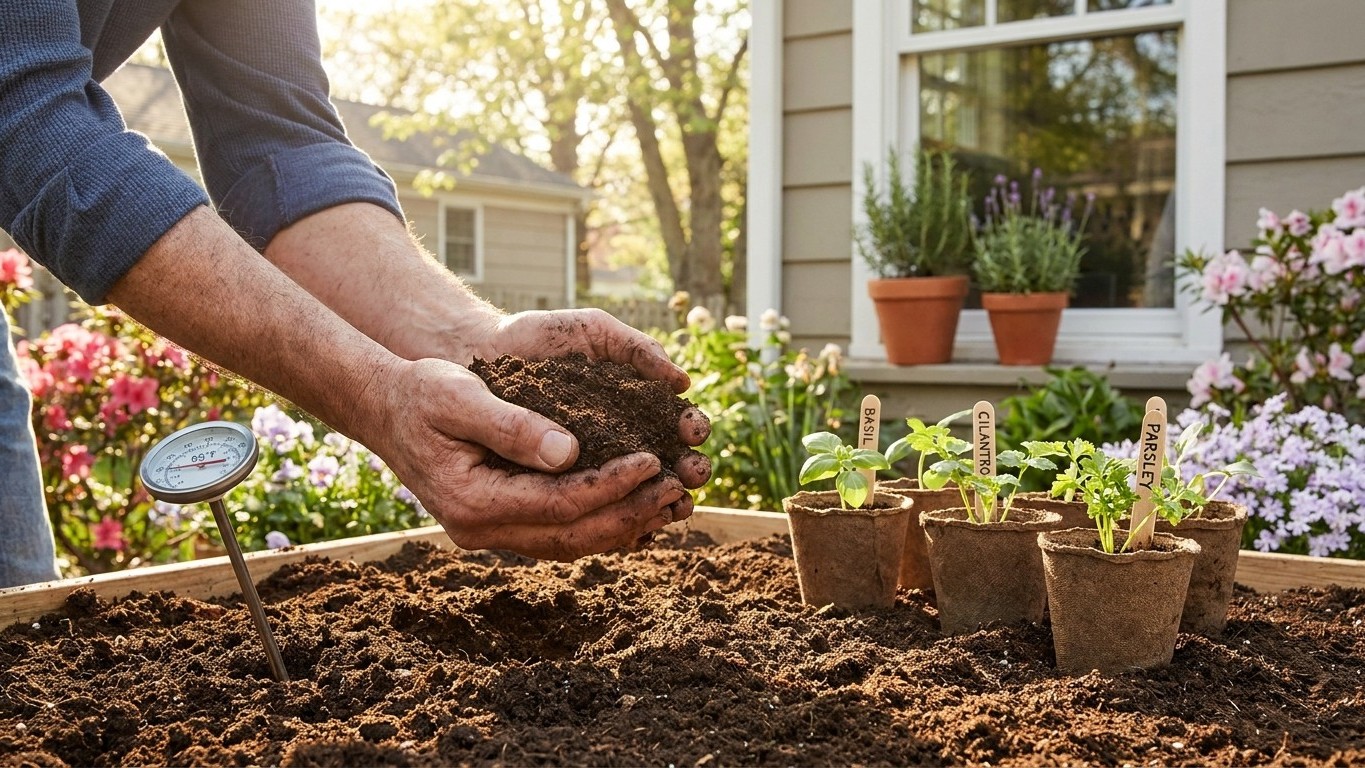
Frost date is the number every seed packet leans on, but it’s a proxy for something else: soil temperature. Herbs don’t care what the air did last night. They care whether the ground around their roots has warmed enough to let seeds germinate or transplants push new growth instead of sulking. Soil lags behind air temperature by a couple of weeks in spring, sometimes longer in a shaded or clay-heavy bed. That gap matters more in a mountain state where cold air pools in hollows and valleys hold onto frost long after a nearby ridge has cleared.
This is why the calendar splits herbs into two behaviors. Cool-season, leafy types in the parsley and cilantro families tolerate cold soil and can go in around the tail end of the frost window, sometimes a bit before it closes, because a light frost won’t kill them outright. Tender annual herbs in the basil family are a different story. Their seeds barely germinate in cold ground, and a transplant set out too early just stalls until the soil catches up, even if the air stays frost-free. For those, waiting past the back edge of the April 9-23 window, and confirming the soil itself has warmed rather than watching the thermometer alone, is the safer call.
Woody perennial herbs, the rosemary, thyme, and sage types, behave differently again. Once established, their concern isn’t spring planting risk so much as winter survival, which the next sections cover. But newly planted starts of these species still want that same soil-warmth buffer before they go in the ground, since a young root system without any cold-hardiness built up yet is just as vulnerable as a tender annual.
None of this changes by hoping. A gardener at 600 feet along the Kanawha and one at 2,800 feet in Pocahontas County are working with different actual dates even though they might reference the same state-level frost normal. Local elevation, aspect, and whether cold air drains into or away from a particular yard all shift the real number in ways a single station can’t capture.
How long the season lasts here
Charleston’s first fall freeze falls between October 18 and November 1, same source, same station, same 30-to-70-percent probability band. Paired with the spring window of April 9 to April 23, that gives a frost-free season running from roughly six months at the shortest read to just over six and a half months at the most generous read, depending on which edges of the two bands you use.
Six-plus months is enough room to do more than one thing with a bed. It’s long enough for an early planting of a quick leafy herb to be cut back, cleared, and replaced with a second sowing of the same type or something else entirely before fall frost shuts things down. It’s also long enough that transplanting, rather than direct-seeding everything, actually pays off: a herb started indoors or bought as a young plant gets a four-to-six-week head start that a six-month window can absorb without crowding the calendar.
Where the elevation caveat bites is exactly here. A garden at higher elevation, working from an earlier fall frost and probably a later spring one too, is working with a shorter season than the Charleston numbers show, even though both places are technically “West Virginia” on a seed rack. That gardener has less room for a second sowing and less slack if a spring transplant gets set back by a late cold snap. The math isn’t the same statewide, and treating it as if it were is the single most common planting mistake in a state this vertical.
For herbs specifically, a season of this length rewards succession planting more than most vegetable crops do, because many culinary herbs are harvested by cutting rather than by a single pull, and a fresh round of plants staggers the supply of tender new growth across more of the summer instead of leaning on one planting that eventually bolts or woodens up. The general mechanics of staggering plantings, spacing sowings out so something is always at a usable stage, are covered in more depth in this site’s succession sowing guide, and the same logic applies to a herb bed as it does to lettuce or beans.
Heat and water in West Virginia
West Virginia doesn’t hand a gardener a hot-climate problem in summer so much as a cold-winter one, and that reframes the whole herb conversation. The number that actually organizes an herb bed here isn’t a heat count, it’s the coldest-month mean daily minimum, which sits at 26.1°F for the Charleston reference station. That’s not the record low and not a monthly average, it’s the typical overnight floor during the coldest stretch of winter, and it’s the figure that decides whether a woody perennial herb survives outdoors year to year or needs to come inside.
Layer the USDA Plant Hardiness Zone range of 5a to 7a on top of that, and the picture sharpens. That map is built on one variable, the average annual extreme minimum temperature, and it’s a statewide range rather than one number. Charleston itself sits toward the warmer end of that band; a lot of the rest of the state, especially the higher counties, sits well toward the colder end. A herb that survives outdoors year-round in a Charleston backyard may need a pot and a spot near a window in a Randolph County winter.
That’s the real decision point for this state’s herb gardeners: which herbs stay in the ground as permanent plants, and which live in containers that get carried indoors or into an unheated garage before the coldest month arrives. Woody Mediterranean-type herbs, the ones that evolved for mild, dry winters, are the usual candidates for the pot-and-carry approach in the colder pockets of the state, even though they might overwinter fine outdoors right along the river in Charleston.
Summer heat plays a smaller role here than it does farther south or west, and it would be dishonest to write this section as if West Virginia baked all summer. What the state’s humid summers bring instead is dampness: foliage that stays wet longer after rain or dew, air that doesn’t dry out quickly in a shaded yard, and the fungal and mildew pressure that comes with both. For herbs, that means airflow around the plants and well-drained soil under them matter more than shade cloth or heat protection. A herb bed packed too tightly in a humid West Virginia summer is more likely to lose leaves to disease than to scorch.
Which herbs suit West Virginia
Put the pieces together and the state sorts herbs into a few practical groups rather than a shopping list. Cool-tolerant, quick-growing leafy types handle the earlier end of the spring window well and fit neatly into a second sowing later in the season, taking advantage of the six-plus-month frost-free stretch. Tender annual herbs that need warm soil are worth waiting on, particularly at higher elevations where that April window realistically shifts later.
Among woody perennial herbs, the deciding question is always the same one this page has come back to: does the coldest month’s typical overnight minimum, roughly 26°F at the reference station and colder at higher elevation, sit within what that particular species tolerates outdoors, or does it need a container it can be moved come fall. That single question does more to organize a West Virginia herb bed than any planting date ever will.
Humidity pushes disease resistance and airflow to the top of the list of things to plan for, ahead of flavor or growth habit, since a herb that mildews out in a damp August is a herb that doesn’t make it to the table no matter how well it started. Wider spacing, morning sun that dries dew quickly, and soil that drains instead of holding water all matter more here than they would in a drier climate.
This page won’t name specific cultivars, and that’s a deliberate choice rather than an oversight. Variety trials, the kind that test how a particular strain of a given herb actually performs against local disease pressure, local humidity, and local winter minimums, are done at the county and state level, not the national one. West Virginia University’s Extension Service, whose current variety recommendations and county-level advice are available at extension.wvu.edu, is the source that actually has that trial data for this state. A generic list from a page like this one would be a guess dressed up as advice. A recommendation from the people running trial plots in West Virginia’s own soil and climate is the only one worth building a herb bed around.