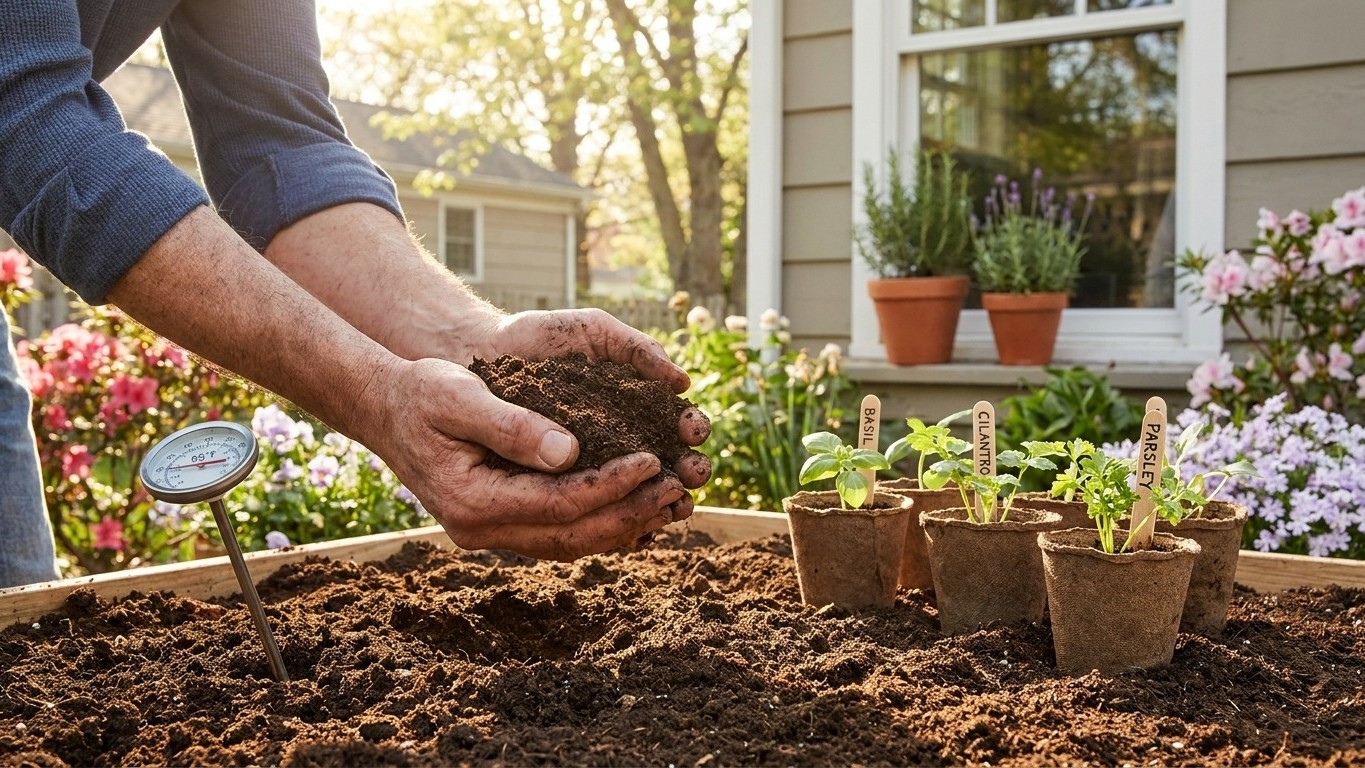

Most Kentucky gardeners can safely transplant herbs outdoors once the last spring frost window has passed, generally late March into early April around Louisville. But the real trigger isn’t the calendar, it’s the soil. The growing season then runs into early-to-mid November, giving a season long enough for two plantings of the fastest herbs and a single, careful run for anything that needs a full summer to bulk up.
When the soil is warm enough in Kentucky
Frost dates get all the attention, but they’re a stand-in for something slower and less dramatic: soil temperature. Air can warm to 65°F on a sunny afternoon while the ground six inches down is still cold enough to stall a seedling’s roots. That lag is why “after the last frost” is really shorthand for “after the ground has caught up,” and the ground usually needs another one to three weeks past that date to do it.
For the Louisville area, NOAA’s 1991-2020 Climate Normals put the last spring frost (32°F) between March 24 and April 4, based on the 30-70% probability band recorded at station USW00093821. That’s a probability, not a guarantee. Some years bring a frost after April 4; some years the risk clears earlier. NWS Louisville also flags that this station sits in an urban setting that runs warmer in spring than the surrounding rural county, so gardeners outside the city should treat that window as tighter, not wider.
What this means in practice depends on the herb. Cool-tolerant types, the ones grown from seed directly in the ground, like parsley, cilantro, dill, and chives, handle a light frost and can go in near the start of that window, sometimes a little before it closes. Warm-season herbs, especially basil and other tender annuals, want soil that’s genuinely warm, not just frost-free, and pushing them out too early usually shows up as stunted, purplish, sulking plants rather than dead ones. Waiting the extra week or two after the last frost date, rather than planting on the date itself, is the more reliable habit.
Perennial herbs that overwinter in the ground, things like thyme, oregano, sage, and chives, don’t face this same decision every spring once established. They’re already in the soil; what matters for them is a different calculation covered further down, tied to how cold the coldest month actually gets here. For now, the seasonal question is really about new plantings and transplants, and for those, patience past the frost date buys sturdier growth than a race to be first in the ground.
How long the season lasts here
Subtracting the two frost windows gives a real number, not a guess, because both come from the same NOAA station and the same 1991-2020 normals. Using the conservative ends, the tail of the spring frost window (April 4) to the front of the fall frost window (November 2), the frost-free stretch runs roughly 212 days, close to seven months. That’s the safe planning figure for gardeners who’d rather lose a week of growing time than lose a planting to an early or late frost.
Seven months is enough to matter. It’s long enough to grow a full crop of a slower herb from seed to a usable plant and still have weeks left over, and it’s long enough to support a second sowing of the quickest-maturing types after the first round has been harvested hard or has started to fade in summer heat. Basil in particular tends to get leggy and want replacing partway through a long season; a window this size makes that replacement realistic instead of rushed.
A shorter window, the kind found in mountain or northern Territories with frost-free stretches closer to four or five months, changes the math entirely. There, the first sowing is often the only sowing, and gardeners lean harder on transplants with well-developed root systems rather than direct seeding, because there’s no slack for a slow start. Kentucky’s window isn’t that tight. It allows both approaches: direct seeding early in the season, then a second round from transplants or fast direct-sown seed in mid-to-late summer, timed to finish before the fall frost risk climbs back up in late October and early November.
The practical decision, then, isn’t just “what to plant” but “when to plant it twice.” For the mechanics of staggering those plantings, spacing out sowings so the harvest doesn’t all land in the same two weeks, this site’s succession sowing guide walks through the timing in more detail than fits here.
Heat and water in Kentucky
Kentucky summers bring the stretch of hot, humid weeks that most people associate with the region, and for vegetable crops that heat is often the headline story. For herbs, it isn’t. Most culinary herbs, being native to Mediterranean hillsides or similarly lean, well-drained ground, tolerate a hot summer without much fuss as long as drainage is decent and airflow around the plants isn’t blocked. Humidity is the bigger day-to-day nuisance, since dense, damp foliage on basil or mint invites fungal problems faster than heat alone would.
The question that actually reorganizes a Kentucky herb bed is winter, not summer. The USDA Plant Hardiness Zone Map, built on the average annual extreme minimum temperature, places the territory across zones 6a to 7a. That’s a range across the state, not one number, and a dated recommendation should point to a reference city rather than the whole span; other parts of Kentucky will run colder or milder than Louisville. For Louisville itself, the 1991-2020 normals put the mean daily minimum of the coldest month at 27.8°F. That figure, not the record low and not the monthly average, is the one that decides whether a perennial herb survives the winter outdoors here or needs to come inside.
That single number splits the herb bed into two groups. Cold-hardy perennials, the ones rated for zone 6 or colder, shrug off a typical Kentucky winter in the ground, sometimes losing top growth to a hard freeze but resprouting from the roots in spring. Herbs rated only for zone 8 or warmer, common among woody Mediterranean types, are not reliably safe left outdoors through a month that regularly dips into the high 20s overnight. Those either get grown as annuals, replaced each spring, or moved into containers that come indoors or into a garage or unheated porch before the first hard freeze.
This is also where a damp summer shows its cost. In a wetter, cooler year, slow drainage around herb roots does more damage than any stretch of 90-degree afternoons, encouraging root rot and mildew rather than drought stress. Raised beds, wide plant spacing, and morning watering instead of evening watering all do more for herb health here than shade cloth or extra irrigation would.
Which herbs suit Kentucky
None of this points to a single named variety, and that’s deliberate. The types trialed and recommended locally change from one growing season to the next as breeders release new disease-resistant lines, and the only source with current, tested answers for this territory is the local extension service, not a general gardening page. For Kentucky, that’s the University of Kentucky Cooperative Extension Service, and its county offices are the right place to ask what’s performed well in trial plots recently.
What can be said by type, based on the territory’s own numbers, is more useful than a brand name anyway. The roughly seven-month frost-free window favors herbs that establish quickly from seed or small transplants, since there’s enough time for a full cycle and often a second one. The 27.8°F coldest-month minimum and the 6a-7a hardiness range mean cold-hardy perennial types, the ones bred or rated for zone 6 and below, are the reasonable candidates for permanent spots in the ground, while herbs rated for warmer zones are better treated as container plants that spend winter somewhere protected.
Humidity through the summer makes disease resistance, particularly resistance to downy mildew and other fungal issues common on dense-leaved herbs, a more relevant selection criterion here than in a drier territory. That’s exactly the kind of trait that shows up in extension trial data and doesn’t show up on a seed packet’s front label. A few herbs, sage and certain mints among them, also carry long-standing medicinal reputations; this page doesn’t evaluate those claims and isn’t the place to look for them.
Put together, the shape of a Kentucky herb bed follows from three numbers already on this page: a frost-free window near seven months, a coldest-month minimum in the high 20s, and a hardiness range spanning 6a to 7a. Those three decide what stays in the ground year-round, what gets grown fresh each season, and what spends the winter indoors, and no variety name changes that underlying math.