
Wyoming herb gardeners get a short, honest answer: plant tender herbs after the last spring frost has passed for your area, treat that date as a probability rather than a guarantee, and build in protection for the swings that come with living at elevation. The details below explain why that date moves and what it changes for your planning.
When the soil is warm enough in Wyoming
The frost date itself is only half the story. According to NOAA NCEI 1991-2020 Climate Normals for station USW00024018, the last spring freeze at 32°F falls somewhere between May 7 and May 18, based on the 30-70% probability band. That’s not a single day you circle on the calendar. It’s a range built from three decades of data, meaning even within that window there’s real year-to-year scatter, and a cold snap outside it is entirely possible.
Frost date is a proxy, not the actual trigger for planting. Herbs don’t respond to frost risk directly, they respond to soil temperature, and soil warms on its own schedule after the air has stopped dropping to freezing overnight. A basil transplant set into cold, wet soil right on the “safe” date will often sulk for two weeks doing nothing, while the same plant set in ten days later, once the ground has actually caught up, takes off. Rosemary, thyme, and other Mediterranean types are even more sensitive to cold, damp roots than they are to a light frost on the leaves.
At the elevations common across Wyoming, this gap between air and soil warming matters more than in lower, flatter states. Around 6,000 feet, growers are working with roughly 130 frost-free days in a typical year, and frost remains possible in any month at the higher elevations found across much of the state. That single fact reframes the whole spring conversation: season extension tools (cold frames, row cover, a sheltered raised bed against a south-facing wall) aren’t a nice-to-have here. They’re often what separates a productive herb patch from one that limps along.
What this means for timing
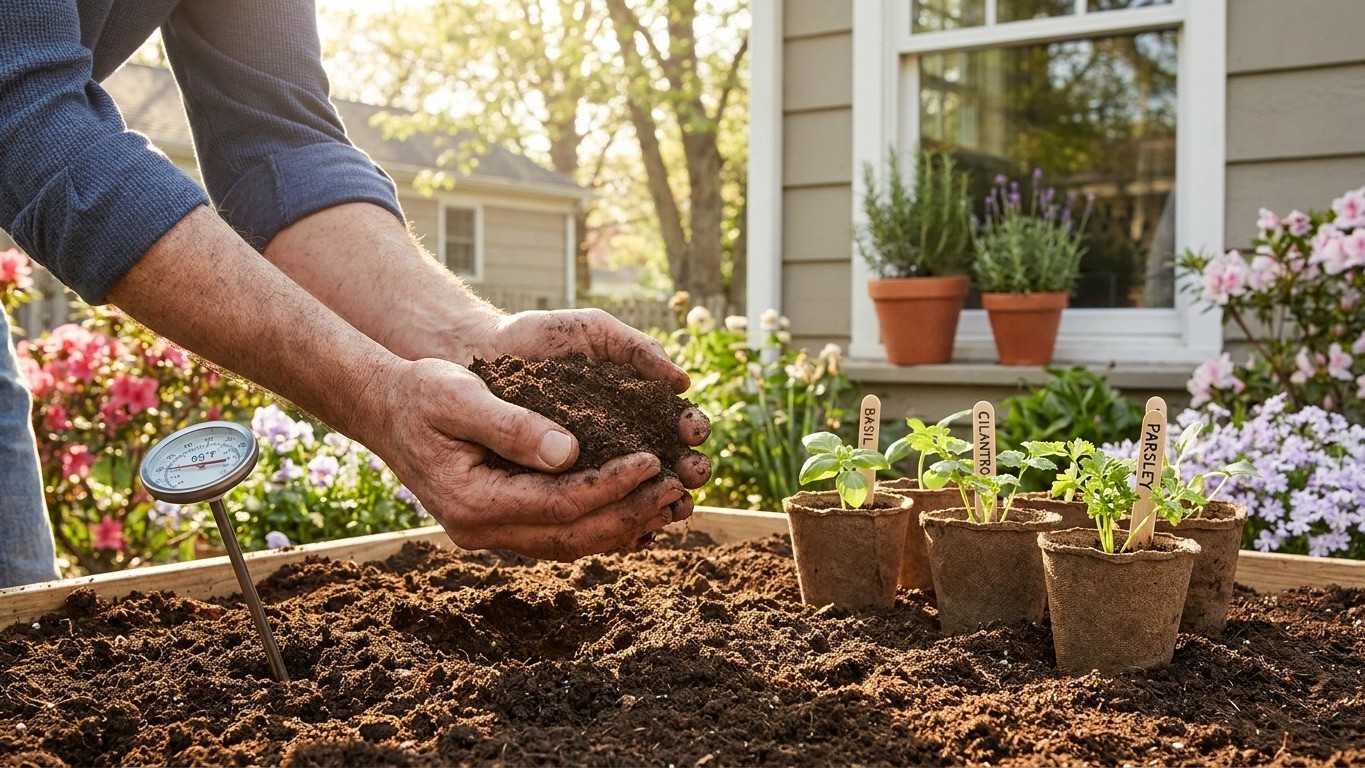
Cold-hardy herbs like chives, parsley, and cilantro tolerate a light frost and can go in near the earlier end of that May 7 to May 18 window, sometimes under cover a bit sooner. Heat-loving types (basil above all) should wait until the later end of the range, and a week or two past it, since soil at elevation takes its time catching up to the air. There’s no shortcut around this; watching your own ground with a simple soil thermometer beats trusting the calendar alone.
How long the season lasts here
The other bookend comes from the same NOAA dataset: the first fall freeze at USW00024018 arrives between September 24 and October 5. Put the two ranges together and the frost-free window runs roughly 129 days at its shortest (May 18 to September 24) to about 151 days at its longest (May 7 to October 5). That lines up with the commonly cited figure of around 130 frost-free days at 6,000 feet, though your own patch could land anywhere in that spread depending on elevation and local terrain.
A season in that range is workable but tight, and it changes two practical decisions. First, whether a second sowing makes sense. With four to five months of frost-free growing, there’s usually enough time for one solid round of fast, cut-and-come-again herbs like cilantro or dill, and possibly a second sowing of those same quick types in early-to-mid summer once the first has bolted or been harvested hard. Slower herbs, though, especially perennial types that need a full season to establish woody growth, get one shot. If you’re weighing a second planting, the site’s succession sowing guide walks through how to stagger plantings so you’re not gambling the whole crop on one window.
Second, it affects whether transplanting from nursery starts is worth the trouble over direct seeding. In a short season, a transplant that’s already six to eight weeks old when it goes in the ground has a real head start over a seed sown outdoors after the last frost risk clears. That head start matters more here than it would in a state with a five- or six-month growing season, where direct-seeded herbs have time to catch up on their own. Checking that a transplant’s roots aren’t pot-bound before it goes in the ground is a small step that pays off disproportionately when there isn’t much season left to recover from transplant shock.
Heat and water in Wyoming
Summer heat isn’t the variable that decides whether herbs thrive in this state, and it’s worth saying that plainly before moving on, because the temptation is to write the same hot-climate advice for every territory. Wyoming’s growing challenge sits almost entirely on the other side of the calendar. The number that actually organizes an herb garden here is the coldest month’s average daily minimum, which sits at 18.1°F at the Cheyenne reference station, per NOAA NCEI Climate Normals (1991-2020). That’s not a record low or a rare cold snap. It’s the typical overnight low across the coldest weeks of a normal winter, and it’s brutal on anything that isn’t genuinely built for it.
That single figure, paired with the USDA Plant Hardiness Zone rating of 3a to 6a for the state, decides which herbs can live outdoors year-round and which need to come inside. This is a wide range for one territory: a 3a garden and a 6a garden are dealing with very different winters, so the zone number for your specific town or county matters more than the statewide range. Using Cheyenne as the reference point, an average daily minimum near 18°F in the coldest month rules out most of the woody Mediterranean herbs as permanent, in-ground plants unless they’re given real winter protection or grown in a sheltered microclimate.
Rosemary is the clearest example. It’s often treated as a perennial shrub in much warmer zones, but at 18.1°F average lows it typically needs to be container-grown and brought indoors, or accepted as an annual replant. Thyme, sage, and oregano have more cold tolerance and can survive outdoors in the milder pockets of the state’s zone range, particularly with mulch and good snow cover acting as insulation, but they’re still marginal at the colder end of that 3a to 6a spread.
This also changes how growers should think about summer moisture management. Where summers run cool and short rather than long and humid, as much of Wyoming’s climate does at elevation, the practical risks skew toward slow ripening and fungal issues in low-airflow plantings rather than drought stress. Spacing herbs for airflow and choosing raised beds that drain well matters more here than watering schedules built for a hot, dry, high-evaporation climate.
Which herbs suit Wyoming
Reasoning from the state’s actual numbers, three categories stand out, and none of them require naming a specific variety to be useful advice.
- Cold-tolerant annuals and biennials such as parsley, cilantro, dill, and chives handle the short frost-free window well because they mature quickly and can be direct-seeded near the earlier end of the last-frost range without much risk.
- Marginally hardy perennials like thyme, oregano, and sage can persist in-ground in the milder parts of the state’s 3a-6a range, especially with mulch and reliable snow cover, but they remain a gamble at the colder end and should be planted with that understood.
- Tender perennials treated as containerized plants, rosemary being the standout example, make more sense grown in pots that spend summer outdoors and winter indoors near a bright window, given that 18.1°F average lows in the coldest month rule out reliable in-ground survival across most of the state.
A humid, disease-prone summer isn’t the main pressure here, so airflow and drainage matter more for avoiding rot and slow ripening than for fighting off the mildew pressure a warmer, wetter state deals with. That’s a genuinely different set of priorities than a herb guide written for the Southeast or the Gulf Coast would give.
This page won’t name a specific cultivar, and that’s a deliberate choice rather than an omission. Variety trials that actually mean something happen locally, with real soil and real winters, and the results shift from one part of the state to another faster than any general guide could track. The University of Wyoming Extension runs exactly those trials and keeps current recommendations for growers by region, and that’s the source worth checking before buying seed or starts, rather than a cultivar name pulled from a national guide written with a different climate in mind.