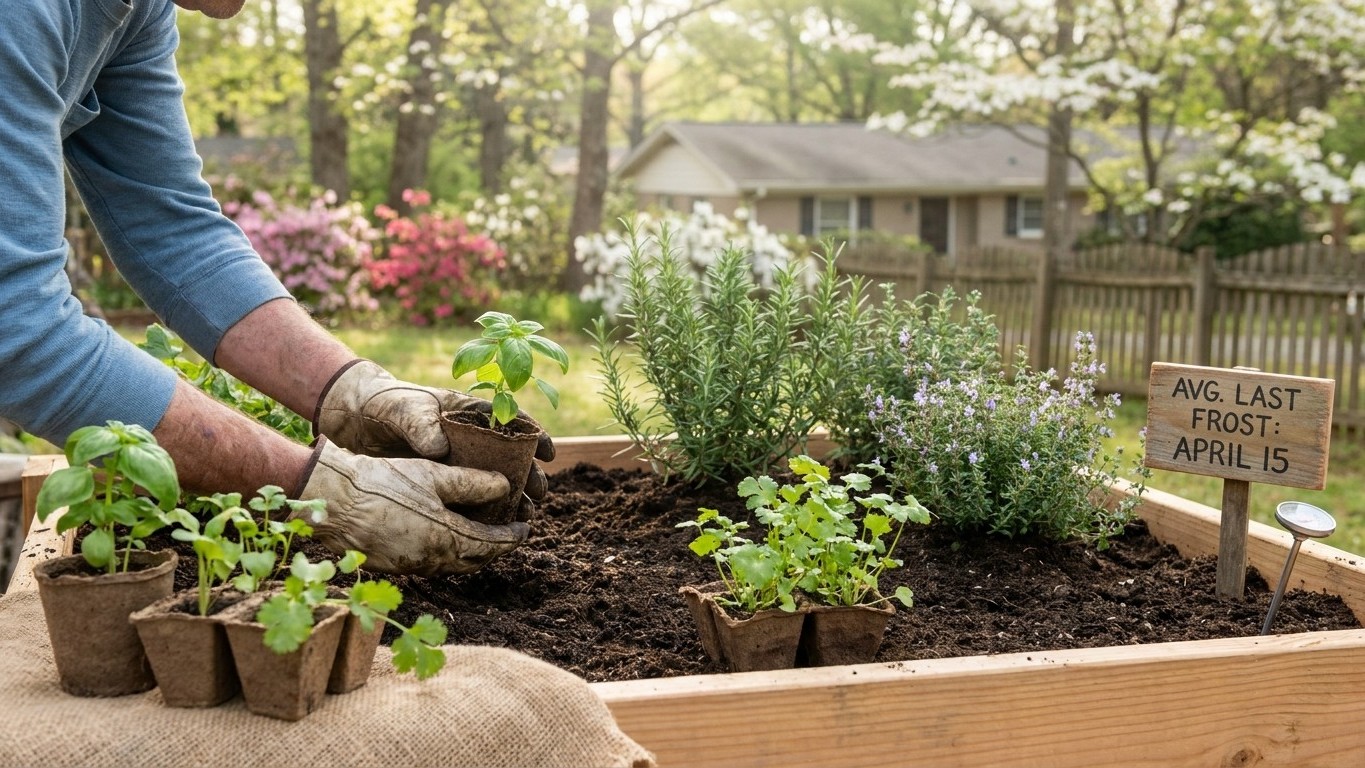

There’s no frost date to build a calendar around in Hawaii, and that changes everything about how you plant herbs here. Instead of watching for a last freeze, you’re watching rainfall, elevation, and whether your yard faces the wind or hides from it. Most herbs can go in the ground any month of the year, but which herbs and where depends entirely on those three factors.
The short answer for Hawaii
NOAA’s 30-year climate data for the islands (1991-2020 Normals, station USW00022521) doesn’t even have a number for last spring frost or first fall frost. The field is flagged “not computable” because the freeze percentiles that every other state’s planting calendar relies on simply never trigger here: inhabited Hawaii logs zero days per year at or below 32°F. Frost exists only on the summits of Mauna Kea, Mauna Loa, and Haleakala, thousands of feet above where anyone is growing basil or thyme.
That means the usual planting-calendar math (count backward from your frost-free date, count forward to your first freeze) has nothing to attach to in Hawaii. There is no spring rush to beat a frost, no fall deadline to get a last harvest in before the cold. Herbs go in when rainfall and soil moisture support them, and for most kitchen herbs that’s essentially any month.
The number that actually matters for winter hardiness is the coldest month’s average daily minimum: 66.8°F, based on Honolulu’s climate normals. That’s warmer than a spring morning in most of the continental U.S. It means cold is never the limiting factor for herbs here. Basil, which sulks and blackens below 50°F almost everywhere else, never sees a temperature close to that threshold in lowland Hawaii. The same goes for tender herbs like Thai basil, lemongrass, and turmeric, which stay in active growth all year rather than dying back for winter.
So the real planting question in Hawaii isn’t “when,” it’s “where on my property, and how much rain does that spot get.” A garden on the windward (wet) side of an island might get soaked through the winter months while a leeward (dry) garden a few miles away stays parched and needs supplemental water most of the year. Elevation shifts things again: gain a few thousand feet and the coldest-month minimum drops well below that 66.8°F Honolulu figure, changing which herbs even survive. Your exact rainfall and elevation are what should shape your planting decisions, not frost.
What will not work here
The herbs that struggle in Hawaii aren’t the ones that mind heat. They’re the ones that need a real winter to do their job. Several classic culinary perennials, French tarragon among them, depend on a period of cold dormancy to reset for the next growing season. With a coldest-month average minimum of 66.8°F, lowland Hawaii never delivers that chill. The plant may survive and even look fine, but it won’t behave the way it does in a temperate garden, and some varieties decline in vigor over a year or two without ever having gone properly dormant.
Lavender is another common disappointment, especially the English types bred for dry, cool-summer climates. Without a frost-based calendar to worry about, gardeners sometimes assume Hawaii’s warmth means anything grows easily. Lavender’s actual enemy here isn’t heat, it’s humidity. In consistently damp, warm soil, its roots rot before it ever gets the chance to flower. This is exactly the kind of failure a frost map would never predict, because the constraint isn’t cold, it’s moisture sitting around the crown of the plant.
Windward gardens, the wetter side of each island, run into a related problem: overcrowding herbs the way a mainland guide might suggest leads to fungal disease fast. Constant humidity plus tight spacing is a recipe for powdery mildew and root rot in herbs like oregano and sage, both of which prefer their soil to dry out between waterings. A planting density that works fine in a dry Arizona summer becomes a liability on Hawaii’s wet side.
Leeward gardens face the mirror-image mistake. Dry, sunny, and often windy, these spots punish anyone treating herbs the way they’d treat a houseplant on a weekly watering schedule. Basil and mint, both shallow-rooted and thirsty, wilt fast in leeward heat if watering is infrequent, even though the air temperature itself is never a threat. The failure isn’t the plant meeting its limit, it’s the gardener applying a watering rhythm built for a cooler, wetter climate somewhere else.
What changes across Hawaii
Hawaii’s USDA hardiness zone range, 9a through 13a, is one of the widest spreads of any state in the country, and it’s built on a single variable: the average annual extreme minimum temperature. That range alone tells you there is no single planting answer for “Hawaii.” A coastal garden in zone 12a or 13a essentially never sees cold stress. A garden higher on a volcanic slope, sitting in zone 9a or 10a, experiences real seasonal cooling that changes what thrives.
Honolulu, the reference city behind the 66.8°F coldest-month figure, sits toward the warmer end of that range. Gardeners at higher elevations on the Big Island, in Upcountry Maui, or in the cooler pockets of Kauai are working with meaningfully lower minimum temperatures, even though they’re on the same island chain and under the same “no frost in inhabited areas” rule. Herbs that thrive without a second thought in Honolulu’s warmth, like basil or lemongrass, may need more protection or simply grow slower a few thousand feet up.
Windward versus leeward exposure layers on top of elevation. Two gardens at the same elevation on the same island can have very different rainfall patterns depending on which side of the mountain they sit on, which changes watering needs and disease risk independent of temperature. That’s three variables stacked together (elevation, hardiness zone, and wind exposure), and none of them can be guessed from a zip code alone.
What it can say is that the spread from 9a to 13a is real and large enough that a recommendation calibrated to Honolulu won’t automatically hold at 2,000 feet on Maui. Check the USDA Plant Hardiness Zone Map for the specific zone at your address before assuming your garden matches the reference city used here.
Where to check this for your own county
The University of Hawaii’s Cooperative Extension Service, part of the College of Tropical Agriculture and Human Resources (CTAHR), is the source built for exactly this gap. Its extension office directory is listed at ctahr.hawaii.edu/site/extension.aspx, and it’s organized by county precisely because a Honolulu recommendation and a Hilo recommendation aren’t the same thing.
What to look for once there: a local planting guide specific to your island and elevation band, and any variety trial results for herbs that have actually been tested in your county’s conditions rather than generalized statewide advice. CTAHR’s county offices track how varieties perform against local rainfall patterns and pest pressure, which matters more in Hawaii than almost anywhere else in the country given how much microclimates shift over short distances.
A county-level recommendation will always beat a state-level one. It can tell you that frost isn’t a factor and that rainfall and elevation are, but it can’t tell you what grows best in your specific valley or your specific side of your specific island. That granularity lives with your local extension office, not with a page written for the whole state.
If your county office doesn’t have a herb-specific calendar posted, ask directly. Extension offices field these questions constantly, and a phone call or email often gets you a faster, more specific answer than searching for a document that may not be published for your exact area.
If you follow the almanac, here is when to plant herbs by the moon. It is a tradition, not a proven method.
Checking this against your own garden
Every fact here describes averages across a state that includes some of the widest climate variation in the country. Your own garden will tell you more than any of them. Three things to watch, and what each one is actually telling you about your specific spot.
Feel the soil an inch or two down before you plant anything. If it’s consistently damp and slow to dry, you’re likely in a windward or higher-rainfall microclimate, and that’s the signal to space herbs further apart and lean toward varieties that tolerate wet feet rather than fighting the site with drainage fixes alone. If it dries quickly and feels warm even a few inches down, you’re probably in a leeward or lower-elevation spot where watering frequency, not temperature, will make or break tender herbs like basil.
Watch how fast new growth appears after you plant. In lowland Hawaii’s warmth, herbs that are suited to the site typically show visible new leaves within days, not weeks. A herb that sits stalled for two or three weeks without pushing new growth is usually telling you the site doesn’t match the plant, whether that’s too much shade, too much standing moisture, or an elevation slightly cooler than the herb prefers.
Pay attention to leaf condition through your first wet season in the garden. Spotting, yellowing, or a fuzzy white coating on leaves points to the humidity and spacing problems common on windward sites. Catching that early, in the first month, lets you thin plantings or move a herb to better airflow before disease establishes, which is far easier than fighting an outbreak later in the season.