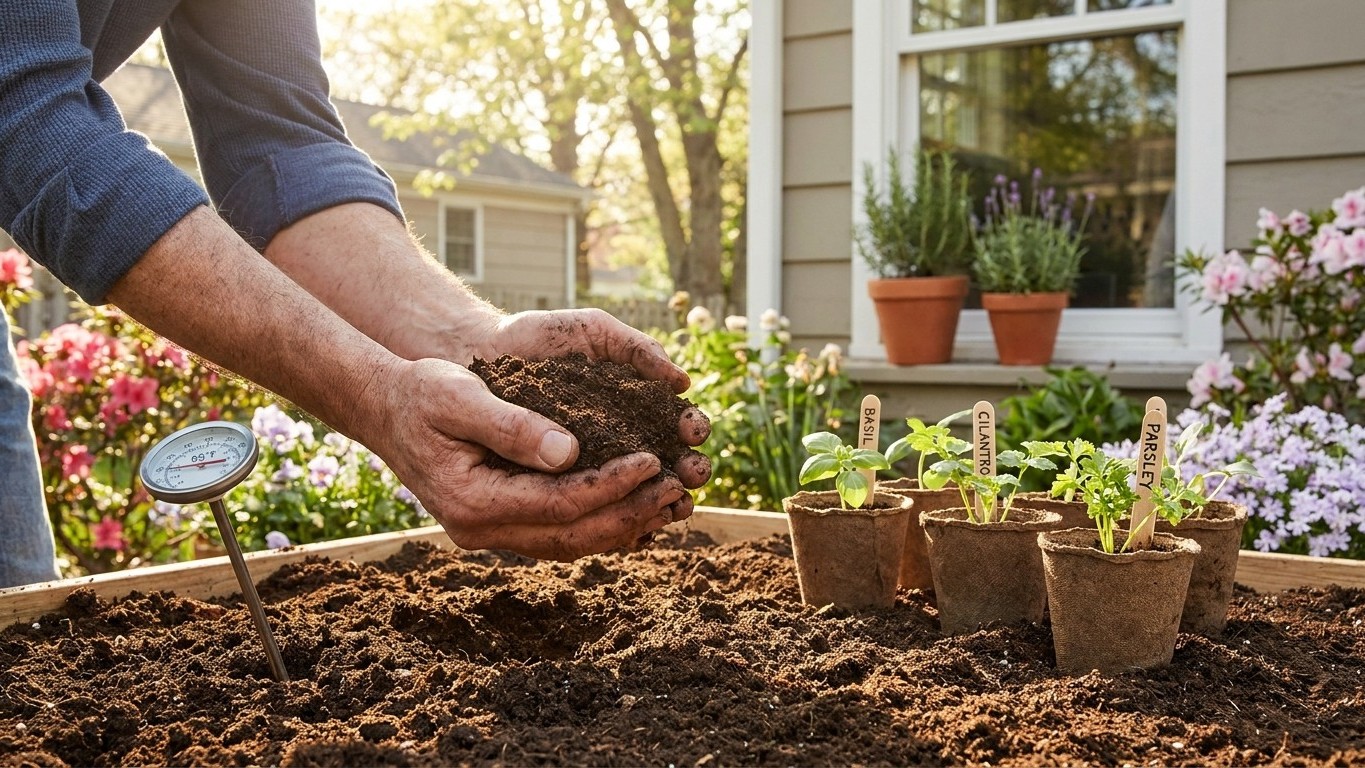

Ask when to plant herbs in Hawaii and the calendar answer is almost beside the point: at sea level, frost never happens, so there’s no last-frost date to count from. NOAA’s 30-year climate normals for Honolulu show zero freeze days, every year. What actually schedules an herb garden here is elevation, rainfall exposure, and a winter minimum warm enough to turn some herbs into permanent plants rather than seasonal ones.
When the soil is warm enough in Hawaii

Every mainland herb-planting guide starts with a frost date. Hawaii breaks that habit entirely. NOAA NCEI’s 1991-2020 Climate Normals for station USW00022521 don’t just show a late spring frost or an early fall one, they show the freeze calculation itself flagged as not-computable. Zero days per year at or below 32°F. The same holds at 36°F. In plain terms: the statistical tool meteorologists use to predict frost risk has nothing to work with here, because in the places people actually garden, it doesn’t happen.
That’s worth sitting with for a moment, because it changes the whole logic of “when to plant.” On the mainland, a frost date is a probability, not a promise, and gardeners plant around it because the risk of a late cold snap is real even after the average date passes. In lowland Hawaii, that risk simply isn’t part of the equation. The soil isn’t warming up after a frost season ends; there was no frost season to begin with.
So what does trigger planting?
Two things replace the frost calendar: elevation and rain. Soil temperature in Hawaii tracks the wet-dry seasonal shift more than any thermometer reading, and it tracks elevation even more directly. A patch of ground near sea level in Honolulu behaves nothing like a garden bed a few thousand feet up the slopes of Mauna Kea or Haleakala, where the CAUTION built into the NOAA data is explicit: frost does occur, but only on the high volcanic summits, never where food gardens sit. For the herb types most home gardeners grow, basil, mint, oregano, thyme, cilantro, the practical trigger is simply moisture and light, not a countdown from a frost that isn’t coming.
This is also the point to say plainly what this page will not do. Some herbs common in home gardens carry a long-standing reputation as remedies. That reputation isn’t something this page weighs in on, one way or the other; it’s a culinary and cultivation guide, not a health resource. And if a plant volunteers in the yard looking like an herb, that’s a job for a local expert to confirm in person, not a paragraph on a website, because several toxic plants mimic culinary herbs closely enough to fool an untrained eye.
How long the season lasts here
Subtracting a last frost date from a first frost date is how most of the country measures its growing season. Hawaii’s own numbers make that subtraction unnecessary: both the spring and fall freeze calculations for station USW00022521 return the same result, no freeze occurs in inhabited areas, zero days per year. There’s no gap to measure between two frost events, because at sea level neither one exists. The functional growing season for lowland Hawaii is the full calendar, all twelve months, every year.
What does a season with no frost boundary actually allow? For annual herbs, it means the “first sowing” is never the only sowing. Basil, cilantro, dill, and similar fast annual herbs can go into the ground on a rolling basis rather than in one springtime push, since there’s no autumn frost event forcing a hard stop. A gardener who treats February as the only planting month is leaving most of the year on the table. This is exactly the situation where a succession sowing guide earns its keep, because staggering plantings every few weeks keeps a steady supply coming rather than one glut followed by a gap.
Where the picture shifts
None of this means every square foot of the islands behaves identically. Elevation changes things even without a frost line to mark the boundary. Upland areas on the Big Island, the slopes above Kona and Waimea, and similar higher-elevation microclimates run noticeably cooler at night than Honolulu’s sea-level normals describe. That doesn’t bring frost into the picture for most inhabited elevations, but it does slow growth and can push a heat-loving herb’s timeline later than it would run on the coast. The rule of thumb for lowland exposure, a nearly continuous season, doesn’t automatically extend to a garden a few thousand feet up the mountain, and that’s a genuine local difference worth checking before assuming the calendar rules apply the same way everywhere on the island.
Heat and water in Hawaii

For most of the continental United States, the summer heat count and the rainfall total are what decide whether herbs cook in the sun or mildew in the humidity. In Hawaii, that framing barely applies, because the islands don’t really have a “too hot” season the way inland regions do. The number that actually drives herb selection here is a winter one: 66.8°F, the mean daily minimum for the coldest month, measured at the Honolulu reference station under NOAA’s 1991-2020 Climate Normals.
That single figure reorganizes the whole conversation about what an herb garden can be in Hawaii. A mean minimum of 66.8°F in the coldest month is warm enough, on average, to keep tender perennial herbs alive outdoors year-round rather than forcing gardeners into the mainland routine of potting up rosemary, bay laurel, or lemongrass and hauling them indoors before winter. In much of the country, that’s the defining fall chore for anyone growing Mediterranean or tropical-origin herbs. In lowland Hawaii, for most years, it simply isn’t necessary.
Reading the hardiness zone correctly
USDA’s Plant Hardiness Zone Map, built entirely on average annual extreme minimum temperature, places Hawaii across a striking range: zone 9a to zone 13a. That’s not a typo and it’s not a single climate. It’s a territory that spans coastal Honolulu at the warm end down through cooler upland zones at the other, and treating “Hawaii” as one hardiness number is a mistake. When making a planting decision, the reference point that matters is the specific location, closer to Honolulu’s zone if the garden sits near sea level on Oahu, considerably cooler if it sits at elevation on the Big Island or Maui’s upcountry.
Rainfall exposure adds a second layer that has nothing to do with temperature. The islands’ well-known windward-versus-leeward split, wetter on the windward side, drier on the leeward side, matters more to herb health than any heat count would. On the wetter, windward side, the risk isn’t scorching, it’s the classic damp-climate problem: mildew, slow ripening, fungal disease creeping into dense basil plantings or overwatered thyme. On the drier leeward side, the concern flips toward making sure Mediterranean-type herbs get the drainage they evolved for, since those species tend to sulk in consistently soggy soil regardless of how warm it is.
Which herbs suit Hawaii
With no frost date narrowing the calendar and a mild winter minimum removing the annual potting-up chore, the deciding factor for herb choice in Hawaii isn’t earliness, it’s humidity tolerance and drainage. That’s a different filter than most of the mainland uses, and it changes which types of herbs make sense in which yard.
On the wetter, windward side of an island, disease resistance becomes the first thing to check. Basil types in particular are prone to fungal problems in consistently damp air, so airflow, spacing, and morning sun that dries leaves quickly matter more here than they would in a drier climate. On the drier, leeward side, Mediterranean species, the rosemary, thyme, oregano, and sage family, tend to do well because that dry, well-drained condition mirrors their native habitat, provided the soil doesn’t stay wet at the root.
Herbs with roots in tropical growing regions, lemongrass among them, tend to handle Hawaii’s warmth and humidity without much fuss, which is part of why they’re common in island gardens. It’s worth noting that lemongrass, like several herbs on this list, carries a long-standing reputation in traditional use; this page doesn’t evaluate that reputation one way or the other, since it’s a cultivation guide, not a health resource.
What this page won’t do is name a specific variety. Cultivar performance, which basil selection resists downy mildew best in Hilo’s rainfall, which rosemary strain handles Kona’s dry heat, is trial-and-error knowledge that only makes sense locally, tested against local disease pressure and local soil. The one recommendation that actually means something is to check with the University of Hawaii’s CTAHR Cooperative Extension, which tracks variety trials for the islands’ specific growing conditions. Refusing to guess at a cultivar name here isn’t a gap in this page, it’s the honest answer.