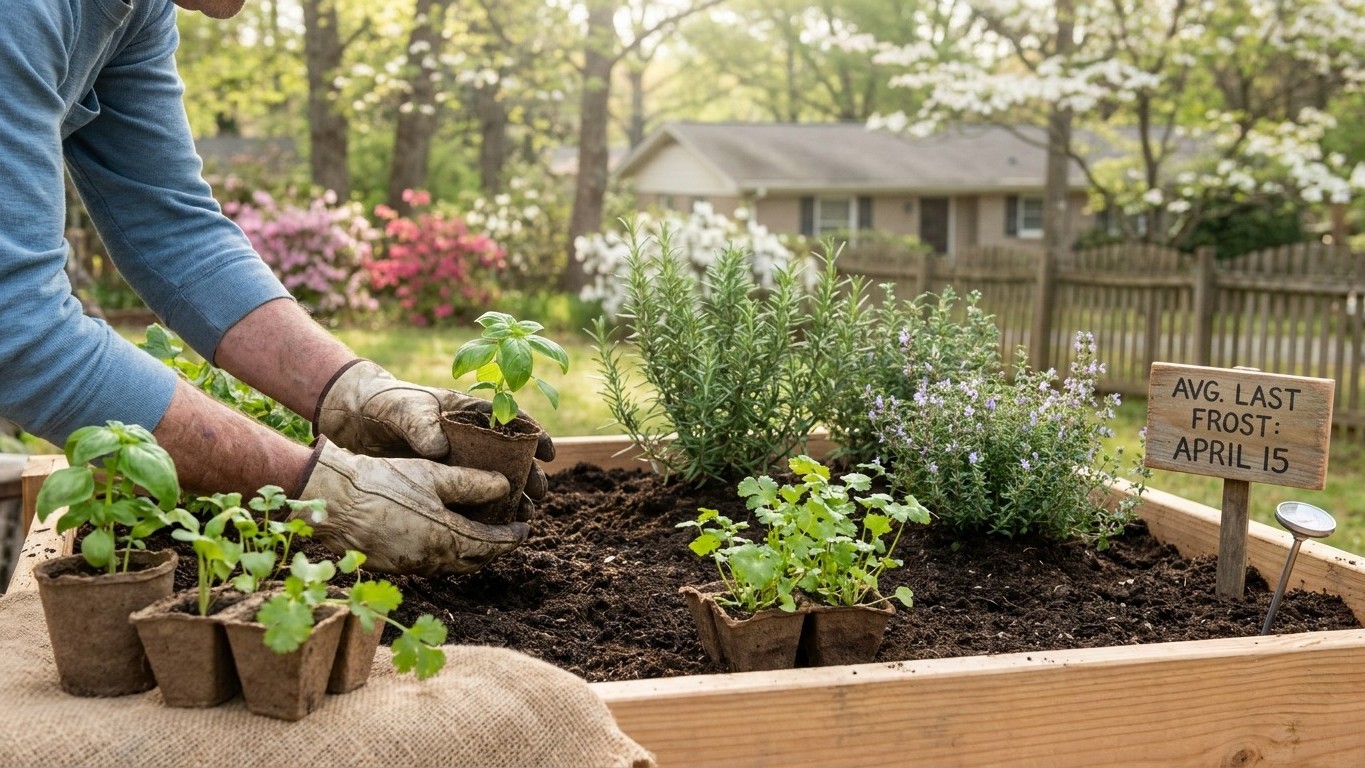

Iowa’s herb-planting window runs from mid-April through late October, but that stretch splits into two very different jobs: getting seeds and transplants into the ground safely in spring, and pulling everything out or moving it indoors before the first hard freeze. The exact dates depend on where in the state you garden and how much risk you’re willing to take with a late cold snap.
The short answer for Iowa
The last spring frost at the Des Moines reference station falls between April 12 and April 24, and the first fall frost lands between October 14 and October 25. Those numbers come from NOAA’s 1991-2020 climate normals, and they mark the 30 to 70 percent probability band for a 32°F freeze, not a guarantee. A date inside that window means there’s still a real chance of frost on either side of it, so treat April 12 as optimistic and April 24 as the safer bet for tender herbs.
Hardy herbs that shrug off a light frost, parsley, chives, cilantro, can go into the ground two to three weeks before that spring window closes, since a stray 30-degree night won’t kill seedlings that already tolerate cold soil. Tender herbs, basil above all, need soil that’s warmed up and settled weather behind them, so waiting until the tail end of the window, or even a few days past it, protects the investment in seed or starts.
On the fall side, the same logic runs in reverse. Perennial herbs like thyme, sage, and oregano don’t need protection from the first light frost in mid-October, but basil and other tender annuals should be harvested or brought inside before that date arrives, since a single freeze turns basil leaves black overnight.
One caution matters here: Iowa State University Extension’s own county-level frost data, built from 1950-2021 records, runs about four days later in spring and ten days earlier in fall than the airport-station numbers above. That means the true safe window for tender herbs is narrower than the NOAA figures suggest, and gardeners who plant right on the airport’s April 12 date are taking on more risk than the raw number implies. When in doubt, split the difference and lean toward the later spring date and the earlier fall one.
What will not work here

Do the arithmetic on Iowa’s growing season and the ceiling becomes obvious fast. Between the optimistic last frost (April 12) and the more conservative first fall frost (October 14), the state offers roughly 185 days frost-free at best, and closer to 173 days at the pessimistic end once the Extension adjustment is applied. That’s enough for basil, dill, cilantro, and parsley to complete a full cycle, but it eliminates herbs that need a genuinely long, hot season to bulk up, like lemongrass grown from seed rather than a rooted stalk.
The bigger obstacle is winter, not summer. The mean daily minimum temperature during Iowa’s coldest month sits at 13.8°F, a figure that measures the average cold a plant actually experiences overnight, not a rare record low. That number rules out leaving Mediterranean perennials like rosemary and bay laurel in the ground year-round anywhere in the state. Both plants are hardy only into the upper teens or low 20s at best, and a winter that regularly bottoms out near 14°F outdoors will kill an unprotected rosemary bush by January in most years, container or no container, unless it’s moved inside or into an unheated but insulated space.
Herbs that need extra help, not a pass
- Rosemary: survives Iowa winters only as a container plant brought indoors before the first hard freeze
- Bay laurel: same story, indoor overwintering is close to mandatory statewide
- Lemongrass: needs a head start indoors in March to have any shot at producing usable stalks before October
None of this means these herbs are off-limits, only that treating them as reliable perennials the way a gardener in USDA zone 8 or 9 might is a mistake specific to Iowa’s cold minimums. The failure here isn’t a short season defeating a slow herb, it’s a cold winter defeating a tender one that never had a chance outdoors past November.
What changes across Iowa
Iowa spans USDA hardiness zones 4b to 6a, a range built entirely on one measurement, the average annual extreme minimum temperature, according to the USDA Plant Hardiness Zone Map. That’s a wide spread for a single state, and it means there’s no one answer to “when do I plant” that applies evenly from the Minnesota border to the Missouri line.
A zone 4b location sits at the cold end of that range, with winter extremes low enough that even some so-called hardy perennial herbs need mulch or a sheltered spot to survive. A zone 6a location, generally in the state’s southern reaches, runs milder, with a shorter, less severe winter and often a slightly longer frost-free stretch in practice, even though the NOAA frost dates cited above are averaged across the whole state’s reference station rather than broken out by zone.
The practical shift for a reader gardening at the colder end of that spread is straightforward: push spring planting dates later than the state average suggests, and pull tender herbs in earlier come fall. A reader at the warmer end can often push both directions by a week or so, though county-by-county frost data would be needed to say exactly how many days that buys anyone.
Which zone applies to a yard depends on exact location, elevation, and local terrain, not just latitude. The USDA’s official Plant Hardiness Zone Map is the tool built for that job, and checking it by ZIP code is a faster, more accurate step than guessing from a state-wide range.
Where to check this for your own county
Iowa State University runs the state’s official Cooperative Extension service, and their site, Iowa State University Extension and Outreach, is the source built to translate state-level frost and zone data into something specific to a single county. That distinction matters more than it sounds: a state average covers conditions across hundreds of miles, while a county extension office works from local trial data and local frost records.
Two things are worth hunting for once there. First, a local planting calendar, since Iowa’s extension network typically publishes county or regional guidance that adjusts the general spring and fall frost windows for local microclimates, something the state-wide NOAA numbers can’t capture. Second, look for any list of herb or vegetable varieties that have actually been trialled in that county’s demonstration gardens or through master gardener programs. Varieties that perform well in test plots near the Mississippi River don’t necessarily perform the same way in the state’s northwest corner, and county-level trial data catches that gap.
A county recommendation will always beat a state one on accuracy, because it’s built from conditions closer to an actual backyard. The frost and hardiness data describes Iowa as a whole. That’s useful for understanding the general shape of the growing season, but it’s not a substitute for what a local extension office already knows about a specific county’s soil, elevation, and microclimate quirks.
Checking this against your own garden
Every date here is a statistical average, and a reader’s own backyard will sometimes disagree with it. Soil temperature is the most reliable check available without any special equipment: on a dry, sunny afternoon, push a finger a couple of inches into the planting bed. Soil that still feels cold and damp like early spring mud isn’t ready for tender herb transplants regardless of what the calendar says, while soil that feels closer to room temperature is a better sign than any date on a chart.
Watching the plants already growing nearby tells its own story. If perennial herbs like chives or established oregano are pushing new green growth and the ground around them has visibly thawed and dried out from winter, that’s a stronger local signal that the soil has warmed enough for seed starting than a printed frost date.
Come fall, the first true leaves on any self-seeded dill or cilantro from the previous year are worth watching too. Volunteer seedlings that germinate and hold on into cooler weather without frost damage suggest a particular yard runs slightly warmer than the state average, likely due to a south-facing wall, urban heat, or wind shelter that a regional frost map can’t account for. That’s the kind of detail no calendar captures, and it’s exactly the sort of local nuance that makes watching a specific plot more useful than trusting a single date on a page like this one.
The Moon calendar is a separate, older custom: see when to plant herbs by the moon, written as tradition rather than fact.