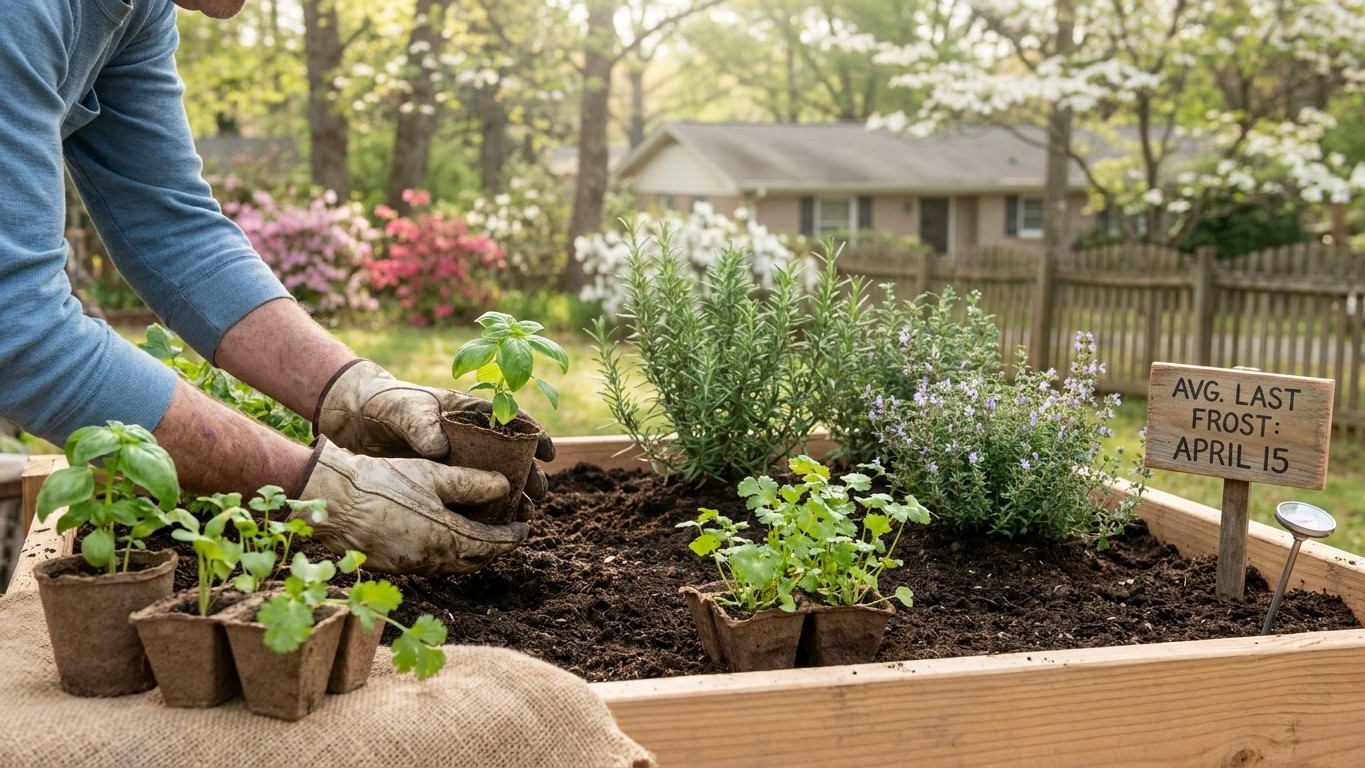

In most of Mississippi, tender herbs like basil go in the ground after your local last spring frost, which the reference station puts between March 6 and March 22. Cool-season herbs such as parsley, cilantro, and dill can go in weeks earlier, and again in fall ahead of the November frost. The exact week still depends on your county, not just the state average.
The short answer for Mississippi
Those frost dates aren’t a promise. NOAA’s 1991-2020 Climate Normals put the last spring freeze at the Jackson airport station somewhere in a window where the odds of a 32°F freeze after that date sit between 30% and 70%. March 6 is the early edge of that window, March 22 the late edge. Planting basil on March 7 means you’re gambling on the better side of a coin flip, not a guarantee.
For frost-tender annuals, basil, most cilantro cultivars grown for leaf, and tender perennials treated as annuals like lemongrass, the safer move is to wait until closer to the back half of that window, or later, since soil needs to sit above roughly 50°F before basil germinates well anyway. Direct seeding into cold, wet March clay usually rots the seed before it sprouts.
Hardy herbs work the opposite way. Parsley, cilantro grown for early leaf before it bolts, dill, and chives tolerate a light frost and actually prefer to get established while nights are still cool. These can go in from late February through March in much of the state, well before that last-frost window closes, because a stray freeze rarely kills an already-hardened seedling of these species outright.
Perennial woody herbs, rosemary, thyme, sage, oregano, lavender, live or die here based on winter, not spring. The coldest month at the Jackson reference station averages a daily minimum of 36.6°F. That’s a mean, not a record low, but it tells you winters here rarely stay brutally cold for long. Rosemary and thyme generally handle that fine once established; a plant set out in spring has all summer and fall to build roots before its first winter test.
Fall is the second sowing window, and it’s easy to overlook. With first fall frost running November 7 to November 22 depending on where you are relative to that reference station, there’s a real stretch in September and early October to get cool-season herbs like cilantro, dill, and parsley back in for a fall and winter harvest, plus a good window to plant perennial herb starts so their roots settle in before cold weather arrives.
What will not work here

Mississippi’s frost-free stretch, roughly late winter to mid-November depending on location, is long by national standards. A short season isn’t what trips people up here. Heat and humidity are what get you, and they arrive fast.
Cilantro is the clearest example. It’s a cool-season herb that bolts, throws up a flower stalk and turns bitter, once temperatures push consistently into the 75-80°F range. In much of Mississippi that threshold shows up within weeks of the last frost date, sometimes before spring even feels settled. Sowing cilantro in April and expecting a long leafy harvest through summer is asking it to do something it physically can’t do in this climate. The fix is treating it as a spring crop and a fall crop, not a summer one, with the fall sowing timed against that November frost window rather than against summer heat.
Dill behaves similarly, bolting once daytime heat sets in for good, which is one reason gardeners here often get better dill from a fall planting than a spring one.
On the other end, herbs bred for dry, airy Mediterranean hillsides struggle with Mississippi’s summer humidity even when the heat itself wouldn’t kill them. Rosemary, lavender, and oregano planted too close together, or in heavy clay that holds water, are prone to fungal problems and root rot in a summer where afternoon humidity regularly sits high. Wider spacing than a seed packet from a drier climate recommends, and well-drained or raised beds, matter more here than in states with less humid air.
Basil set out too early runs into a different problem: chilling injury. Basil can suffer blackened, damaged leaves at temperatures well above freezing, sometimes below 50°F, even without an actual frost. A gardener who plants basil right at the early edge of that March 6 window, betting the frost stays away, can still lose the crop to a cold, damp week that never drops to 32°F.
What changes across Mississippi
Mississippi spans USDA Hardiness Zones 7b through 9a, and that spread matters more for herbs than most vegetables, because it’s perennial herbs, rosemary, bay laurel, some sages, that live or die by winter cold rather than getting replanted each year. A zone 9a garden near the Gulf Coast and a zone 7b garden in the northern hill country are not the same growing environment, and there’s no single winter-hardiness answer that covers both.
The frost date range in the Facts, March 6 to March 22 for last spring frost and November 7 to November 22 for first fall frost, reflects that same north-south spread. Gardens further north and further from the reference station’s moderating influence generally see their last frost land later in that window and their first fall frost land earlier, sometimes by a week or two beyond what the range alone suggests. A gardener in the northern part of the state planting on the early date, March 6, is taking on more risk than the range implies.
Elevation plays a smaller but real role too. Higher ground in the hill country can run cooler at night than valley or coastal locations even within the same general zone, pushing both the last spring frost later and the first fall frost earlier.
The USDA Plant Hardiness Zone Map is built for exactly that lookup, using ZIP code, and it’s worth checking before deciding whether a perennial herb like rosemary can stay in the ground year-round at your address or needs a container that comes indoors.
Where to check this for your own county
Mississippi State University Extension runs the state’s land-grant extension service, and its planting guidance lives there. That’s the right next stop, because everything above is a state-level picture built from one reference weather station, and a county-level recommendation from local extension agents beats it every time.
Two things are worth hunting for once you’re there. First, a county or regional planting calendar, if your local extension office publishes one, will reflect actual frost records for your area rather than the airport-station range used here. Second, look for any variety trial results or recommended cultivar lists for herbs grown in your part of the state. Extension offices often test how specific basil, rosemary, or cilantro varieties perform under local humidity and soil conditions, information a general state guide can’t capture.
Mississippi State Extension also maintains county offices with agents who field exactly this kind of question, when to sow, what varieties held up last summer, whether a particular winter proved hard on rosemary in that specific county. That local, season-by-season knowledge is worth more than any date range pulled from thirty years of averages at a single airport.
The state-level picture is a starting point. It’s meant to narrow the question, not answer it down to the week for your specific yard. Treat the frost windows and hardiness zone spread here as the frame, and let your county extension office fill in the specifics.
Checking this against your own garden
Calendar dates are averages built from decades of weather station data. Your own garden runs on its own microclimate, and it will tell you more than any date range if you know what to watch.
Start with soil warmth by feel. Push a finger a couple of inches into the bed where you plan to sow. If it feels cold and damp rather than cool and slightly warmed by the sun, basil seed sitting there is more likely to rot than sprout, regardless of what the calendar says about the frost being past.
Watch for the first true leaves on anything you’ve direct-sown, cilantro, dill, parsley. The initial seed leaves that pop up first don’t tell you much, but the second set, the true leaves that actually look like the herb’s mature foliage, signal the plant has settled in and is growing rather than just surviving. A slow gap between seed leaves and true leaves in a cold spring is a sign your particular bed is running cooler than the general date range assumes.
Last, keep an eye on early flowering in cool-season herbs like cilantro and dill. If you see flower stalks forming well before you expected, that’s your own yard telling you summer heat arrived earlier at your address than the state-level frost dates would suggest, and it’s a useful cue to shift your fall sowing earlier the following year too.
The Moon calendar is a separate, older custom: see when to plant herbs by the moon, written as tradition rather than fact.