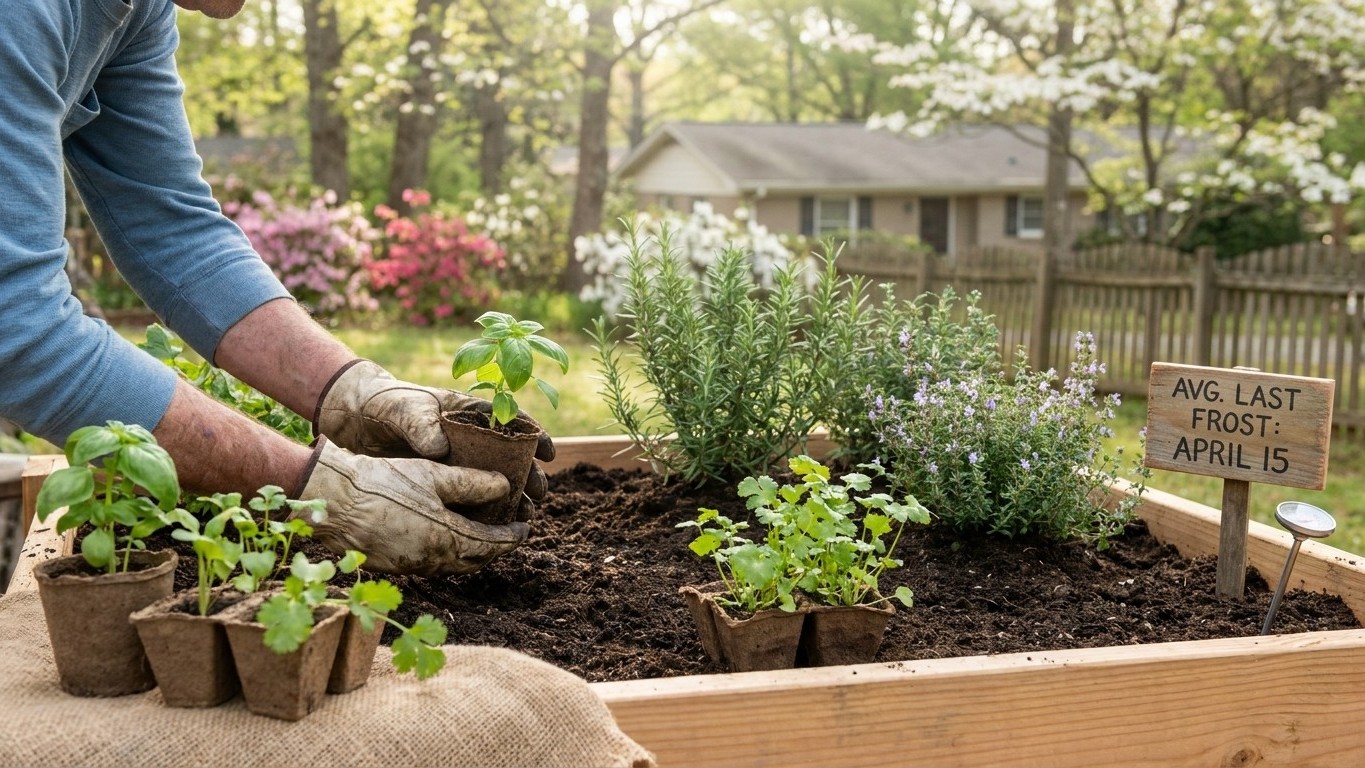

Kentucky gardeners can direct-sow hardy herbs like parsley, cilantro, and chives a few weeks before the last spring frost, but tender herbs such as basil need to wait until that frost risk has genuinely passed, somewhere between March 24 and April 4 depending on where you garden. Perennial herbs like rosemary face a tougher question: whether they survive the winter at all.
The short answer for Kentucky
The frost window that matters here runs March 24 to April 4 for the last spring freeze, and November 2 to November 12 for the first fall freeze, based on NOAA’s 1991-2020 climate normals for the 30 to 70 percent probability band. That band means something specific: on March 24, there’s still roughly a 70 percent chance of a freezing morning, and by April 4, that risk has dropped to about 30 percent. Neither date is a guarantee. It’s a fading probability, and treating it as a hard line is where a lot of transplant losses start.
For hardy herbs, cold-tolerant sowing works well ahead of that window. Parsley, cilantro, dill, and chives germinate in soil that’s still on the cool side and can handle a light frost once they’re up. Chives in particular can go in the ground three to four weeks before the last frost date without much drama.
Tender herbs are a different story. Basil is the clearest example: it stalls or blackens at temperatures anywhere close to freezing, so pushing it into the ground before the risk has dropped near that 30 percent mark is a bet against the odds. The safer play is waiting until early April in most of the state, and later than that in spots where local frost risk runs higher than the regional average.
Perennial herbs answer to a different number entirely. Rosemary, sage, thyme, and oregano aren’t decided by the spring frost date, they’re decided by whether they can survive the coldest stretch of winter in the ground. The mean daily minimum temperature during Kentucky’s coldest month sits at 27.8°F, not the record low, but the average nightly floor. Sage and thyme handle that range without much trouble. Rosemary is borderline depending on the cultivar, and some of the woodier Mediterranean herbs simply won’t make it through an average Kentucky winter outdoors.
USDA places Kentucky across hardiness zones 6a to 7a, a range built entirely on average annual extreme minimum temperatures. That range is wide enough that a planting decision safe in one corner of the state isn’t automatically safe in another, which matters more for perennial herbs than it does for anything you’re replanting from seed each spring.
What will not work here
The most common mistake isn’t picking the wrong herb, it’s planting the right herb on the wrong day. Sowing basil or other tender herbs right at March 24, the early edge of the frost window, means gambling on the 30 percent side of a coin that still lands on frost more often than not. NWS Louisville has flagged that its own reporting station tends to run milder in spring than the rural county around it, which means a rural garden’s real frost window is tighter than the station numbers suggest. A gardener outside the city reading “March 24” as a green light is working from a date that skews later than what their own soil will actually see.
Treating the hardiness zone as one number for the whole state doesn’t hold up either. Kentucky spans 6a to 7a, and that spread is the difference between a rosemary plant that limps through winter under mulch and one that dies outright. Rosemary cultivars rated hardy to zones 8 through 10, which cover a lot of what’s sold at garden centers, have no realistic path to surviving outdoors year-round anywhere in this state. Even the milder 7a pockets sit two to three zones colder than what those plants are bred for, and the 27.8°F average nightly minimum in the coldest month is well below what an unprotected Mediterranean perennial tolerates over a full season, not just one hard freeze.
Waiting too long to harvest is its own failure mode. Basil, along with most other tender annual herbs, dies at the first real frost, and that frost is arriving somewhere between November 2 and November 12 across most of the state. Leaving a full basil bed standing into the second week of November because “there’s still time” is planting a loss into the calendar. The same 30 to 70 percent probability logic that applies in spring applies here in reverse: by November 2, there’s already meaningful frost risk, not zero.
None of this means the season here is short. A frost-free stretch running from early April into early November is a workable seven months for annual herbs. The failures aren’t about running out of season, they’re about misreading which side of a probability window you’re standing on, and about assuming a plant’s zone rating from the tag applies to a state that spans two zones’ worth of winter severity.
What changes across Kentucky
Kentucky isn’t one climate wearing one name. A state that spans USDA zones 6a to 7a is really describing two different winters, one where the average annual extreme minimum dips toward 6a’s colder end, and one that stays closer to 7a’s milder floor. That’s not a rounding difference. It typically shows up as an earlier usable planting date and a longer perennial-herb survival rate in the milder zone, and a later start with tighter margins for anything left outdoors in the colder one.
For annual herbs, the practical effect is a shifted calendar rather than a different one. A gardener in the milder end of the state’s zone range can often push tender herb transplants out a bit earlier than the regional frost dates suggest, while someone in the colder end should treat the later side of the March 24 to April 4 window, or even a few days past it, as the safer target.
For perennial herbs, the zone spread decides survival outright rather than just timing. Sage, thyme, and oregano tend to handle both ends of Kentucky’s range without much fuss. Rosemary is the herb where the zone difference actually changes the outcome: it has a real shot at overwintering in the milder pockets of 7a with some protection, and a much thinner one in colder 6a conditions where the coldest-month average minimum runs closer to the harsher end of that 27.8°F statewide figure.
There’s no single answer for “when do I plant” that covers the whole state accurately, and that’s the honest limit of a state-level page like this one. The right move is checking the USDA Plant Hardiness Zone Map for the specific zone at your address, not guessing based on which part of the state you think runs colder.
Where to check this for your own county
Kentucky’s climate is described at the state level. It doesn’t describe your county, and the gap between those two things is exactly where a state-level frost date can mislead a specific garden. The University of Kentucky Cooperative Extension Service is where that gap gets closed.
Two things are worth looking for there specifically. The first is a county-level planting calendar, which will reflect local frost data rather than a single regional station, the same NWS Louisville data that’s explicitly flagged as running milder in spring and colder in fall than the surrounding rural county. A county office working from local station data or long-running local observation will have a tighter, more accurate window than a statewide range can offer.
The second is variety information trialled specifically in that county’s conditions. Extension offices often track which herb cultivars, particularly perennial ones like rosemary or the hardier culinary sage varieties, have actually made it through winters in that specific area. That’s a different kind of information than a hardiness zone number. A zone tells you the statistical cold floor; a county extension trial tells you what actually lived through it, locally, more than once.
A county recommendation beats a state one every time, for the simple reason that it’s built on a smaller, more relevant sample. The state-level picture is useful for understanding the general shape of the season, less useful for making a planting decision down to the week. That decision belongs to the local office.
Some gardeners also time this by the Moon: when to plant herbs by the moon, as almanac tradition rather than fact.
Checking this against your own garden
Every date here is a statistical average pulled from decades of regional weather records. Your own garden is a single, specific spot, and it will sometimes disagree with the calendar in ways worth trusting.
Soil warmth by feel is the first check. Push a finger a couple inches into the bed where herbs are going. If it still feels cold and slightly damp in a way that reminds you of early spring rather than a mild afternoon, seeds like basil or cilantro will sit and sulk rather than germinate, even if the calendar date has technically arrived. Warmth you can feel with your hand is a better predictor of germination speed than the date on a seed packet.
The first flush of new growth on anything that overwintered, chives coming back, perennial thyme pushing new leaves, tells you how your specific microclimate handled the winter that just passed. A south-facing bed against a brick wall often shows growth days or even a couple weeks ahead of an open, north-facing spot in the same yard. That gap is real information about a spot warmer or colder than the regional average, and it’s worth remembering for next year’s planting order.
First true leaves on seedlings, the second set that appears after the initial rounded leaves, mark the point where a young herb plant has enough root and leaf structure to handle a light setback. Seedlings without true leaves yet are far more vulnerable to a late cold snap than ones already past that stage, which is one more reason a slightly later, more cautious sowing date often outperforms an early one in an average Kentucky spring.