
Rosemary, bay laurel, Mexican tarragon, and Thai basil handle Louisiana’s long, wet, subtropical season better than almost anything else you could plant. Classic cool-climate herbs like French tarragon, chervil, and English lavender struggle here, not from cold, but from a winter that never gets cold enough and a summer that never lets up.
The short answer for Louisiana
Louisiana sits in USDA hardiness zone 8a-10a, and the mean daily minimum of the coldest month at the New Orleans reference station is 46.1°F. That single number reorders the whole conversation about herbs. In most of the country, the question is which herbs survive the winter. Here, winter barely qualifies as an obstacle. A 32°F freeze happens in only 86.8 percent of years at that station, meaning roughly one winter in seven brings no freeze at all. The herb question in Louisiana isn’t “will it survive January,” it’s “will it survive July and August.”
That reframing points straight to the answer. Woody Mediterranean perennials that dislike hard freezes but tolerate heat and humidity do well across most of the state: rosemary, bay laurel, and oregano all shrug off a coldest-month average in the mid-40s and just keep growing through winter. Louisiana gardeners often treat these as true perennials rather than the annuals-in-disguise they become in colder states.
For tender annuals, heat tolerance decides everything. Sweet basil bolts and sulks once summer humidity locks in, but Thai basil and other heat-adapted basil types keep producing leaves through August without much complaint. Lemongrass, which needs a long warm season to bulk up, finds exactly that here, and comes back from the roots most winters south of the I-10 corridor. Mexican tarragon (sometimes sold as Texas tarragon) fills the anise-flavor niche that French tarragon can’t hold in this climate, for reasons the next section covers.
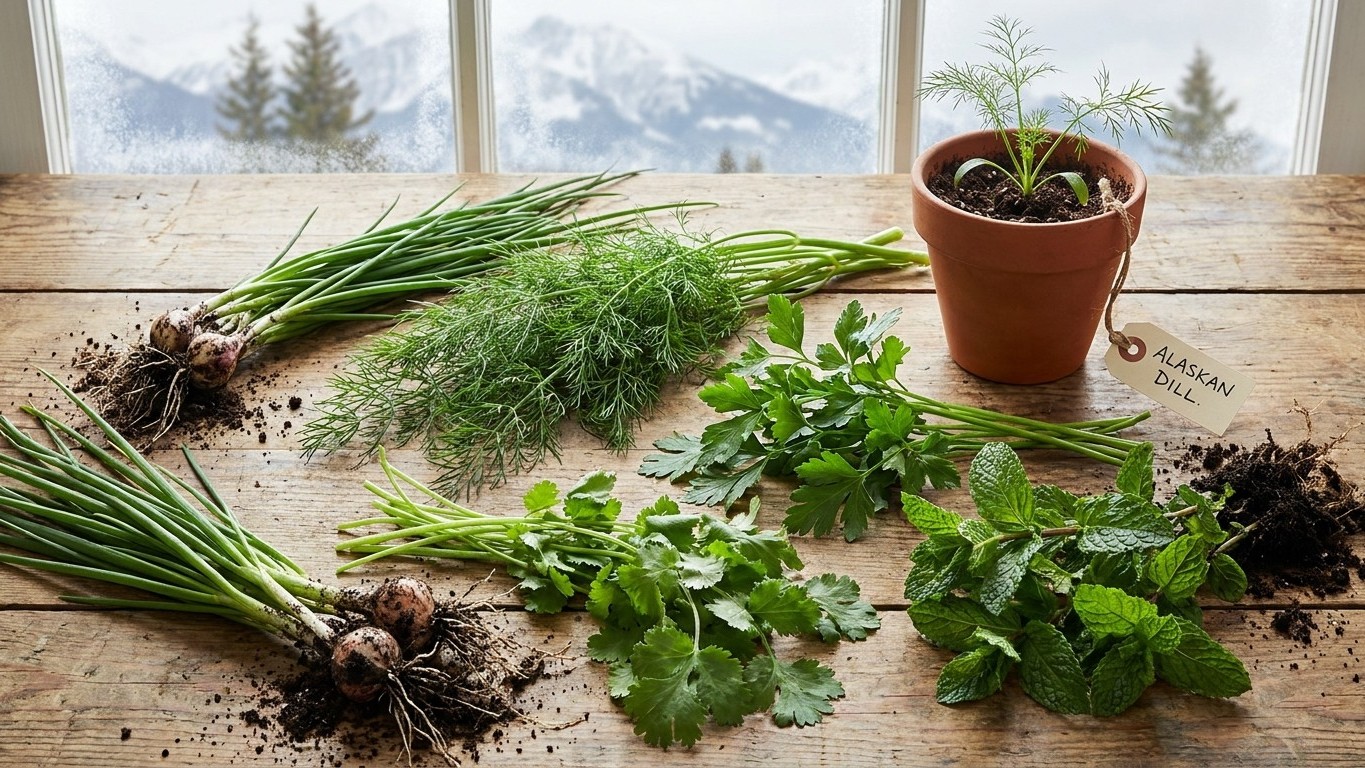
Cilantro, dill, and parsley belong on the list too, but with a caveat: they’re cool-season herbs here, not warm-season ones. The narrow window between the first fall frost (December 17 to January 8) and the last spring frost (January 18 to February 8) is actually their best growing stretch, since Louisiana’s mild winters let them grow through months that would freeze them solid farther north. Sow these when everyone else’s garden is shutting down, not in spring.
Mint deserves a mention with a warning: it grows almost aggressively well in Louisiana’s humidity, to the point where most gardeners regret planting it in open ground and switch to containers within a season.
What will not work here

French tarragon is the clearest failure, and the reason traces directly to that 46.1°F coldest-month minimum. This herb needs a real winter dormancy, a stretch of genuine cold, to reset and produce its signature anise flavor the following year. Louisiana’s winter doesn’t dip low enough or stay cold long enough to deliver that reset, especially in the roughly one year in seven when no freeze occurs at all. The plant often survives here. It just never tastes like itself. That’s exactly why Mexican tarragon, a completely different species that doesn’t need winter dormancy, has become the standard substitute in Gulf Coast gardens.
Lavender fails for a different reason: not the temperature, but what comes with it. English lavender is bred for dry summers and sharp drainage, and Louisiana offers neither. High humidity combined with heat creates ideal conditions for the fungal and root-rot problems that kill lavender long before any freeze would. Even in the warmer parts of the hardiness range (9a-10a) where cold is never the issue, lavender rots out from excess moisture at the roots. Raised beds with heavy sand or gravel amendment help, but they don’t fully solve a climate mismatch this fundamental.
Cilantro and dill fail when gardeners treat them as spring crops the way a Midwestern calendar would suggest. Planted in March or April here, they hit summer heat within weeks and bolt to seed, cutting the harvest window down to almost nothing. The fix isn’t a different variety, it’s a different season: grow them in the frost-window months instead, when Louisiana’s mild winter actually favors cool-season growth better than most of the country can manage.
Tight spacing is its own quiet killer. A humid climate punishes crowded plantings that would be fine in a drier state, because still, damp air between leaves is exactly what powdery mildew and other fungal diseases need. Herbs spaced for a dry-summer state and transplanted straight into Louisiana without extra room between plants tend to develop leaf spot and mildew well before any nutrient or watering problem shows up. Wider spacing than a seed packet recommends, plus morning watering instead of evening, cuts that risk substantially.
What changes across Louisiana
Louisiana spans hardiness zones 8a through 10a, which is a wide enough range that no single planting rule covers the whole state. The reference figures above, drawn from the New Orleans station, describe the mild, barely-freezing conditions typical of the southern parishes near the Gulf. North Louisiana, up around Shreveport and the Arkansas border, sits at the cooler end of that range and freezes far more reliably each winter than the coast does.
That difference matters for exactly the herbs discussed above. In the north, a French tarragon might actually get enough winter chill in some years to perform closer to its reputation, while lavender gets a slightly better shot thanks to lower humidity away from the coast, even if drainage problems remain. Rosemary and bay laurel, which take mild winters for granted in New Orleans, need more winter protection or a more sheltered spot the farther north and inland a garden sits.
The frost windows shift too. A December 17 to January 8 first-frost date and a January 18 to February 8 last-frost date describe the milder end of the state’s range; gardens closer to the Arkansas line will see frost arrive earlier in fall and linger later into spring, shrinking that mild-winter herb-growing window that coastal gardeners rely on for cilantro and dill.
None of this means picking a spot on a map and assuming a number. It means recognizing that “Louisiana” covers a real climate gradient, and that a gardener’s actual position within zones 8a to 10a shifts every recommendation by a few degrees and a few weeks in either direction.
Where to check this for your own county
Louisiana in general, using a single reference station’s climate normals, is described here. Your parish is not that station. The LSU AgCenter is the state’s official land-grant extension service, and it publishes planting calendars and variety recommendations built from trials conducted across Louisiana’s different parishes, not from one coastal weather station.
Two things are worth searching for there. First, a parish-level or regional planting calendar, since the AgCenter breaks recommendations down by area rather than issuing one blanket schedule for a state that spans three hardiness zones. Second, look for herb variety trial results, especially for basil, rosemary, and any cool-season herb you’re considering for the winter window. Extension trials test actual cultivars under local disease and humidity pressure, information no national gardening guide can replicate.
A county or parish recommendation will always outrank a state-level one, for a simple reason: it accounts for the exact soil, humidity pattern, and frost timing of a specific place rather than an average drawn from a wide range. This page can tell you that Louisiana broadly favors heat-tolerant herbs and struggles with cool-climate ones. It can’t tell you what a specific parish agent has seen fail or thrive in the fields and gardens they actually monitor. That’s a different, more detailed answer, and the AgCenter is where it lives.
Checking this against your own garden
Every date and average is a starting point, not a guarantee, and a garden’s own signals settle the argument in the end. Three things are worth watching directly.
- Soil warmth by feel: press a hand into the planting bed each morning for a week. Once it feels consistently warm rather than cool and damp, heat-loving herbs like basil and lemongrass are ready to go in, regardless of what a calendar date suggests.
- The first flush of flowers: basil and oregano that begin flowering earlier than expected are responding to heat stress specific to that spot, often a sign of a sunnier or more reflective microclimate (near pavement or a south-facing wall) than the surrounding yard.
- First true leaves on cool-season seedlings: cilantro or dill sown in the winter window should show true leaves within a couple of weeks. A slow, stalled germination points to a colder or wetter pocket of the garden than the rest of the property, worth noting for next year’s placement.
These observations reflect the actual microclimate of one yard, shaped by shade, drainage, and wind exposure in ways no state-level figure can capture. Over a couple of seasons, that hands-on record becomes a more reliable planting guide than any date range.