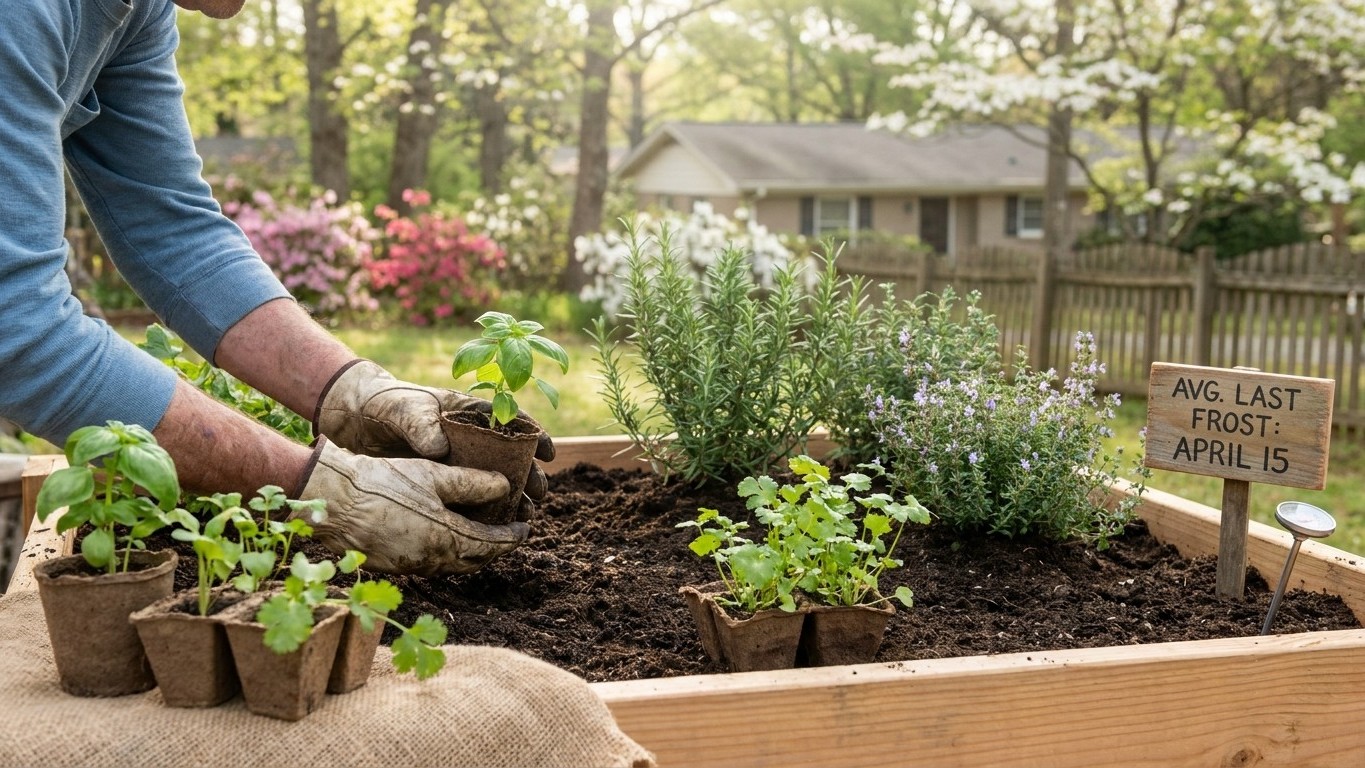

Louisiana gardeners get two real planting windows, not one: a cool-season stretch that runs from fall into winter, and a short warm-season push in late winter before summer heat takes over. Frost barely factors into the decision. Heat does.
The short answer for Louisiana
NOAA’s 1991-2020 climate normals put the last spring frost at this reference station between January 18 and February 8, and the first fall frost between December 17 and January 8. Those dates come from the 30-70 percent probability band for a 32F freeze, meaning they mark the window where a freeze is neither rare nor a sure thing, not a guarantee either way. And here’s the twist that makes Louisiana different from most planting calendars you’ll find online: a 32F freeze only happens in 86.8 percent of years at this station. Roughly one winter in seven, it never freezes at all. The fall and spring frost windows sit close enough together, straddling the New Year, that the entire “frost season” is short and unreliable to begin with.
That changes how you should read this calendar. For warm-season herbs like basil, Thai basil, and most annual varieties sold at nurseries, the limiting factor isn’t the last frost date, it’s whether the soil has warmed enough and whether you can get a full harvest in before June heat stalls growth. Many Louisiana gardeners set out basil transplants in late February through March, ahead of where a colder-zone chart would put them, because a hard freeze after that point is genuinely unlikely in most of the state.
For cool-season herbs, cilantro, dill, parsley, chervil, the calendar flips. These plants don’t die from Louisiana’s mild winters. The coldest month here averages a daily minimum of just 46.1F, which is above freezing more often than not and rarely dips into damaging territory for a hardy herb. What kills cilantro and dill in Louisiana is heat, not cold. Sow them from October through February, and let them grow through the mild winter months when they’re happiest, rather than waiting for a traditional spring planting date that will only put them in the ground right as they start to bolt.
USDA places the state across hardiness zones 8a to 10a, using the average annual extreme minimum temperature as its single variable. That range matters more for perennial herbs like rosemary and bay laurel, which is covered below, than for the annual crops most home gardens focus on.
What will not work here
Planting cool-season herbs in spring, the way a seed packet grown for a northern climate suggests, sets you up to fail. Cilantro and dill are notorious bolters, and Louisiana’s spring warms up fast. A crop sown in March instead of October or November will often throw a flower stalk and go to seed within a few weeks of the first genuinely hot days, long before you’ve gotten much of a harvest. The plant isn’t struggling, it’s doing exactly what heat tells it to do.
Herbs that need a real winter chill to thrive don’t get one here. French tarragon is the classic example: it wants a period of cold dormancy to reset for the next growing season, and a coldest-month average minimum of 46.1F simply doesn’t deliver that kind of cold snap with any reliability. Gardeners who bring tarragon plants from a nursery grown up north often watch them limp along for a season or two before giving out, not from frost damage but from never getting the rest period the plant is built for.
Humidity does more damage in a Louisiana garden than cold ever will. Close spacing that works fine in a drier climate becomes a liability here, because still, damp air between crowded basil or oregano plants is exactly what powdery mildew and fungal leaf spot need to take hold. Wider spacing than the seed packet suggests, plus watering at the soil line instead of overhead, does more to keep an herb bed alive through a Louisiana summer than any fertilizer schedule.
A weekly watering routine, the kind that works for a lot of the country, doesn’t hold up against Louisiana’s summer heat and its habit of alternating drenching downpours with dry, blazing stretches. Container herbs especially can go from soggy to bone-dry in the same week. And because a hard freeze is rare enough that it doesn’t reliably knock back overwintering pests and fungal spores the way it does farther north, disease and insect pressure tends to carry over from one growing season into the next rather than resetting each winter.
What changes across Louisiana
A hardiness range of 8a to 10a is not a small spread. That’s the difference between a garden that can expect a hard freeze most winters and one where a 32F reading is genuinely unusual, and it covers roughly 20 degrees of difference in the average annual extreme minimum temperature that the USDA map is built on. There is no single planting date that fits both ends of that range, and this page isn’t going to pretend otherwise.
A gardener in the northern part of the state, closer to zone 8a, should expect a more dependable freeze each winter and a shorter true warm season for tender herbs. That argues for holding basil and other frost-sensitive transplants a bit later into spring than the state-wide window suggests, and for treating perennial herbs like rosemary as plants that may need winter protection some years.
Closer to the coast, where the range pushes toward zone 10a, a hard freeze is rare enough that woody perennial herbs, rosemary, bay laurel, even some lemongrass, can be grown as true, unprotected perennials that simply keep producing year after year. Gardeners there can also push warm-season herb transplants earlier in late winter with less risk, since the odds of a damaging freeze after mid-February are already low and get lower the farther south you are.
None of that tells you which zone your own yard sits in. The USDA’s interactive map lets you enter a ZIP code and get a zone assignment built from decades of station data, which is the right tool for that question. What this section can tell you is that “Louisiana” isn’t one climate for planting purposes, it’s a gradient, and the further you are from the Gulf, the more seriously you should take the frost dates given above.
Where to check this for your own county
The LSU AgCenter, Louisiana’s land-grant extension service, is the right next stop, and it’s reachable at lsuagcenter.com. State extension services exist specifically to translate broad climate data like NOAA’s frost normals into planting advice tested on real soil, in real parishes, over real growing seasons.
Two things are worth looking for once you’re there. The first is a parish-level or regional planting calendar, since LSU AgCenter publishes guidance calibrated for Louisiana’s own agricultural regions rather than the single statewide window this page has to work with. The second is variety trial information, meaning which basil, cilantro, or parsley varieties have actually performed well in university trial gardens or extension demonstration plots within the state, since heat tolerance and bolt resistance vary a lot between cultivars even within the same herb.
A parish recommendation will always beat a state-wide one, for the simple reason that it’s built on a smaller, more specific set of conditions. This page works from station-level NOAA frost data and USDA zone ranges that span the whole state, which makes it useful for understanding the overall pattern, why Louisiana’s calendar looks different from a northern one, and why heat matters more than frost here, but not a substitute for guidance built around your own parish’s soil, rainfall, and microclimate.
If your parish extension office publishes its own calendar or holds a master gardener program, that local layer of information is where general climate data turns into a planting date you can actually trust for your own yard.
Some gardeners also time this by the Moon: when to plant herbs by the moon, as almanac tradition rather than fact.
Checking this against your own garden
Every date on this page is an average built from decades of station readings. Your own garden runs on its own schedule, shaped by how much sun it gets, whether it sits in a low spot that holds cold air, and what’s under the soil surface. Three things will tell you more than any calendar.
Feel the soil itself before you sow. Push a finger a couple of inches down in the morning; if it feels cool and slightly damp rather than cold, warm-season herb seed is more likely to germinate than sit and rot. Cold, wet soil is the single biggest reason spring-sown basil seed fails even after the calendar says it’s safe.
Watch your cool-season herbs for the first sign of a flower stalk starting to form at the center of the plant. That’s the early warning of bolting, and it shows up before the plant looks stressed in any other way. Once you see it starting on cilantro or dill, the harvest window is closing fast regardless of what the calendar predicted.
Track how quickly seedlings put out their first true leaves, the second set that looks like the mature plant rather than the rounded first leaves. Fast, sturdy true-leaf growth means your particular spot is running warm and fertile enough to support that herb right now. Slow, pale growth is your garden telling you the timing, or the spot, isn’t quite right yet, no matter what the regional average predicted for this week.