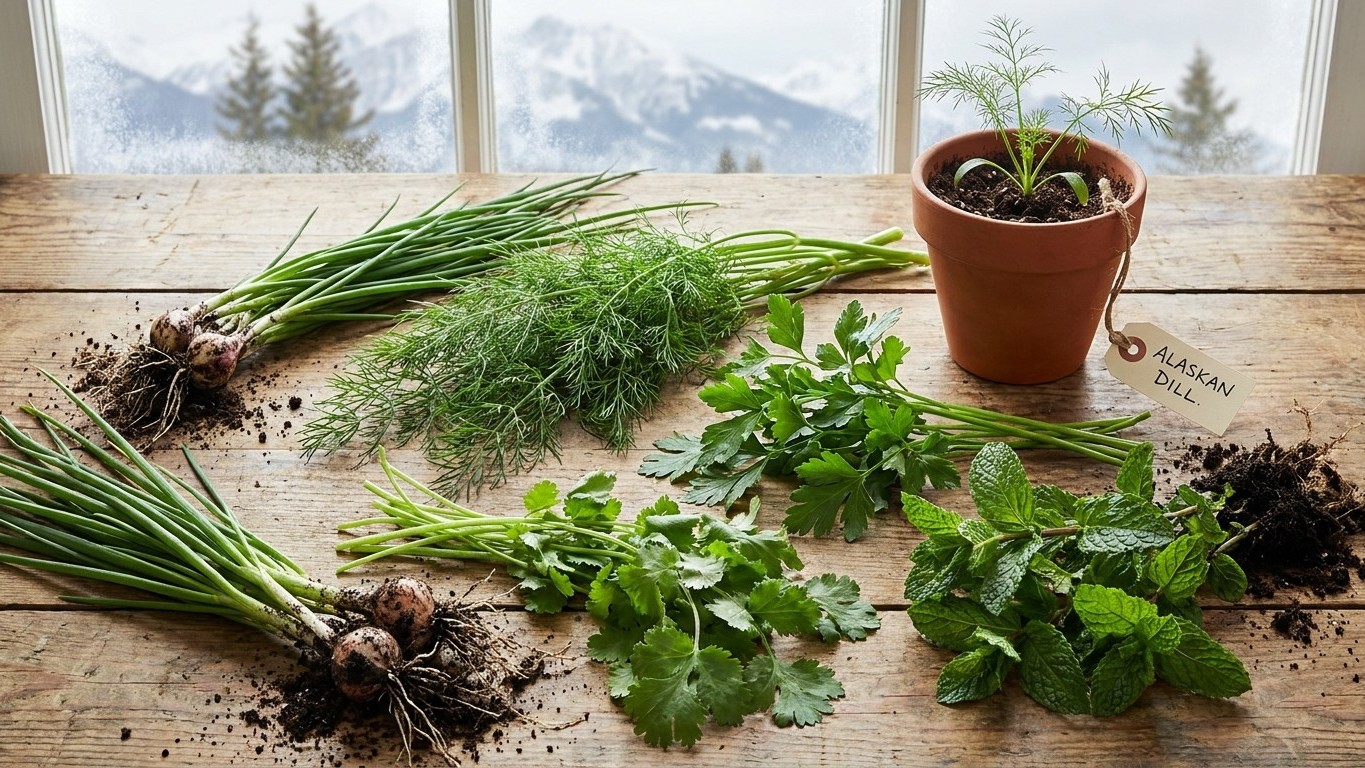

Montana’s growing season runs short and its winters run cold enough to kill anything not built for it, so the herbs that actually work here are the tough perennials (chives, thyme, oregano, sage) and the fast annuals (dill, cilantro, parsley) that can finish inside that narrow window. Basil survives but sulks. Rosemary mostly doesn’t survive at all.
The short answer for Montana
Start with the number that matters most: at Billings, the state’s reference station and one of its milder valleys, the last spring freeze typically falls between April 29 and May 10, and the first fall freeze arrives between October 1 and October 14. That puts the usable window somewhere around 150 to 160 days, depending on where in that spread a given year lands. Everything you plant has to either finish inside that window or be tough enough to sit outside it entirely.
That’s the filter for annual herbs. Dill, cilantro, and parsley all mature well inside 150 days, which is why they’re the safest direct-seeded choices across most of the state. Basil technically fits the calendar too, but it wants warm soil and warm nights to actually grow fast, and Montana’s spring soil warms slowly even after the air does. Treat basil as a transplant crop, not a direct-seed one, if you want a real harvest before the calendar runs out.
Perennial herbs answer to a different number: the mean minimum of the coldest month, which at Billings sits at 17.9°F. That’s not the record low for the winter, it’s the average nightly floor during the coldest stretch, and it’s the figure that decides whether a perennial herb roots through winter or dies at the crown. Chives, thyme, oregano, sage, and mint are all rated hardy well below that mark, which is why they’re the backbone of a Montana herb bed that comes back year after year without replanting.
Mint deserves a caveat that has nothing to do with cold: it spreads aggressively once established, and in a short-season state where garden space is precious, letting it run loose in a bed with slower perennials is a mistake gardeners make once and regret for years. Contain it.
The honest, type-by-type answer looks like this: lean on chives, thyme, oregano, sage, and mint for anything you want to survive winter untouched. Lean on dill, cilantro, and parsley for anything you’re willing to reseed each spring. Treat basil as a warm-season guest you start indoors and move out once the soil has actually warmed, not on a fixed date. That’s the state-level answer, and it holds up whether you’re gardening in the milder river valleys or the colder benches above them.
What will not work here

Rosemary is the herb most Montana gardeners try and lose, and the coldest-month figure explains exactly why. A mean nightly minimum of 17.9°F during the worst stretch of winter is well below what rosemary tolerates in open ground almost anywhere it’s grown as a perennial. It needs winter lows nowhere near that harsh to survive outdoors, which is why it belongs in a pot that comes inside for winter here, not in a permanent bed. Planting it in the ground and hoping is a wasted season, not a long-term herb.
French tarragon is the other common disappointment, for a different reason. It’s a slow starter that wants a long, steady growing season to bulk up before it can be harvested hard, and a 150-to-160-day window with a hard stop at both ends doesn’t give it much margin. Gardeners who plant it expecting a quick first-year harvest usually find themselves waiting for a second or third season that never quite arrives before an early fall freeze cuts it back.
Bay laurel and lemongrass fail for the same reason rosemary does, just more decisively. Neither one is built to handle a Montana winter in the ground under any circumstances, and both need to be containerized and brought indoors if you want to keep them from one year to the next.
There’s a watering trap worth naming too. Montana summers run dry, and herbs that want consistent, close-in moisture (basil especially, and dill to a lesser extent) will bolt or stall if you’re watering on a once-a-week schedule instead of checking soil moisture directly. A dry stretch during the hottest weeks of July will push cilantro to bolt and turn bitter faster than most gardeners expect, since it’s already a cool-season herb being asked to finish its life cycle in the hottest part of a short summer.
Finally, remember the caution baked into those frost dates: Billings is one of the milder valleys in the state, and mountain valleys elsewhere can see a freeze in any month of the year. An herb that “works in Montana” on paper can still get hit by a surprise frost in July at elevation. Nothing on this list is frost-proof once you leave the milder river valleys.
What changes across Montana
Montana’s USDA hardiness zone range runs from 3a to 6a, and that’s not a rounding error, it’s a real split in what a perennial herb can survive from one part of the state to another. A zone 3a valley in the north or at high elevation demands a different bet than a zone 6a pocket along a warmer river corridor. There is no single hardiness answer for “Montana,” only a spread, and treating the state as one climate is how gardeners end up losing perennials that would have been fine forty miles away.
The practical shift for a reader in the colder, higher end of that range is to lean harder on the toughest perennials, chives above all, since it’s rated hardy to the coldest end of that spread with the least fuss. Thyme and oregano follow close behind. Sage does fine in most of the range but is the first of the four to hesitate in the harshest pockets, especially if it goes into winter without much snow cover to insulate the crown.
For annuals, the shift is less about survival and more about margin. A gardener at the colder end of the 3a-to-6a spread should assume a shorter effective season than the Billings frost dates suggest, since those dates come from one of the milder stations on the state’s network. That means favoring the fastest-maturing dill and cilantro varieties available and giving basil transplants a head start indoors rather than counting on direct seeding to finish in time.
None of this is a substitute for knowing where you actually sit in that 3a-to-6a range. The spread exists and shapes your choices, but it can’t place you on the map. That’s a separate step, and it’s worth taking before you commit a perennial herb bed to a spot you haven’t checked.
Where to check this for your own county
Montana State University Extension is the state’s land-grant extension service, and it’s the right next stop for county-level answers. A statewide page like this one can only work from statewide averages and reference-station data. Your county office works from what actually grows there.
Two things are worth asking for specifically. First, a local planting calendar, if the county office publishes one, will reflect the actual frost pattern of your valley or bench rather than the Billings reference dates used here. Given how wide the spread is between a milder river valley and a colder mountain pocket, that local calendar can shift your safe planting window by two or three weeks in either direction. Second, ask about herb and vegetable varieties that have actually been trialled in your county. Extension offices track which cultivars perform under local conditions, and a variety recommendation built on local trial data will beat a general statewide suggestion every time.
A county-level recommendation outranks a state-level one. That’s not a knock on either; a state page is useful for understanding the general shape of the growing season and which herbs are worth attempting at all, but it can’t tell you what your specific soil, elevation, and microclimate will do with them. The county office can get closer to that answer, and a local nursery or extension agent who’s watched gardens through several winters in your area can often get closer still.
Checking this against your own garden
Every date and average is a starting estimate, and your own garden will always outrank it once you’ve got something growing in the ground. Three things are worth watching directly, none of which require anything more than your hands and your eyes.
Soil warmth by feel matters more than the calendar for anything you’re direct-seeding. Push a finger a couple inches into the bed where you plan to sow dill or cilantro; if it still feels cold and damp rather than just cool, the soil hasn’t caught up to the air temperature yet, and seed sown into it will sit and rot rather than germinate. Wait until it feels closer to room temperature before committing seed to it.
The first true leaves on any direct-seeded herb tell you whether your timing worked. Seedlings that push past their initial seed leaves and put out a real second set within a week or two are growing in conditions that suit them; ones that stall for two or three weeks are telling you the bed was planted too early for that particular spot, whatever the calendar said.
Spring regrowth on your perennial herbs is the clearest local read you’ll get on where you actually sit in that 3a-to-6a range. If chives, thyme, and oregano all push new growth reliably each spring without dieback at the crown, your microclimate is running on the milder side of the spread for that spot. If sage struggles or dies back hard some winters and not others, you’re closer to the edge of what that herb can handle where you garden, and that’s worth knowing before you invest in a bed of it again.