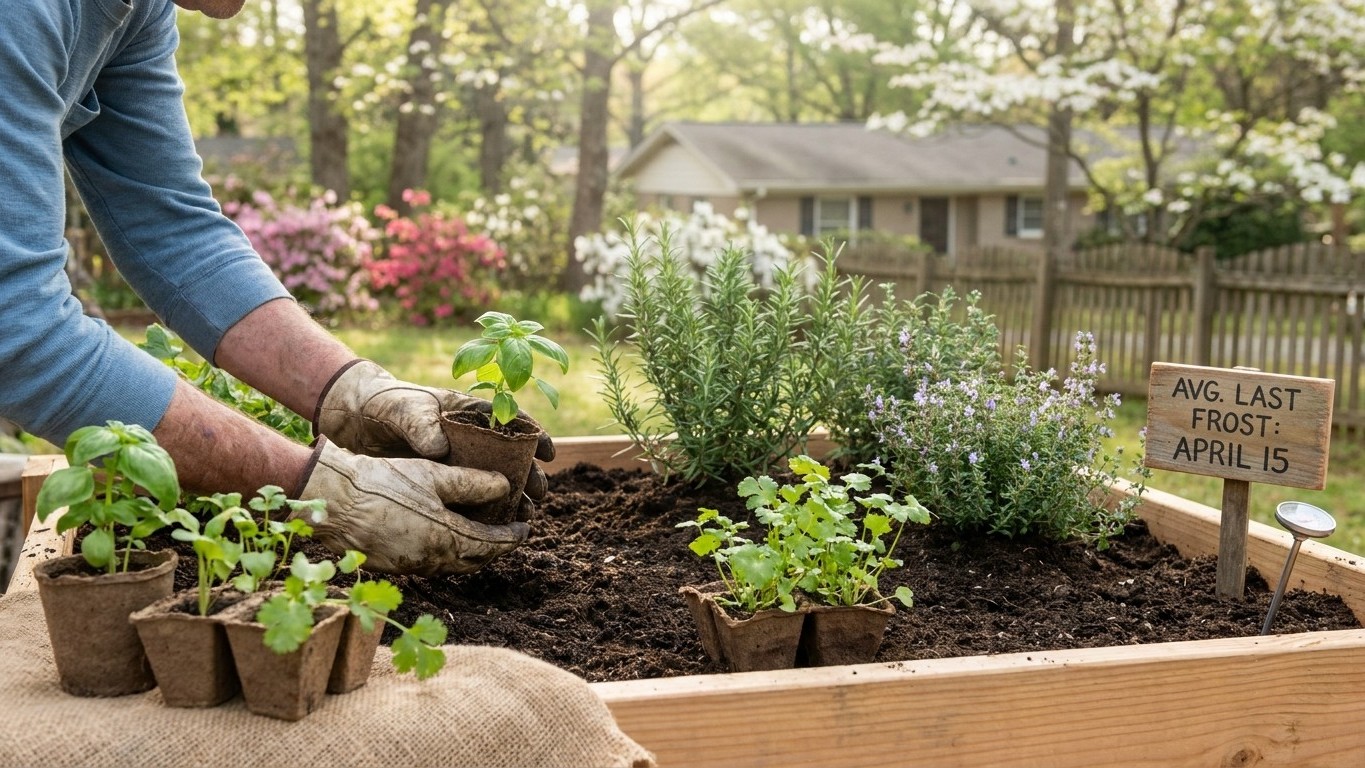

Montana’s outdoor sowing window for hardy herbs opens around the last spring frost date, April 29 to May 10 near Billings, and closes with the first fall frost, October 1 to October 14. Tender herbs like basil wait until well inside that window; cold-tolerant herbs like chives, dill, and parsley can go in two to three weeks earlier under cover. Indoors, back-count six to eight weeks from the frost date for transplants.
The short answer for Montana
Those frost dates aren’t a guarantee, they’re a probability. NOAA’s 1991-2020 climate normals for the Billings station put April 29 to May 10 in what’s called the 30-70% band for a 32°F freeze, meaning any date inside that range still carries a real, non-trivial chance of frost. Gardeners treating May 10 as a hard finish line get burned some years; treating it as “still risky, bring the row cover” is the more honest read of the data.
That single fact splits Montana’s herb list into three practical groups. Cold-hardy herbs that shrug off a light frost, chives, cilantro, dill, parsley, can go into the ground two to three weeks before the window opens, since a stray 30°F night won’t kill established seedlings. Tender annual herbs, basil above all, need the window to have fully passed with margin; sowing them at the early edge of April 29 is a bet against a 30-70% freeze probability, and it’s a bet that loses often enough to matter. Perennial herbs sold as nursery starts, rosemary, sage, thyme, oregano, go in after the window closes, but their real test isn’t spring planting, it’s the winter that follows.
What this means by herb type
| Herb type | Examples | Timing relative to the frost window |
|---|---|---|
| Cold-hardy annual/biennial | Chives, dill, parsley, cilantro | Direct sow 2-3 weeks before window opens |
| Tender annual | Basil, tender annual herbs | Sow only after window fully closes, ideally after May 10 |
| Perennial (nursery transplant) | Rosemary, sage, thyme, oregano | Transplant after window closes; winter survival is separate question |
The fall side of the calendar matters just as much and gets ignored more. First frost arrives October 1 to October 14 in the same probability band, which means anything still needing weeks to mature by late September in Montana is racing a clock that’s already ticking against it.
What will not work here

Do the arithmetic on the frost dates and Montana’s frost-free season runs somewhere between 144 and 168 days, depending on which end of each window you land on in a given year. That’s a short season by national standards, and it quietly rules out herbs bred for a long, slow build. Parsley varieties that need a full 90 days just to reach usable size, or herbs typically started from seed and grown to woody maturity in one summer, can run out of daylight before they run out of growth left to do.
The bigger failure point isn’t the season length, it’s the winter. The mean daily minimum of Montana’s coldest month sits at 17.9°F. That’s not the record low, it’s the average low on a typical cold-month night, and it’s the number that actually decides whether a perennial herb survives outdoors at all. Rosemary and lemongrass, both marginal even in mild zones, have no realistic path through a winter where 17.9°F is the routine nightly floor rather than the exception. Plant them expecting a perennial and they’ll behave like an annual, full stop, unless brought indoors.
There’s a second trap buried in the frost-date caution itself: Billings is one of the milder valleys in the state, and mountain valleys elsewhere in Montana can see frost in any month of the year. A gardener in a high mountain valley who plants tender basil on the Billings-based calendar, trusting May 10 as safe, is applying a lowland number to a landscape that doesn’t share it. Weekly watering schedules run into a similar mismatch problem: a plan built around one valley’s evaporation rate doesn’t automatically hold at a different elevation, and herbs that get watered on autopilot rather than by checking the soil are the ones that show stress first.
What changes across Montana
Montana spans USDA hardiness zones 3a to 6a, per the 2023 Plant Hardiness Zone Map, and that’s a wide enough spread that no single planting date works for the whole state. The USDA zone system is built on one variable, the average annual extreme minimum temperature, so it’s a hardiness measure, not a planting calendar by itself, but the spread it shows is real: a herb that overwinters fine in a 6a valley can die outright in a 3a mountain basin a few hundred miles away.
The frost dates and coldest-month figure in this article are anchored to the Billings station, sitting toward the milder end of that zone range. A reader gardening at higher elevation or farther north should expect the last spring frost to land later than April 29 to May 10, the first fall frost to arrive earlier than October 1 to October 14, and the coldest-month minimum to run colder than 17.9°F, sometimes considerably so. That combination shortens the usable season further and makes perennial herb survival even less of a sure thing.
Practically, that means shifting sowing dates later in spring and harvest expectations earlier in fall for anyone north of the Billings valley or gardening at altitude, and treating rosemary, sage, and other borderline perennials as strictly container plants that come indoors for winter rather than garden fixtures. The USDA Plant Hardiness Zone Map can tell an individual reader which zone they sit in, down to the ZIP code.
Where to check this for your own county
Montana State University Extension runs the state’s land-grant extension service, and its site is the next stop for anyone who wants a number sharper than the state-level figures used here. Extension offices work at the county level specifically because a state’s climate data, even broken down by hardiness zone, still averages over terrain that varies enormously from one valley to the next.
Two things are worth hunting for once there. First, a local planting calendar, if the county office publishes one, built from soil temperature and frost records specific to that area rather than a statewide station like Billings. Second, a list of herb and vegetable varieties that have actually been trialed in that county, since extension offices often track which cultivars held up locally against the exact combination of frost timing, season length, and winter cold that county experiences.
A county recommendation beats a state one every time, for the same reason a local weather forecast beats a national one. State-level and single-station data give a general planting window and the mechanics behind it, but county offices know a specific patch of ground better. Their staff also field direct questions by phone or email, which is worth using for a variety that hasn’t been mentioned or a planting date that doesn’t quite match local experience.
Checking this against your own garden
Every date in this article is a regional average built from decades of station data. A reader’s own garden, checked by hand, will outrank all of it, because it reflects the actual soil, slope, and microclimate the herbs are growing in rather than a statewide or single-station approximation.
Three signs are worth watching. Soil warmth by feel comes first: squeeze a handful of soil from four to six inches down, and if it still feels cold and slightly damp rather than crumbly and mild, tender herb seeds sown there will likely sit and rot rather than germinate, whatever the calendar says. Second, watch the first true leaves on any cold-hardy herb sown early, chives or parsley usually show them before basil would even germinate, and their appearance is a decent signal that the soil has crossed the threshold most seeds need. Third, track how fast volunteer weeds green up nearby; weeds respond to the same soil temperature cues as herb seeds, and a lawn or bed greening up unusually early or late compared to most years is a rough but useful clue about how that particular spot compares to the regional average.
None of that requires a soil thermometer or any other tool. It requires paying attention, which, over a season or two, tells a gardener more about their own patch of Montana than any frost-date table ever will.
The Moon calendar is a separate, older custom: see when to plant herbs by the moon, written as tradition rather than fact.