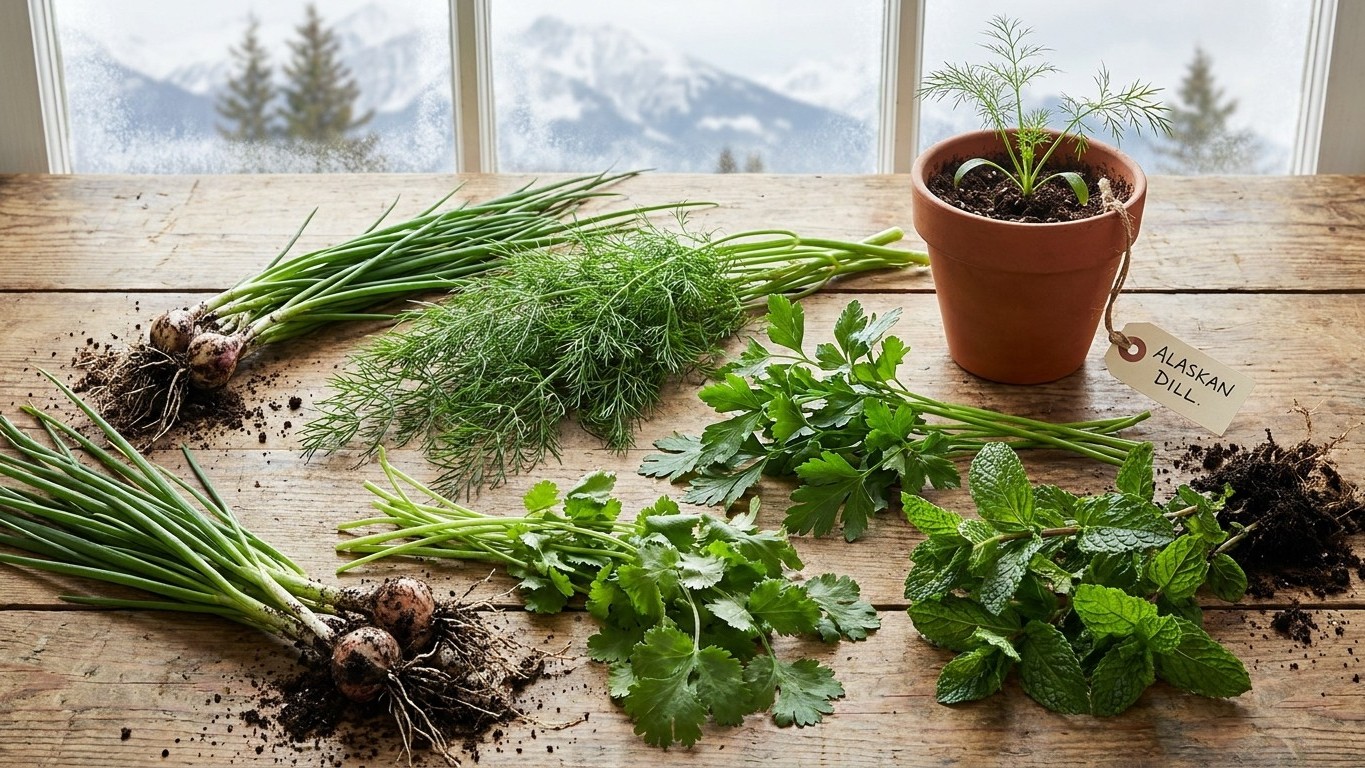

The herbs that reliably succeed in Newfoundland and Labrador are the fast, cold-tolerant kind: chives, parsley, dill, cilantro, and mint. Slow-maturing, heat-loving herbs like basil, rosemary, and tarragon struggle outdoors here and need containers, a sunny wall, or a trip indoors before the cold arrives.
The short answer for Newfoundland and Labrador
Start with the number that governs everything else: a frost-free window that runs, on average, from May 30 to October 17 at the St. John’s A station. That’s roughly 140 days, and it is a mean, not a promise. Half the years on record, frost arrives later than May 30 in spring, or earlier than October 17 in fall. Anyone planning a herb garden here needs to build in a margin on both ends rather than treating those dates as fixed.
Within that window, the decision by type is straightforward. Herbs that germinate fast, tolerate cool soil, and can be harvested young fit the province’s growing conditions well. Chives come back from the root every spring and shrug off a late cold snap. Parsley and dill germinate in soil that’s still on the cool side and don’t ask for a long stretch of heat to mature. Cilantro actually prefers the shorter, cooler summer, since it bolts to seed fast once real heat shows up, something that’s rarely a problem here. Mint, planted in a contained bed or a pot, is close to foolproof provided it gets enough moisture.
On the other side of the ledger are the herbs that need a long run of warm days to bulk up: basil, rosemary, tarragon, and to a lesser extent, sage. These aren’t herbs that fail outright in Newfoundland and Labrador, but they need help. Basil wants soil and air warmth that a coastal or northern summer doesn’t reliably deliver for the full season, so it’s usually grown from a transplant set out well after the average frost date, not direct-seeded. Rosemary and tarragon, meanwhile, run into a winter problem more than a summer one, which the next section covers in detail.
The practical shortcut: if a herb is usually direct-seeded and harvested within six to eight weeks, it’s a strong bet here. If it needs three months of unbroken warmth to make full-size leaves or flavor compounds, plan on a container you can move, or accept a shorter, less productive season outdoors.
What will not work here
Rosemary is the clearest case. The mean daily minimum of the coldest month at the reference station is 16.4°F. Rosemary’s woody stems are reliably damaged well above that temperature when grown in open ground, and a plant left outside through a Newfoundland and Labrador winter in unprotected soil has very little chance of coming back in spring. This isn’t a marginal risk to hedge with mulch alone. It’s a herb that needs to spend winter in a container, moved indoors or into an unheated but frost-shielded space, if it’s going to survive here at all.
Basil fails for a different reason: timing risk stacked on a short season. Because the May 30 frost date is a midpoint, not a guarantee, a gardener who sets out basil transplants right at that average date is accepting real odds of a setback if the season runs late, which happens in roughly half of all years on the historical record. Combine that with a summer that doesn’t always deliver sustained heat, and basil ends up needing both a later, more cautious start and consistently warm, sheltered placement to produce a usable harvest before the October frost mean arrives and shuts things down.
Tarragon runs into the same overwintering problem as rosemary, just less severely. French tarragon in particular is known for being touchy about wet, cold roots, and a 16.4°F average minimum in the coldest month, combined with whatever colder snaps occur around that average, puts sustained survival in open ground in question in much of the province. Gardeners who want tarragon here typically treat it as a container plant that gets moved somewhere protected for winter, the same strategy that works for rosemary.
None of this means these herbs are impossible in Newfoundland and Labrador. It means they aren’t a set-and-forget outdoor planting the way chives or parsley are. The short season and the cold winter minimum are the two numbers doing the work here, and any herb that needs to beat both at once is the one to watch closely rather than assume will coast through.
What changes across Newfoundland and Labrador
The hardiness zone figure available for this territory, 6a on the Canadian system, applies to the reference city used for that measurement, not to the province as a whole. That distinction matters more here than in most places. Newfoundland and Labrador covers coastal lowlands, interior barrens, and the far more severe climate of Labrador itself, and a single zone rating from one reference point cannot describe all of it. There is no single answer to “what zone am I in” for a territory this size, and this page isn’t the place to guess at one.
It’s also worth remembering that the Canadian zone system isn’t built the same way as the USDA system used elsewhere on this site. Natural Resources Canada calculates its zones from seven climate variables, not the single winter-minimum figure the USDA system uses, and the two don’t convert cleanly. NRCan’s own comparison shows a single Canadian zone can overlap up to nine different USDA zones. So a Canadian 6a reading tells you something real about a location’s overall climate profile, but it isn’t a stand-in for a USDA number, and it shouldn’t be read as one.
What a reader further north, in Labrador, or at higher elevation inland should assume: the season is very likely shorter than the averages given here, both because spring warmth arrives later moving north and because the frost dates cited are from a coastal station where the ocean moderates temperature swings. Inland and northern sites lose that moderating effect. The practical shift is to treat the herbs that already sit near the edge of what this territory allows, basil, rosemary, tarragon, as even more marginal the farther a garden sits from the coast or the farther north it sits, and to check a local zone map before betting on anything borderline.
Where to check this for your own county
This page describes the province using data from a single reference station and a single reference city. That’s useful for a first pass, but it isn’t a substitute for what the Newfoundland and Labrador Department of Fisheries, Forestry and Agriculture can offer. A provincial page averages away exactly the local detail that decides whether a herb bed thrives or struggles at a specific address.
Two things are worth looking for there. First, any local planting calendar the department publishes, which will reflect actual conditions in a specific region of the province rather than the single coastal station cited on this page. Second, any list of herb or vegetable varieties that have actually been trialled locally, since a variety proven to perform in a shortened, cool, coastal-influenced season is a better bet than one chosen off a generic seed packet written for a much longer, warmer growing region.
A regional or county-level recommendation will always beat a province-wide one, for the same reason a weather forecast for a specific town beats one for an entire coastline. This page works from averages drawn from one weather station and one hardiness reference point. It’s meant to answer the general question of which herbs suit Newfoundland and Labrador’s overall climate, not to replace a source that knows the frost patterns, soil, and wind exposure of one particular community. Anyone serious about squeezing a full season out of basil, or successfully overwintering rosemary in a specific yard, should treat the provincial department’s local resources as the next and more authoritative step, not this page.
Checking this against your own garden
Every date and average in this article describes the province in general. A gardener’s own observations, made right at the bed, outrank all of it, because they reflect the specific soil, wind exposure, and shelter of that one spot rather than a regional average.
Three things to watch. First, soil warmth by feel: press a bare hand into the top couple inches of soil in spring. If it still feels cold and damp rather than merely cool, seeds like dill or cilantro will sit and rot rather than germinate, regardless of what the calendar says about the average frost date having passed. Second, watch for the first true leaves on anything already seeded, the second set of leaves that look like the mature plant rather than the rounded seed leaves that appear first. Their appearance, and how quickly they follow germination, is a better local signal of how much warmth and light a particular bed is actually getting than any provincial average.
Third, for herbs grown from transplants, like basil, watch how the plant handles its first week outside. Leaves that stay upright and dark green through a cool night suggest a sheltered spot that’s running warmer than the general provincial pattern would predict. Leaves that droop or purple at the edges after a cool night are a sign that particular spot runs colder than average, and that basil, tarragon, or any other marginal herb needs more shelter, a warmer wall, or a container that can be moved, rather than a fixed spot in open ground. These small signs, read over a season or two, tell a gardener more about their own microclimate than any single date on a provincial chart ever will.