
Herbs grow well across Newfoundland and Labrador, but the window is short and the winter is the real gatekeeper. Tender annuals like basil need to wait far longer here than in most of Canada, while hardy perennials such as chives, thyme, and mint can survive outdoors only if the bed is chosen with the coldest month in mind, not the summer.
When the soil is warm enough in Newfoundland and Labrador
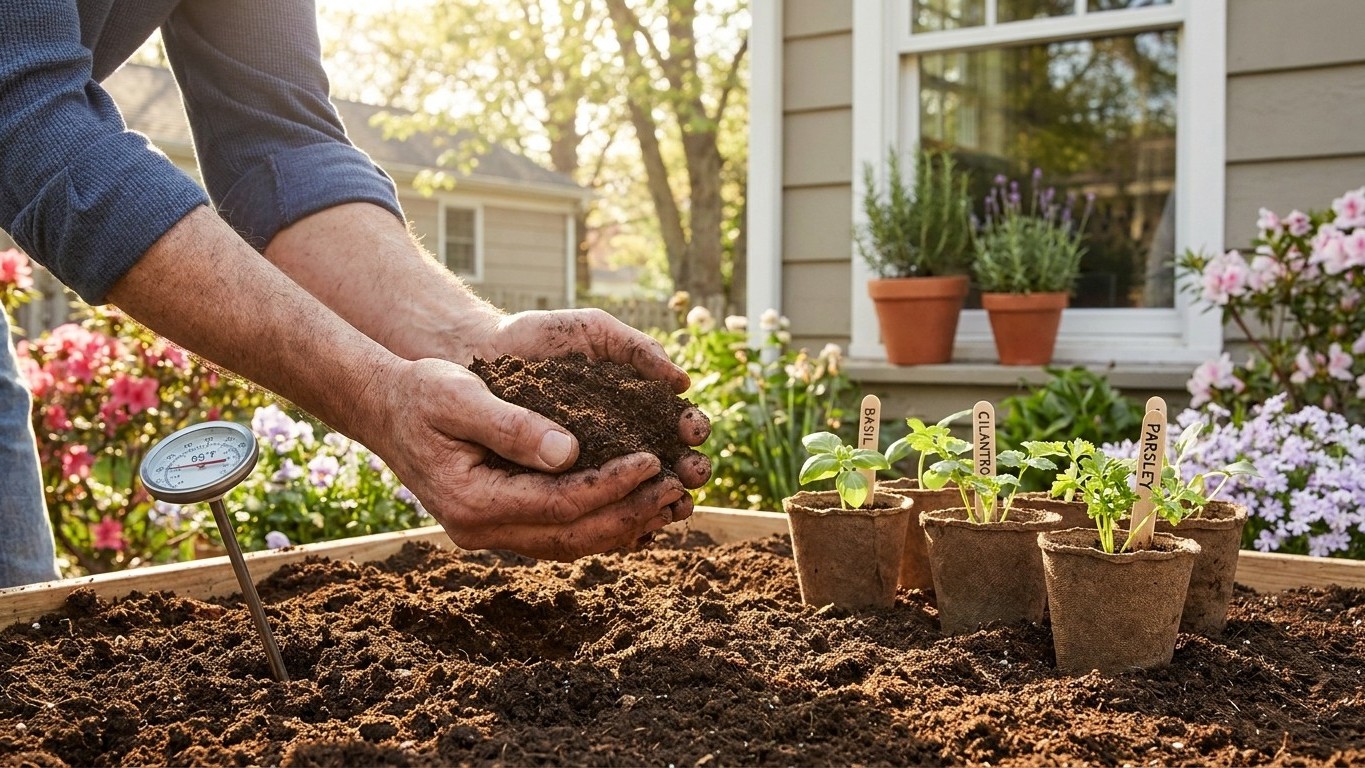
The average last spring frost at the ST JOHN’S A station is May 30, according to Environment and Climate Change Canada’s Canadian Climate Normals 1981-2010. That date answers a narrower question than most gardeners assume. Frost dates track air temperature at a specific hour of a specific morning; soil temperature is a slower, separate variable, and herbs germinate and root according to the soil, not the calendar. A basil seed dropped into cold, wet ground on May 31 will simply sit there, or rot, no matter how mild the air feels that afternoon.
Treat May 30 as a midpoint, not a guarantee. In one year out of two, the last frost at this station falls after that date, sometimes well after. That is what a mean date means in Environment and Climate Change Canada’s normals: half the years beat it, half do not. Gardeners on the Avalon Peninsula near St. John’s are working from the closest match to this figure. Anyone farther into central Newfoundland, on the west coast, or across Labrador should expect the frost-free window to open later still, often by two to three weeks, because a single reference station cannot describe a province this large and this varied in terrain.
Reading the herb bed by type, not by name
Tender annual herbs, the basil-and-cilantro group, want warm soil and no lingering frost risk before they go outside or before seed goes into open ground. Hardy perennial and biennial herbs, the chive, thyme, oregano, and parsley group, tolerate a cooler start and can go in slightly ahead of the tender types, though they still benefit from soil that has actually warmed rather than merely thawed. This page will not put a cultivar name on either group. Local trial data on what performs best in a given Newfoundland and Labrador garden lives with the provincial extension service, not with a general planting guide, and matching the two would be guessing dressed up as advice.
Some herbs common in home gardens, including a few in the mint family, carry a long-standing medicinal reputation. This page does not evaluate those claims, does not describe preparation, and does not suggest a dose or a use. It sticks to growing the plant, not to what might be done with it afterward.
How long the season lasts here
Subtract the two dates and the frost-free window at the ST JOHN’S A reference station runs from May 30 to October 17, roughly 140 days. That is a workable length for a herb garden, longer than many people assume for this latitude, and it changes two practical decisions right away.
First, it makes a second sowing realistic for the fastest annual herbs. Something sown in early June and cleared by late July still leaves nearly two and a half months before the average first fall frost on October 17, enough time for a fast-cycling herb to be sown again and reach usable size before the season closes. A gardener working a shorter window, say 90 days instead of 140, would not have that option; the first sowing would be the only one worth planning around, because there would be no time left to recover from a slow start or a patch of disease.
Second, the length of the window changes whether starting indoors and transplanting is worth the trouble. With 140 days on the table, direct-sown herbs like dill or cilantro have enough runway to mature without a head start. Slower annual herbs, basil in particular, still benefit from being started indoors and moved out once the soil has genuinely warmed, since a transplant arrives with weeks of growth already behind it, weeks the outdoor soil temperature simply would not have allowed. Anyone weighing which herbs are worth starting early versus sowing straight into the ground, and how to stagger a second round once the first is spent, should look at this site’s guide to succession sowing before laying out the bed.
Remember that October 17 carries the same caution as the spring date: it is a mean, not a promise, and a fall frost arriving early can cut a second sowing short with little warning.
Heat and water in Newfoundland and Labrador
Ask a herb gardener in Kansas or Arizona about summer heat and they will talk about shade cloth and afternoon wilting. That conversation does not apply here. This is a maritime province where extreme heat is not a meaningful part of the growing calculation, and the figures that matter instead point toward the opposite end of the thermometer.
The number that actually organizes a Newfoundland and Labrador herb bed is the coldest month’s average daily minimum: 16.4°F, per the ECCC Canadian Climate Normals 1981-2010 for the St. John’s reference station. That single figure decides which herbs are permanent residents of the garden and which are, in effect, container plants that spend winter indoors. A hardy perennial rated for the region’s Canadian hardiness zone, 6a according to Natural Resources Canada’s Plant Hardiness Site (1991-2020 normals, St. John’s), can generally take a winter with minimums in that range. A tender perennial that would sail through winter in a milder zone has no such guarantee here, and treating it as a permanent outdoor fixture is how a gardener loses it every few years without understanding why.
One caution worth repeating: Canadian zone 6a is not the same scale as the USDA zones used elsewhere on this site. The Canadian system runs on seven climate variables, not one, and Natural Resources Canada itself notes there is no clean conversion between the two, since a single Canadian zone can overlap several USDA zones. Compare herbs to this province’s zone only against other Canadian-zone figures, never against a USDA number.
On the water side, summer in this province tends to run cool and damp rather than hot and dry, which shifts the herb gardener’s real enemy from drought to mildew. Dense, leafy herbs planted too close together, or left without airflow at the base, are the ones that suffer in a wet, cool summer, not the ones exposed to baking sun. Spacing and drainage do more work here than shade ever will.
Which herbs suit Newfoundland and Labrador
Three facts from above point toward three practical choices, reasoned by type rather than by name.
A season of roughly 140 days rewards the earliest-maturing annual herb types, cilantro and dill among them, especially when a second sowing is planned in behind the first. Slower annual herbs, the basil group, still work here but need the indoor head start discussed above rather than a direct sowing into cool spring soil.
A cool, damp summer makes disease resistance the first thing to look for within any herb type, ahead of flavor or leaf size. Herbs prone to mildew in humid conditions do better with wide spacing, raised beds, and a spot that catches wind rather than one tucked against a damp wall.
A coldest-month minimum of 16.4°F inside Canadian hardiness zone 6a is the deciding line for perennials. Herb types generally considered hardy, chives, thyme, oregano, and some mints among them, can be planted with the expectation of surviving outdoors in a well-drained bed. Herb types generally considered tender perennials, several in the rosemary and bay families, are safer treated as container plants brought in before the cold month arrives, rather than gambled on a mild winter that this province cannot promise.
This page will not attach a variety name to any of those types. Cultivar performance is local by nature, tested plot by plot, and the only trial results worth trusting are the ones run in this province’s own conditions. That work belongs to Newfoundland and Labrador’s Department of Fisheries, Forestry and Agriculture, reachable at gov.nl.ca/ffa, and it is the right next stop for anyone ready to put a specific name on a specific herb this year.