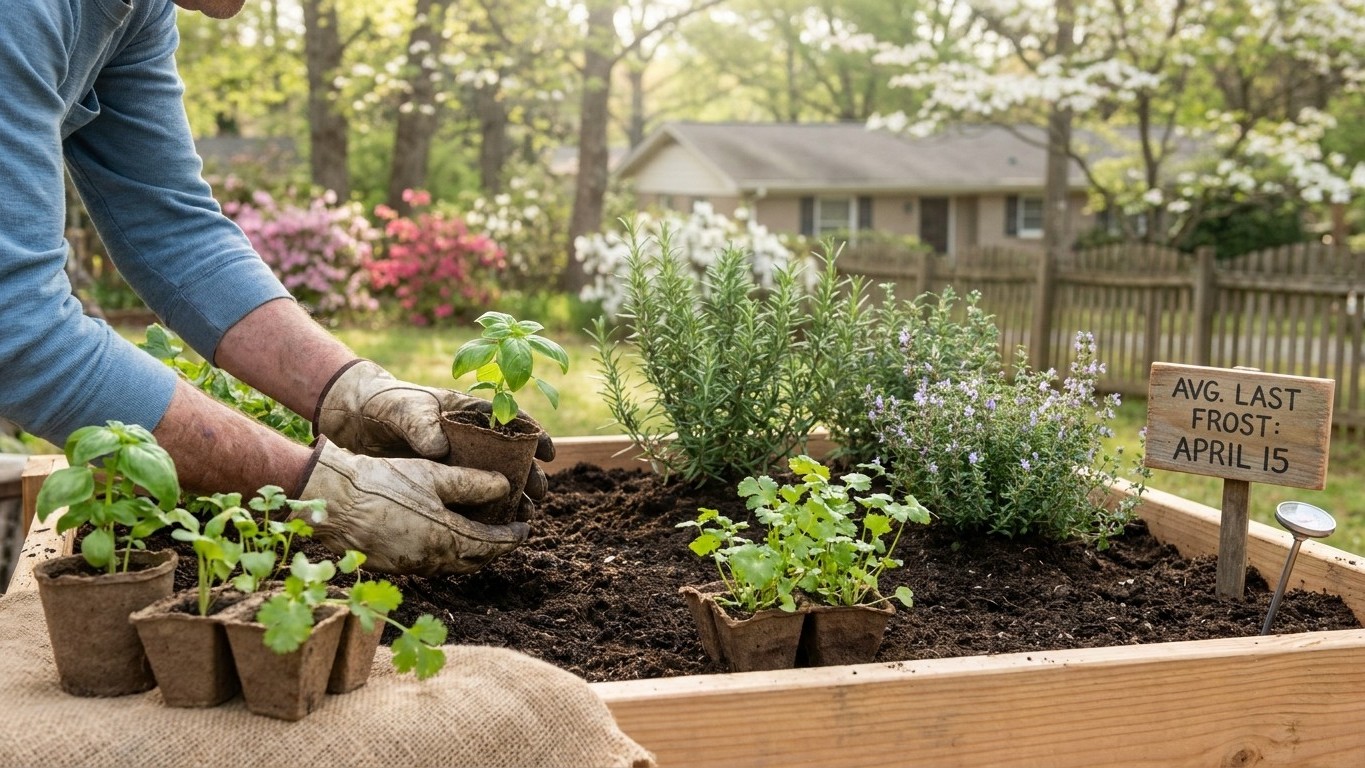

Newfoundland and Labrador’s herb garden runs on two dates: an average last frost of May 30 and an average first fall frost of October 17. That gives roughly 140 days to work with, and it means hardy herbs go in around late May while anything tender waits until the soil has actually warmed, not just the calendar.
The short answer for Newfoundland and Labrador
Start with the two numbers that matter: last spring frost on average May 30, first fall frost on average October 17, both measured at the ST JOHN’S A station by Environment and Climate Change Canada using the 1981-2010 normals. Those are mean dates, not guarantees. In roughly one year out of two, frost arrives later than May 30 in spring, and the same logic applies in reverse come fall. Treat May 30 as the midpoint of a window, not a green light.
That distinction changes how you sow. Cold-tolerant herbs, the kind that shrug off a light frost, can go into the ground as seed or transplant in the two or three weeks bracketing that mean date. Parsley, chives, cilantro and dill fall into this group. They germinate at cooler soil temperatures and tolerate the up-and-down nights that are normal for this part of the season.
Tender herbs are a different story. Basil, in particular, stalls or yellows if soil temperatures dip below the mid-50s Fahrenheit, and a frost that arrives after the May 30 average will kill it outright. Because that date is a coin-flip, not a promise, the safer move for basil and other heat-loving herbs is to wait until early-to-mid June, after the real risk has passed, rather than planting on the mean date and hoping.
| Herb type | Examples | Timing relative to May 30 mean frost |
|---|---|---|
| Cold-hardy, direct-sow | Chives, parsley, cilantro, dill | Around the mean date, slightly before is workable |
| Tender, frost-sensitive | Basil, tender annual herbs | Two to three weeks after the mean date |
| Perennial, cold-hardy | Thyme, chives, established mint | Planted once, survives winter outdoors in favorable microsites |
| Perennial, tender | Rosemary, bay laurel | Not reliably hardy outdoors here; treat as container plants |
Perennial herbs bring a second consideration: winter survival. The coldest month here averages a daily minimum of 16.4°F, a figure from the same 1981-2010 normals that decides which perennials actually make it through to spring rather than just which ones can be planted in June.
What will not work here
A roughly 140-day gap between frosts sounds generous next to a shorter growing season, but it defeats slow-maturing herbs that need a long, warm stretch with no interruptions. Rosemary grown from seed, for instance, can take well over a hundred days just to reach a usable size, leaving almost no margin if the season starts late or ends early, which the frost data says happens about half the time.
The bigger obstacle for many gardeners in this province is not the length of the season but its character. St. John’s summers run cool and often damp, shaped by ocean fog and marine air rather than steady inland heat. Basil, oregano and other Mediterranean natives evolved for hot, dry summers with intense sun. Cool nights and overcast stretches slow their growth, dull their flavor, and in humid patches invite fungal problems on the leaves before the plant ever reaches full size.
That humidity works against tight spacing too. Herbs like mint, lemon balm and bee balm are often planted close together to fill a bed quickly, but in coastal Newfoundland’s damp air, crowded plantings trap moisture around the foliage and set up conditions for powdery mildew and other leaf diseases. Wider spacing and airflow matter more here than in a drier climate where the same crowding would barely register.
Winter is the real filter
The 16.4°F average minimum in the coldest month rules out leaving tender perennials outdoors without protection. Rosemary and bay laurel, both marginal even in much milder zones, have no realistic path to surviving a Newfoundland winter in open ground. Gardeners who want them here generally grow them in containers that move indoors or into an unheated but frost-free space for the cold months, rather than treating them as permanent garden residents.
Watering habits imported from drier climates also backfire. A schedule built around infrequent, deep watering assumes a summer that dries the soil out between waterings. In a season with more cloud cover and higher ambient moisture, that same schedule can leave herb roots sitting wet, particularly in heavier soils that don’t drain quickly.
What changes across Newfoundland and Labrador
The hardiness zone figure used above, 6a in the Canadian system, applies to the reference city of St. John’s, not to the province as a whole. Newfoundland and Labrador is not one climate wearing different hats. It’s several distinct ones, and the Canadian zone system, built from Natural Resources Canada’s seven-variable model, reflects that by assigning very different zones to different parts of the province.
Labrador in particular sits in a different world climatically from the Avalon Peninsula. Interior and northern Labrador districts run colder, with shorter frost-free windows and lower winter minimums than the coastal station used for this page’s figures. A planting date that works on the Avalon Peninsula can be weeks too early for a garden further north or inland.
It’s worth being clear here too about what the Canadian zone number is not. It does not translate directly to a USDA zone. NRCan itself publishes the comparison, and a single Canadian zone can overlap as many as nine different USDA zones depending on location. So this page’s 6a figure should never be read against a USDA hardiness map, and it should never be treated as the zone for anywhere in the province except the reference city it was measured for.
Given that spread, there’s no single answer for “when to plant” across the whole province. A reader in a colder inland or northern district should expect to push every date on this page later, sometimes by a meaningful margin, and should check the Natural Resources Canada plant hardiness map for their own location rather than assuming the St. John’s figures apply directly.
Where to check this for your own county
Everything above comes from one weather station and one reference city. It’s a province-level starting point, not a local forecast. For anything closer to your own backyard, the Newfoundland and Labrador Department of Fisheries, Forestry and Agriculture is the place to go.
Once there, look for two specific things. First, any local or regional planting calendar the department publishes, which will reflect frost patterns closer to your actual location rather than the St. John’s averages used on this page. Second, information on herb and vegetable varieties that have actually been trialled in Newfoundland and Labrador conditions, since a variety bred for a longer, hotter season elsewhere may underperform here regardless of when it’s planted.
A provincial page like this one is useful for setting expectations and understanding the mechanics behind the dates. It is not a substitute for guidance tied to your own district. If the department’s resources point to a different window for your area than the one described here, that local guidance should take priority. This page describes the province-wide pattern; a county or regional recommendation describes your actual growing conditions, and the two won’t always match exactly.
Checking this against your own garden
Frost dates and zone maps describe averages. Your own garden describes itself, usually more accurately, if you know what to watch for.
Soil warmth by feel is the simplest check. Push a bare hand a couple of inches into the bed in the morning. If the soil still feels cold and slightly damp in a way that chills your fingers quickly, it’s not yet ready for tender herbs like basil, regardless of what the calendar says. Warm, slightly dry-to-the-touch soil is a better signal than any date.
Watch for volunteer seedlings too. Dill, cilantro and parsley often self-seed from the previous year, and when those volunteers start appearing on their own in a garden bed, it’s a reliable local sign that soil conditions have turned favorable for germination, often a more honest indicator than the regional average.
Finally, track the first true leaves on anything you’ve already direct-sown. The initial pair of leaves that emerge from a seed are not the plant’s real leaves; the second set, which look like a miniature version of the mature plant, are the first true leaves. Their appearance tells you the seedling has moved past the fragile germination stage and into active growth, which is the point where a light, unexpected frost becomes far more dangerous than it was a week earlier.