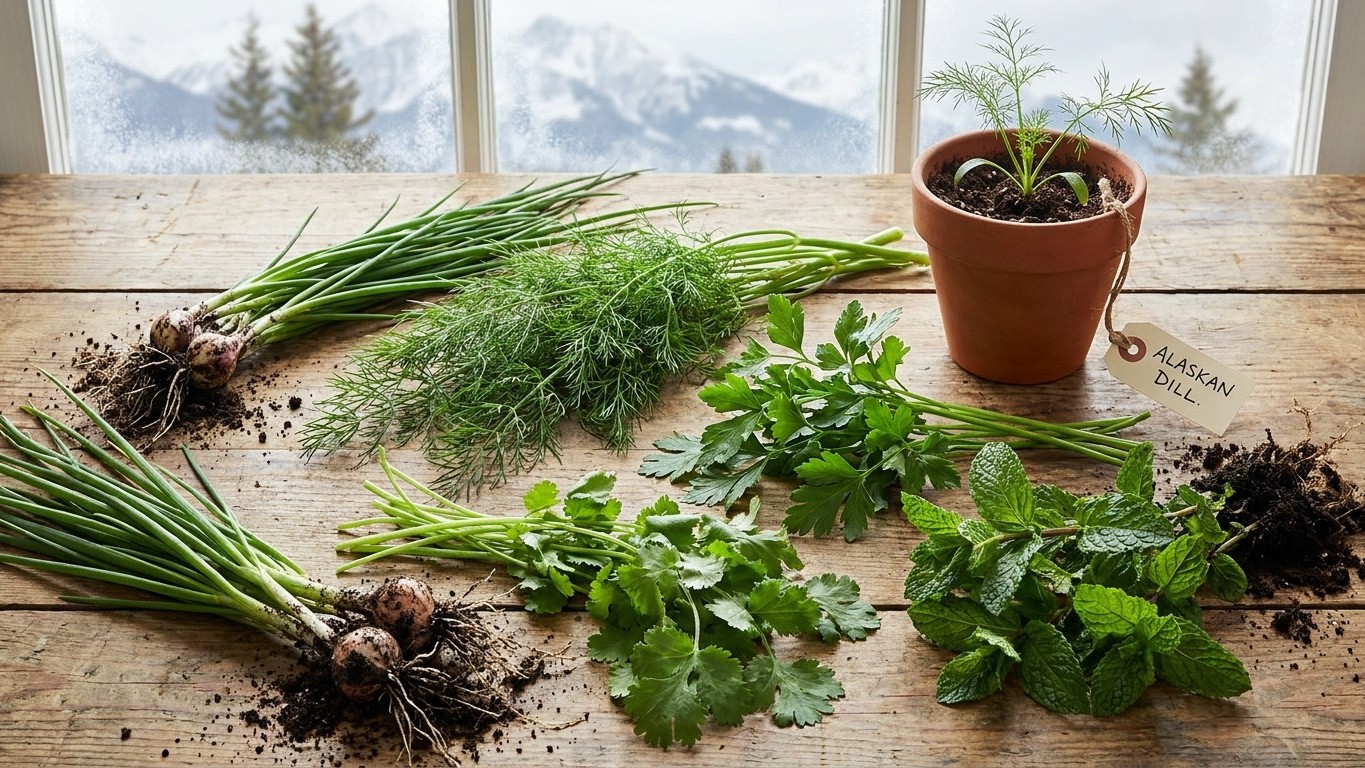

Herbs that survive New Hampshire’s winters in the ground, chives, thyme, oregano, sage, are the safest long-term bet here. Fast annuals like dill, cilantro, and basil fill the gaps once the last frost passes, while Mediterranean natives such as rosemary and bay need a pot they can come indoors with, because no part of this state is warm enough to keep them outside year-round.
The short answer for New Hampshire
The decision splits cleanly by category, and the split comes straight from two numbers: how cold the coldest month gets, and how many frost-free days sit between spring and fall. At the Manchester reference station, the coldest month averages a daily minimum of 17.1°F, and the frost-free window runs from a last spring frost of April 16 to April 27 out to a first fall frost of October 13 to October 26. Stack those against each other and you get somewhere between 169 and 193 frost-free days depending on where in that probability band your year lands.
That’s a middling season, long enough for nearly every annual culinary herb to go from seed to harvest, but the cold is the real filter. Herbs bred for Mediterranean hillsides, where winter lows rarely see single digits, run into trouble the moment New Hampshire’s actual winter shows up. Garden sage and common thyme generally tolerate it. Rosemary, in most cuts, does not.
Practically, that sorts New Hampshire herbs into three groups:
| Category | Examples | How to grow it here |
|---|---|---|
| Cold-hardy perennials | Chives, mint, oregano, common thyme, garden sage | Plant once, in the ground, expect it back each spring |
| Fast annuals | Basil, dill, cilantro, parsley, summer savory | Restart from seed or transplant every year, timed to the frost window |
| Container-only | Rosemary, bay laurel, lemongrass | Pot it, bring it inside before the first fall frost |
Basil and cilantro don’t care that they’re annuals everywhere; they’d be killed by frost even in a mild climate. What changes state to state is whether a perennial like rosemary gets a second season for free. in New Hampshire, it doesn’t. Treat that middle row of the table as the low-maintenance backbone of the garden and the container row as the plants you’re actively managing twice a year.
What will not work here
Rosemary left in the ground over winter is the most common disappointment reported by New Hampshire gardeners, and the math explains why. Most rosemary cultivars start dying back somewhere between 10°F and 20°F. The coldest month here averages a daily minimum of 17.1°F at the reference station, and that’s an average, not the floor. Add a stretch of clear, calm nights, the kind that produce the real cold snaps, and temperatures drop well past what any rosemary root system can shrug off. Snow cover buys some insulation, but a low-snow winter strips that safety net away entirely.
Bay laurel fails for a simpler reason: it’s rated for USDA zones 8 through 10, and New Hampshire’s hardiness range tops out at 6a in its mildest pockets. There’s no elevation or microclimate in this state that closes a two-to-four zone gap. The same logic rules out lemongrass outdoors year-round; it’s a zone 9-10 plant, and even grown as a one-season annual, it wants a longer, hotter stretch than the 169-to-193-day frost-free window here typically delivers before it reaches a usable size.
French tarragon sits in a gray area. It’s often listed as hardy to zone 4, which covers a good share of New Hampshire, but the state’s own hardiness range dips as low as 3b in northern counties and at elevation. When the coldest month’s daily minimum runs at or below that 17.1°F average repeatedly, with thin snow cover on top, French tarragon can heave out of the soil or fail to return. Russian tarragon, a hardier substitute with a milder flavor, tends to survive where its French cousin doesn’t.
The other common failure has nothing to do with winter and everything to do with impatience. With a last spring frost landing anywhere from April 16 to April 27 at the reference station, and later than that in most suburban and rural yards, basil set outside in early April is a gamble that loses more often than it wins. A single overnight frost after transplanting will blacken the leaves and set the plant back weeks, sometimes for good. There’s no shortcut around waiting for consistently frost-free nights, whatever the calendar says about “average” last frost.
What changes across New Hampshire
New Hampshire’s hardiness range runs from zone 3b to zone 6a, which is not a small spread. Zone 3b describes average extreme annual minimums near -35°F, while zone 6a sits closer to -10°F. That’s roughly a 25-degree difference in the coldest temperature a plant can expect to face in an ordinary winter, packed into one state. Northern counties and higher elevations, think the White Mountains and Coos County, sit toward the cold end. The Merrimack Valley, the seacoast, and the state’s southern tier toward the Massachusetts border sit toward the warm end.
That gap changes which perennial herbs actually make it through winter without protection. Garden sage or common thyme rated hardy to zone 5 is a safe bet in the state’s southern and coastal towns but a real risk in a zone 3b or 4a garden farther north, especially in a thin-snow year. Lavender follows the same pattern: English lavender varieties bred for zone 5 hardiness can persist in southern New Hampshire and struggle badly, or die outright, in the colder third of the state.
The frost dates carry a caveat worth repeating. The April 16 to April 27 and October 13 to October 26 windows come from one airport weather station, and they represent a 30 to 70 percent probability band, not a guarantee. Suburban and rural gardens, and especially anything at elevation, typically see the last spring frost later and the first fall frost earlier than that station records, sometimes by one to two weeks. There is no single frost date for New Hampshire, and there is no single hardiness zone either. Anyone deciding whether to plant something borderline, tarragon, lavender, an unprotected sage, should check the USDA Plant Hardiness Zone Map for their own address rather than assume they fall in the middle of that 3b-to-6a range.
Where to check this for your own county
This page describes New Hampshire as a whole, which means it’s built to be wrong at the edges on purpose, averaged across a state that spans three full USDA zones. The fix is the University of New Hampshire Cooperative Extension. It’s the land-grant extension service for the state, and it publishes county-level guidance that this page can’t.
Two things are worth looking for specifically once there. First, a planting calendar tuned to the reader’s own county rather than to the Manchester airport station used for the frost dates on this page; extension offices track local frost records that often diverge from the statewide averages by a week or more, particularly in the North Country. Second, herb variety trial results, if the local office has run any, showing which cultivars of sage, thyme, or lavender have actually overwintered in that county’s conditions rather than which ones are rated hardy on a seed packet grown for a national market.
A county recommendation beats a state recommendation every time there’s a conflict between them, because it’s built on the same soil and the same winters the reader is actually gardening in. This page is the state-level version, useful for deciding broad categories, hardy perennial versus annual versus container plant, but not the final word on whether a specific rosemary cultivar might squeak through a mild winter in a sheltered spot near the seacoast. That answer lives at the county level, and the extension office is where it’s kept.
Checking this against your own garden
Frost dates and hardiness zones describe an average year at one weather station. They don’t describe this year, in this yard, and that’s where the reader’s own observation starts to outrank everything printed above.
Three things are worth watching directly. Soil warmth by feel is the first: cold, damp soil that feels uncomfortable to bare hands in the early morning is telling you it’s not ready for heat-loving seeds like basil or dill, regardless of what the calendar says about the last frost having passed. Second, watch for the first true leaves on anything direct-sown, the second set that emerges after the initial seed leaves; their appearance, and how quickly they show up, is a real-time read on how warm the soil actually is in that specific bed. Third, track when perennial herbs already in the ground break dormancy, chive tips pushing up, new growth on established thyme or oregano. Early, vigorous growth points to a warmer microclimate than the state average; late, sluggish growth suggests a colder pocket, maybe from low ground, shade, or exposure to wind, that deserves more caution with anything borderline like lavender or French tarragon.
None of that requires equipment. It just requires paying attention to the same patch of ground across a few seasons, which tends to be a better guide than any single number on this page.