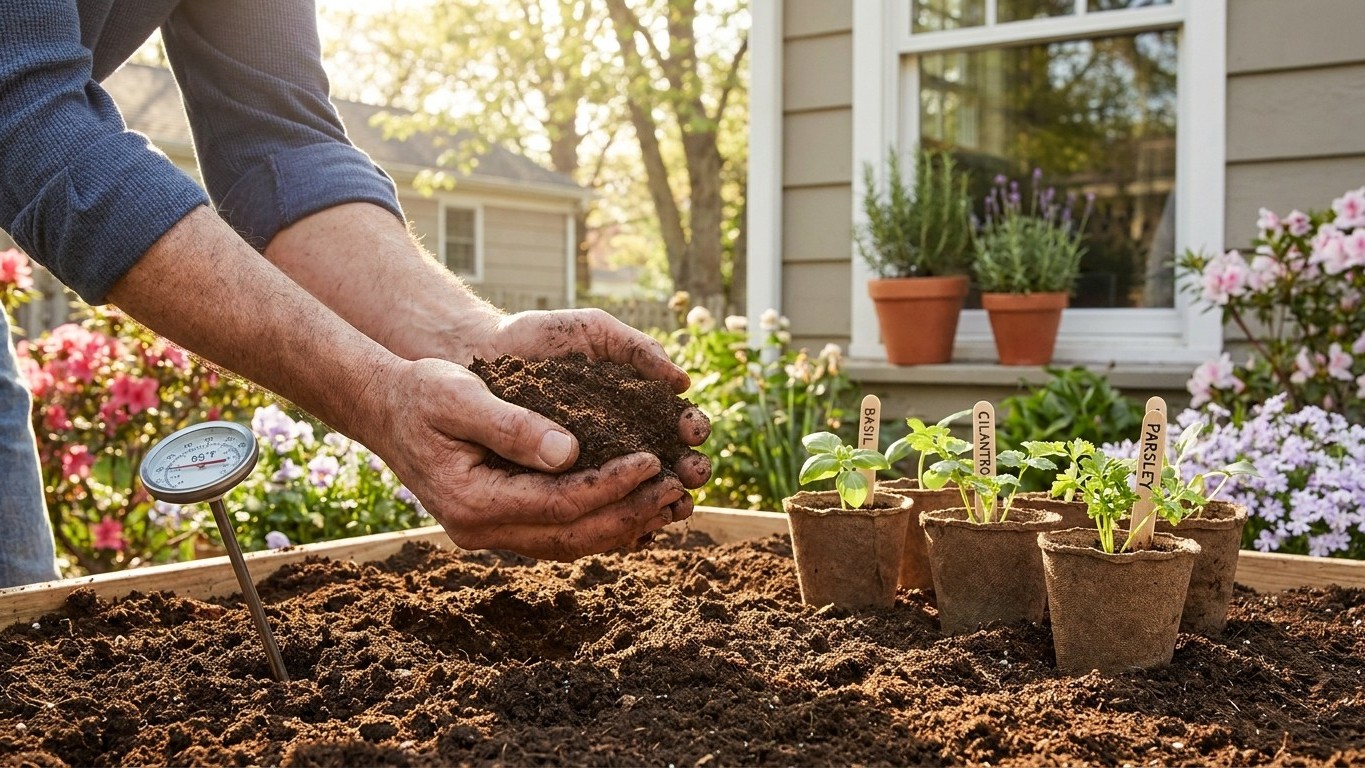

New Hampshire gardeners can safely set out most herb transplants after mid-to-late April, once the frost risk has passed and the soil itself has warmed, not just the air. But the real question for this state isn’t when to plant, it’s which herbs survive the winter here at all. That answer depends on cold, not heat, and it reshapes the whole herb bed.
When the soil is warm enough in New Hampshire
The reference station for southern New Hampshire, Manchester (USW00014710), puts the last spring frost somewhere between April 16 and April 27, based on NOAA’s 1991-2020 Climate Normals and their 30-70% freeze-probability band. That’s a two-week window, not a single date, and it’s worth sitting with that fact before planting anything.
A frost date is a probability, not a promise. Even inside that window, a given year can dip colder or stay milder than the normal suggests. Treat the range as a planning tool, not a guarantee stamped on the calendar.
Frost itself is also only a proxy for what herbs actually need, which is warm soil. Air temperature can climb into the 50s during the day while the ground four inches down is still cold and slow. Basil, in particular, sulks and yellows if it goes into chilly soil, even after the air frost risk has technically ended. The safer marker for tender, warm-season herbs is soil that’s stayed reliably above the mid-50s for several days running, which in the Manchester area usually trails the last frost date by a week or two.
Hardier herb types, the woody perennials and some biennials, don’t need to wait that long. They can go into the ground as soon as the ground is workable and the worst of the freeze risk has passed, because their root systems handle a light, late frost without much drama.
One more caution matters here: the Manchester figures come from an airport weather station, and airports sit in open, paved terrain that tends to run warmer than the surrounding countryside. Suburban yards and rural gardens across New Hampshire typically see their last spring frost land later, and their first fall frost arrive earlier, than the reference station shows, sometimes by one to two weeks. Gardens at higher elevation, common across much of the state, can lag even further behind. Check your own county’s frost history, or ask a neighbor who’s gardened the same soil for a few seasons, before trusting the airport number as your personal date.
None of the herbs discussed on this page should be confused with wild plants that resemble them. Several dangerous look-alikes exist in fields and woodlands, and this page won’t attempt foraging identification of any kind. Buy starts or seed from a known source, and grow what you know.
How long the season lasts here
Put the two Manchester frost windows together and you get a growing season that runs, at its shortest, from around April 27 to October 13, about 169 days. At its longest, using the early end of spring and the late end of fall, it stretches from April 16 to October 26, roughly 193 days. That’s a real spread: the difference between the two scenarios is more than three weeks, and it depends entirely on which year you happen to be gardening in.
Even the shorter estimate, 169 days, is a genuinely workable season for herbs. Most culinary herbs, whether direct-sown or set out as transplants, finish their productive cycle well inside that window. The longer end, closer to 193 days, opens up more flexibility, particularly for gardeners who want a second round of fast-growing annual herbs like dill or cilantro once the first planting bolts in summer heat.
That length also changes a practical decision: whether to start herbs from seed indoors and transplant, or direct-sow once soil has warmed. In a shorter-season year, transplanting buys back two to four weeks of growing time that a slower-maturing herb, like parsley, needs to reach a useful size before fall frost cuts things off. In a longer-season year, that head start matters less, and direct-sowing becomes a reasonable option for gardeners who’d rather skip trays and grow lights altogether.
A season in the 169-to-193-day range also supports succession sowing for quick annual herbs, seeding a second or even third round every few weeks so you’re not stuck with one big cilantro harvest that bolts in July heat and then nothing until next year. For the mechanics of staggering plantings and reading your own garden’s bolt-prone crops, see our guide to succession sowing.
The gap between the short and long estimates is also a good argument for keeping a simple log of your own yard’s first and last frost each year. After two or three seasons, a home gardener in Concord or Keene often has a better personal frost record than any airport station can offer.
Heat and water in New Hampshire
This page doesn’t have station-specific counts for days above 90°F or summer rainfall totals for New Hampshire, and rather than guess at numbers, it’s more useful to point at what actually drives herb success in this state: winter, not summer heat.
New Hampshire’s hardiness range, according to the USDA Plant Hardiness Zone Map (built on 1991-2020 normals), spans zone 3b to 6a across the state. That’s a wide spread for one state, and it reflects real differences between the milder Merrimack and Connecticut River valleys and the colder North Country and higher elevations. The reference figure for the coldest month’s average daily minimum, from the Manchester station, is 17.1°F. That’s not a record low, and it’s not a seasonal average, it’s the typical overnight low across the coldest month, and it’s the number that actually decides which herbs make it through winter outdoors and which don’t.
Herbs split into three rough camps against a number like 17.1°F. Some woody perennial herbs are bred for cold and shrug off a Manchester-style winter without protection. Others are borderline, surviving in milder pockets of the state or with mulch and a sheltered spot, but failing outright in a harder winter or at higher elevation. And a third group, mostly Mediterranean natives, simply can’t take a New Hampshire winter in the ground at all. For that group, “grown here” means grown in a pot that comes indoors before the first hard freeze, not a permanent garden resident.
Summer in New Hampshire tends to run mild and humid rather than scorching, and without a hot, dry stretch to keep things in check, that humidity brings its own problems: powdery mildew on crowded plantings, slower ripening on sun-loving herbs, and root rot in any bed that doesn’t drain well after a wet spell. Airflow between plants and a well-drained spot matter more here than shade cloth or heat protection.
Why winter, not summer, is the deciding factor
A gardener moving to New Hampshire from a hotter climate often plans the herb bed around heat tolerance. That instinct doesn’t fit this territory. The bed should be planned around which herbs can sit outside all winter at 17.1°F average lows, and which need to come inside before the ground freezes.
Which herbs suit New Hampshire
Given a roughly 169-to-193-day season and a winter that can drop to a 17.1°F average low in the coldest month, the herbs that suit New Hampshire best split cleanly by type rather than by any single variety.
- Cold-hardy perennial types built for northern winters, which can generally stay in the ground year-round across most of the state without special protection.
- Borderline perennial types that survive in milder valleys or sheltered microclimates but may need mulch, a protected wall, or simply luck in a harder winter or at elevation.
- Tender perennial types, mostly of Mediterranean origin, that are best treated as container plants brought indoors before the first fall frost rather than left outside to gamble against a New Hampshire winter.
- Fast annual and biennial types that complete their whole life cycle within a single season here, some of which handle a light frost and some of which don’t, making the spring soil-temperature question from earlier in this page directly relevant to when they go in.
A short growing season favors the earliest-maturing types within each of these groups, since a herb that needs the full length of the longer 193-day scenario to reach a useful size is taking a real risk in a year that runs closer to 169 days. A humid New Hampshire summer also makes disease resistance, particularly to powdery mildew and root rot, a more relevant selection criterion than heat tolerance or drought resistance, which matter far less here than in a hotter, drier state.
This page won’t name specific cultivars, and that’s a deliberate choice rather than an oversight. Variety performance depends on trials run in local soil and local weather, and the only recommendations worth trusting are the ones tested in New Hampshire conditions, not generic national picks. The University of New Hampshire Extension runs exactly those trials and publishes county-specific guidance for gardeners across the state, from the Seacoast to the North Country. That’s the source to check before buying seed or starts, because it accounts for the elevation, frost timing, and soil differences that a statewide article like this one can only describe in general terms.
Some herbs discussed in gardening circles also carry a reputation for traditional or medicinal use. This page doesn’t evaluate those claims one way or another; it treats every herb here strictly as a culinary and garden plant, and readers curious about other uses should look elsewhere for that evaluation.