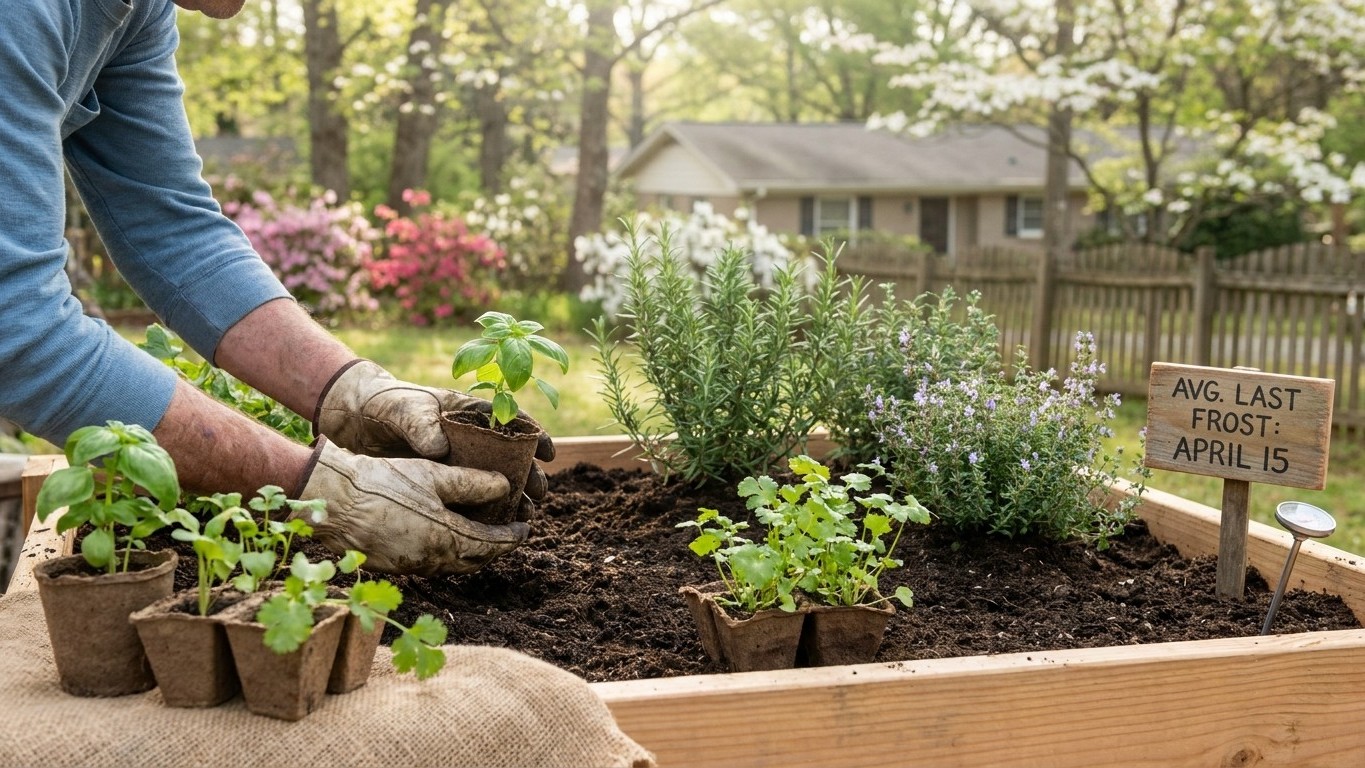

Sow hardy herbs like parsley, cilantro, and chives two to three weeks before the last spring frost, and wait until after it to move basil, dill seedlings that hate the cold, and other tender herbs outside. In New Hampshire, that frost date lands somewhere between April 16 and April 27, depending on where you sit relative to the Manchester weather station used to build this window.
The short answer for New Hampshire
NOAA’s 1991-2020 climate normals put New Hampshire’s last spring frost between April 16 and April 27, and the first fall frost between October 13 and October 26. Those aren’t fixed dates on a calendar. They’re a probability band: a 30 to 70 percent chance of a 32F freeze occurring on any given day inside that range, calculated from decades of readings at the Manchester airport station. Half the years, frost shows up before April 16. Some years it lingers past April 27. The planting calendar you’re looking for lives inside that spread, not at a single point on it.
For direct-sown cold-tolerant herbs, that means getting seed in the ground around early to mid-April, four to six weeks ahead of the earliest likely frost-free date, since parsley, chives, and cilantro germinate and grow fine in soil that’s still chilly. For anything that dies at 32F, basil above all, the safer play is treating April 27 as your line rather than April 16, and adding another week of buffer if your garden sits somewhere colder than the airport that generated this data.
On the back end, the first fall frost window (October 13 to October 26) sets the outer boundary for a second sowing of quick, cold-hardy herbs like dill or cilantro, which can go in as late as August in much of the state and still finish before that window opens. Anything you’re still harvesting from in October should be a herb that tolerates a light frost, not one that collapses at the first cold snap.
None of this replaces a look at your own thermometer and your own soil. The airport station behind these numbers sits in a relatively warm, low-lying spot compared to a lot of New Hampshire gardens, so what follows explains exactly how much that matters and where the gap tends to be widest.
What will not work here
The most common mistake in New Hampshire herb gardens isn’t planting too early. It’s assuming the airport’s frost dates apply to a garden that sits higher, farther from pavement, or farther north. NOAA’s own guidance is explicit here: suburban and rural gardens typically see the last spring frost later and the first fall frost earlier than the reference station shows, often by one to two weeks, and more at elevation. A garden in the Monadnock foothills or up in Coos County can lose two to three weeks of season compared to what this page’s numbers suggest, just from cold air pooling in a valley or altitude knocking a few degrees off every night.
That squeeze matters most for herbs that need a long run to finish. Do the arithmetic on the worst-case combination in these numbers, a last frost on April 27 paired with a first fall frost on October 13, and you get roughly 169 frost-free days. The best-case combination (April 16 to October 26) stretches to about 193 days. That’s a 24-day swing built into the state’s own climate data, before you even account for a colder microclimate stacking more days on top of it. Herbs that need the full season to mature and produce well, especially heat-loving basils sown late or transplanted after a cool spring, can run out of runway in the shorter version of that window.
Winter is the other failure point, and it’s less forgiving than most gardeners expect. The coldest month here averages a daily minimum of just 17.1F, and that’s the mean, not the record low. Herbs commonly sold as perennial, rosemary and bay laurel in particular, don’t reliably survive outdoor winters anywhere near that temperature without protection. Gardeners who plant them expecting them to come back each spring, the way they might in a milder climate, are usually disappointed by March.
Tight spacing is a subtler failure. New Hampshire summers bring enough humidity that herbs planted shoulder to shoulder, especially in a wet stretch, stay damp longer after rain and dew, inviting fungal problems in dense plantings of basil or oregano. Air movement between plants matters more here than the seed packet spacing guidelines usually suggest.
What changes across New Hampshire
New Hampshire’s USDA hardiness zones run from 3b to 6a, and that’s not a rounding error, it’s one of the widest internal spreads a state this size can have. Zone 3b bottoms out at an average extreme annual minimum of -35 to -30F. Zone 6a only drops to -10 to -5F. That’s a 25-degree gap in what a perennial herb has to survive over winter, and it’s the reason there’s no single answer to “will this herb come back next year” for the state as a whole.
The USDA system behind that range measures exactly one thing: the coldest temperature a given spot typically sees in a year, averaged over time. It says nothing about summer heat, rainfall, or how long the growing season runs, only how brutal the winter gets. A gardener near the milder end of that range can reasonably expect chives, thyme, oregano, and mint to overwinter outdoors most years. A gardener at the colder end should plan on treating those same herbs as needing mulch protection at minimum, or accept that some winters will kill them regardless.
Elevation compounds the zone difference in ways the map alone won’t show. Two gardens in the same county, one in a valley and one a few hundred feet higher, can effectively behave like different zones because cold air sinks and pools overnight. The frost dates in this page’s first section come from one reference station; a garden at higher elevation should assume both a later spring start and an earlier fall cutoff than those numbers show, on top of whatever the zone map already indicates for that location.
None of this is something to guess at from a state-level description. The right move is checking the current USDA Plant Hardiness Zone Map for the specific location in question, since a five-mile difference in New Hampshire can plausibly cross a full zone boundary, something that wouldn’t happen in a flatter, more climatically uniform state.
Where to check this for your own county
This page describes New Hampshire in general terms, built from one weather station and a statewide hardiness range. That’s useful for understanding the mechanics of frost windows and winter survival, but it’s not a substitute for what the UNH Cooperative Extension publishes for individual counties.
UNH Extension is the state’s land-grant university extension service, and it maintains local planting guidance built from county-level data and field trials rather than a single airport station. Two things are worth looking for there specifically. First, a local planting calendar for the county in question, which will reflect the actual frost pattern of that area rather than the statewide probability band described above. Second, variety trial results or recommendations specific to New Hampshire growing conditions, since not every herb variety sold nationally performs the same way in a short, humid Northeast growing season.
A county-level recommendation from extension staff who work with local growers will consistently beat a state-level generalization, simply because it accounts for the microclimate factors this page can only describe in the abstract, elevation, valley cold pockets, soil type, and local frost history collected over multiple seasons rather than one 30-year normal period. This page is the state-level starting point. The extension office is where that gets refined into something specific to a particular garden’s actual conditions.
It’s also worth checking whether the local extension office runs a master gardener helpline or a seasonal planting hotline, common features at land-grant extension services, since a quick call can sometimes answer a timing question faster than digging through published calendars.
Checking this against your own garden
Every date on this page is an average built from decades of past weather. Your actual garden, this year, in this soil, is a different question, and there are three things worth checking with nothing more than your hands and eyes.
Soil warmth by feel matters more than the calendar for germination. Push a finger a couple of inches into the bed where herbs are going. If it feels cold and damp rather than cool and workable, seeds like basil and cilantro will sit and sulk rather than sprout, regardless of what the frost date calendar says about timing. Waiting a few extra days for that soil to warm often outperforms sowing exactly on schedule into ground that hasn’t caught up yet.
Watch for the first true leaves on anything already sown. The initial pair of leaves that pop up from a seed are usually generic-looking cotyledons, not the plant’s actual foliage. The second set, the true leaves, tells you the seedling has moved past its most fragile stage and is drawing energy from its own roots rather than the seed’s stored reserves. That’s a better signal for when to thin or transplant than counting days since sowing.
For perennial herbs coming out of winter, the first flush of new growth at the base of the plant is the tell for whether it actually survived, rather than assuming based on the region’s general hardiness zone range. A plant that looks dead in early May but pushes new leaves by month’s end has made it through; one that stays bare past that point usually hasn’t, whatever the zone map might suggest was possible.