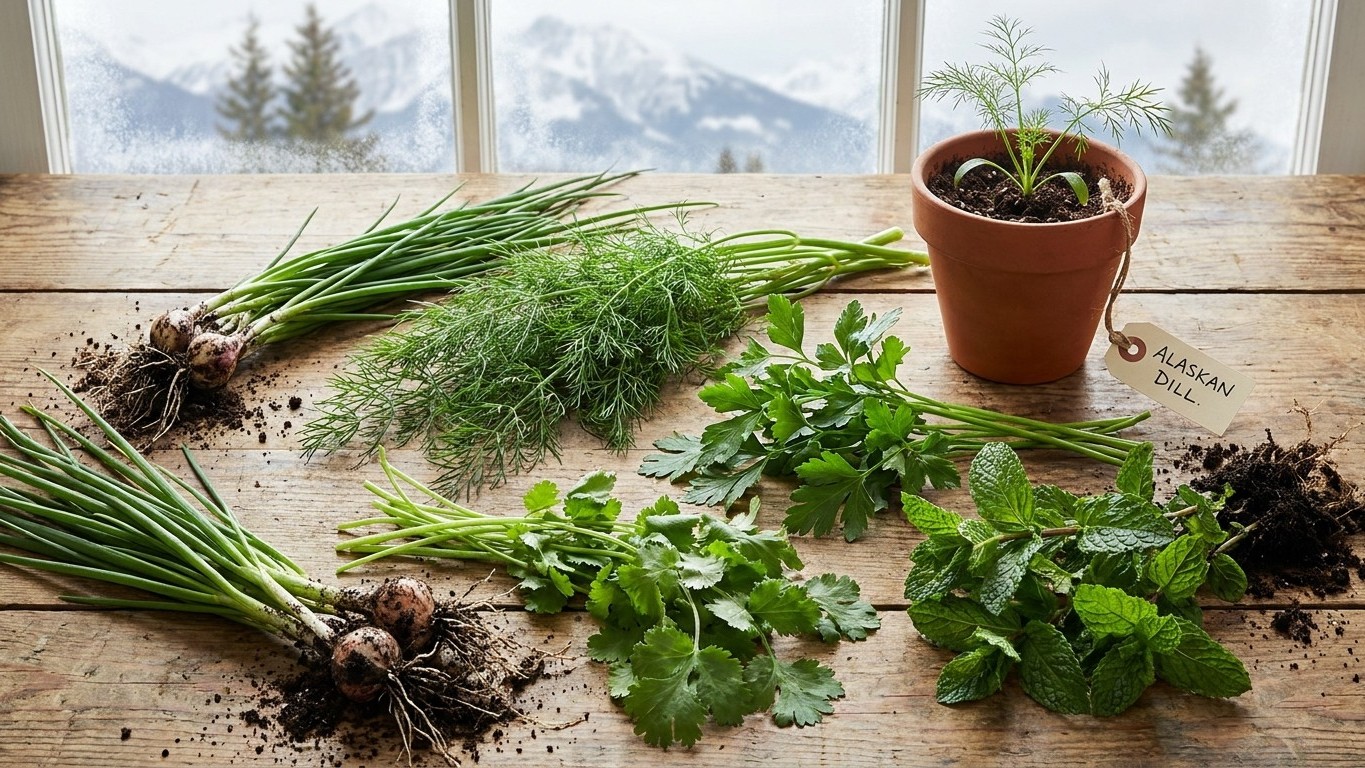

Chives, mint, oregano, thyme, dill, cilantro and parsley are the herbs that consistently do well in Nova Scotia’s cool, damp maritime climate. They tolerate a growing window that averages 164 frost-free days and a winter low that dips to 13.3°F in the coldest month. Basil, rosemary and other Mediterranean natives need a warm, sheltered spot or a pot you can bring indoors.
The short answer for Nova Scotia
Start with the math: last spring frost lands, on average, May 7, and the first fall frost arrives October 18. That’s a 164-day stretch, which sounds generous until you factor in what kind of 164 days they are. Halifax Stanfield’s normals describe a coastal, fog-prone, humidity-heavy season, not a hot one. Growing degree days accumulate slowly here even when the calendar window is wide open, and that single fact decides which herbs thrive and which just survive.
Hardy perennial herbs are the safest long-term investment. Chives shrug off the cold and come back reliably; mint spreads fast enough that the real challenge is containing it, not growing it; oregano and thyme handle the humidity better than most woody herbs because their low, wiry growth sheds moisture instead of trapping it. None of these three demand a long stretch of heat to produce a usable crop, which matters when your coldest month averages a 13.3°F low and your summer rarely gets properly hot.
Fast annuals fill the gaps well. Dill, cilantro and parsley all mature quickly enough to fit inside the frost-free window with room to spare, and none of them need blazing heat to flourish, unlike basil. Parsley, technically a biennial, behaves like an annual here anyway since few gardeners push it through a Nova Scotia winter outdoors.
| Herb type | Fit for Nova Scotia | Why |
|---|---|---|
| Hardy perennials (chives, mint, oregano, thyme) | Best fit | Tolerate the 13.3°F winter low and don’t need sustained heat |
| Fast annuals (dill, cilantro, parsley) | Good fit | Mature well within the 164-day window |
| Mediterranean heat-lovers (basil, rosemary, lavender) | Needs help | Cool, humid summers and cold winters work against them |
None of this replaces what a reader’s own patch of ground tells them, but it’s the reasoned starting point for the province as a whole, not a guess borrowed from a warmer neighbor.
What will not work here
Basil planted straight into open garden soil is the classic disappointment. It wants warm nights and dry foliage, and Nova Scotia’s coastal summers deliver neither reliably. Cool nights slow it down, and the same humidity that oregano tolerates well turns into downy mildew on basil leaves within weeks. Gardeners who get a good basil harvest here are almost always working from a container on a warm south wall, or under some kind of cover, not from an open row.
Rosemary left outdoors year-round is the other predictable failure. Most rosemary varieties struggle once temperatures drop much below 10 to 20°F, and a coldest-month average low of 13.3°F puts Nova Scotia squarely in the range where an unprotected plant can die in an ordinary winter, not just a harsh one. This isn’t a maybe. Treat rosemary as a container plant that spends winter indoors or in an unheated but frost-free space, and it can live for years. Leave it outside through a Nova Scotia January, and the odds are against it.
Lavender runs into a different problem: not the cold alone, but the combination of cold and wet feet. Lavender wants sharp drainage and dry roots through winter, and Nova Scotia’s fog, rain and heavy clay in many areas work against exactly that. Root rot, not frost, is usually what kills it.
Tight spacing is a mistake that shows up across all these herbs, not just the sensitive ones. In a dry inland climate, crowding herbs close together barely matters. Here, where humidity lingers longer after rain and fog rolls in from the Atlantic, tight spacing traps moisture around the leaves and invites fungal disease, even in herbs like thyme and oregano that otherwise handle the province’s climate well. Give every plant more air than a seed packet grown for a drier state would suggest, and skip the herbs that need consistently hot, dry conditions to avoid disease altogether, chamomile and certain sages among them.
What changes across Nova Scotia
The hardiness zone figure attached to this province, 6b in the Canadian system, applies to the Halifax reference station used for these normals, not to the province as a whole. That distinction matters more here than it might elsewhere, because the Canadian zone system is built from seven separate climate variables, not the single winter-low figure the USDA system uses, and Natural Resources Canada is explicit that the two systems don’t convert cleanly. A single Canadian zone number can span nine different USDA zones. So a 6b reading for Halifax says nothing precise about how a USDA-style gardening guide would rate the same spot, and it says even less about anywhere else in the province.
Nova Scotia is not one climate. Halifax and the immediate coastline sit close to the moderating influence of the Atlantic, which softens both the winter lows and the timing of frost. Move inland, up into the Annapolis Valley’s colder pockets, into the Cape Breton highlands, or to any higher-elevation interior spot, and both the last spring frost and first fall frost can run meaningfully later and earlier than the Halifax averages used on this page. That means a shorter effective season, a colder true winter minimum, and less margin for herbs that are already borderline here, rosemary and lavender chief among them.
There’s no single number that covers this properly. Anyone gardening outside the immediate Halifax area should check where their location falls using Natural Resources Canada’s Plant Hardiness Site, rather than assuming the 6b figure quoted here applies to their yard.
Where to check this for your own county
This page describes Nova Scotia at the provincial level, using normals from a single Halifax reference station. That’s useful for a first read, but it’s not a substitute for a local check, and Nova Scotia’s Department of Agriculture is the place to do that. Visit novascotia.ca/agri/ and look specifically for two things: any planting calendar or frost-date guidance published for your specific county or region, and any variety trial results for herbs grown in your part of the province.
A county-level recommendation, where one exists, beats a provincial one every time, because it accounts for elevation, distance from the coast, soil drainage patterns, and microclimates created by hills, valleys or shoreline exposure. This page gives the honest provincial starting point built on verified normals. It is not a replacement for what your own county’s growing conditions actually look like on the ground.
If the provincial site doesn’t have county-specific herb guidance posted, that’s worth knowing too, rather than assuming detail exists somewhere and guessing at it. In that case, the frost dates and hardiness zone figures on this page remain the best documented starting point available, used with the understanding that they describe the Halifax area specifically, and applied with the adjustments described in the section above for anywhere else in the province.
Checking this against your own garden
Every date on this page is an average pulled from decades of records at one station. Your own garden will tell you something more specific, and it’s worth trusting over a calendar date. Three things to watch, all checkable without any equipment:
- Soil warmth by feel: push a finger a couple of inches into the bed in spring. If it still feels cold and damp rather than merely cool, seeds like dill and cilantro will sit and sulk rather than germinate, whatever the calendar says about the frost date having passed.
- The first true leaves: seedlings show rounded seed leaves first, then a second set with the actual shape of the mature plant. That second set showing up strong and green, rather than pale or slow, is a better sign of a hospitable microclimate than any date on this page.
- How fast frost-tender transplants recover: if a basil seedling moved outside sits stalled and sulky for a week rather than pushing new growth, that’s the plant reporting that your particular spot runs cooler than the provincial average suggests, and it’s worth listening to.
None of these observations require a thermometer or a soil probe, just attention paid over a few consecutive days. They outrank the Halifax averages used throughout this page, because they come from the exact soil, exposure and shelter of the garden the herbs are actually growing in.