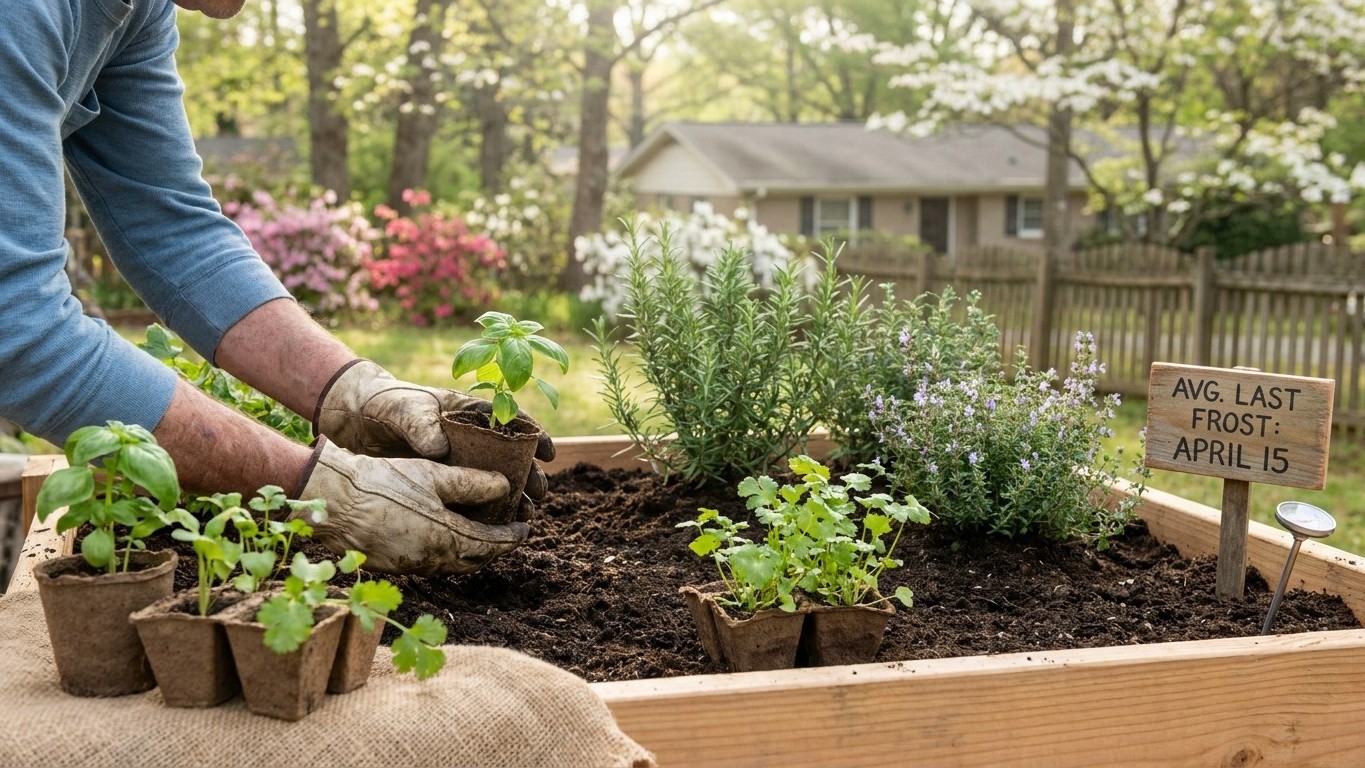

Sow tender herbs like basil after the last spring frost, on average May 7 in the Halifax area, and finish harvesting before the first fall frost, on average October 18. That gives an average frost-free stretch of about 164 days, but “average” is the key word here, not a promise.
The short answer for Nova Scotia
Hardy herbs, chives, parsley, cilantro, can go into the ground two to three weeks before that May 7 mean date, since a light frost rarely bothers them. Tender herbs, basil above all, need the soil to have actually warmed, which usually means waiting until after that date rather than sowing on it.
That May 7 figure comes from Environment and Climate Change Canada’s 1981-2010 climate normals for the Halifax Stanfield International Airport station. It is a mean date, not a safe date. In one year out of two, the last frost lands later than May 7, sometimes by a week or more. Treat it as the midpoint of a risk window, not a green light. The same caution applies to the October 18 fall frost mean: half the years bring frost after that date too, which is good news if you are hoping for a few extra weeks of harvest, but it is not something to plan around.
Why the winter minimum matters more than the frost dates for some herbs
The frost-free window answers when to sow. It does not answer whether a perennial herb will survive the winter that follows. For that, the number that matters is the mean daily minimum of the coldest month, which sits at 13.3°F for this reference station. That is cold enough that rosemary, bay laurel, and most Mediterranean woody herbs will not reliably overwinter outdoors here, container or no container, unless they are moved somewhere unheated but frost-buffered, like an attached garage.
Nova Scotia’s plant hardiness zone for this reference location is 6b on the Canadian system, which is not the same scale as a USDA zone. Natural Resources Canada builds its zones from seven climate variables rather than the single minimum-temperature metric the USDA uses, and the two agencies themselves say there is no simple conversion between them. If a seed packet or a gardening guide gives you a USDA zone recommendation, it is not directly transferable to this number.
What will not work here

A 164-day average frost-free window sounds generous until you count backward from a slow-maturing herb. Rosemary and lavender started from seed often need 80 to 90 days just to reach a plantable size indoors, then more weeks outdoors before they harden into anything resembling a mature plant. Direct-sow those from seed outdoors in Nova Scotia and you are frequently racing a fall frost that arrives before the plant has done anything useful.
Basil direct-sown right at the May 7 mean date is a common disappointment. That date describes when frost risk drops, not when soil temperature has caught up. Basil seed sits and sulks in cold, damp spring soil, then rots before it germinates. Starting basil indoors four to six weeks ahead and transplanting once nights are reliably above the mid-50s does better than trusting the calendar date alone.
The humidity problem specific to this coast
Nova Scotia’s maritime exposure brings persistent coastal fog and higher relative humidity than inland gardeners deal with, especially along the Atlantic shore and around the Bay of Fundy. Herbs that want dry air and sharp drainage, oregano, thyme, sage, sulk in that dampness if they are planted at the spacing recommended for a drier climate. Powdery mildew and root rot show up faster in Nova Scotia gardens planted at textbook spacing than they would in a drier prairie or interior garden. Wider spacing and raised beds or mounded rows do more here than in most other Canadian provinces.
Trying to keep tender perennial herbs alive outdoors year-round through a Nova Scotia winter, betting that a mild year will spare them, is also a losing habit. The 13.3°F coldest-month minimum is a mean, which means colder nights than that happen regularly within any given winter. Herbs marketed as hardy to a zone warmer than 6b on the Canadian scale are a gamble here, not a safe bet.
What changes across Nova Scotia
Nova Scotia is not one climate, even though it is a small province by Canadian standards. The 6b hardiness zone and the frost dates above describe the reference station at Halifax Stanfield, near the province’s most temperature-moderated corner. Inland and upland districts, and anywhere further from the coast’s moderating water influence, commonly sit a full zone or more colder, with frost lingering later in spring and arriving earlier in fall.
The Annapolis Valley has a reputation among Nova Scotia growers for a longer, warmer growing season than the coastal norm, sheltered as it is from the harshest Atlantic exposure. Cape Breton’s highland interior sits at the other extreme, with a shorter season and colder winter minimums than the Halifax figures suggest. Fog-prone stretches of the South Shore run cooler and damper through summer than the province’s inland farmland, even at similar latitude.
There is no single frost date or hardiness zone that describes all of Nova Scotia accurately. Natural Resources Canada’s Plant Hardiness Zone map lets you check the zone for your own municipality directly, rather than assuming the Halifax reference figures apply where you garden.
Where to check this for your own county
The Halifax-based figures on this page are a provincial starting point, not a local forecast. Nova Scotia’s Department of Agriculture publishes region-specific guidance through its main site at novascotia.ca/agri, and that is the place to look for a planting calendar closer to your own county rather than the reference station used here.
What to look for there specifically: any local or regional planting calendar the department or an affiliated extension program has published for your part of the province, and any list of herb or vegetable varieties that have actually been trialled in Nova Scotia conditions rather than generic national recommendations. A variety trialled and recommended for the Annapolis Valley’s warmer microclimate is not the same recommendation you want if you are gardening on the Eastern Shore or in Cape Breton’s interior.
A county-level or regional recommendation, when one exists, outranks the provincial figures on this page every time. This page works from a single reference station’s climate normals because that is the only province-wide dataset available with verified sourcing. Your own county’s soil, elevation, and coastal exposure will shift the real numbers, sometimes by weeks on either frost date, and only a local source captures that.
Checking this against your own garden
No published frost date replaces what your own garden is telling you in a given year. Climate normals average three decades of weather into one number; your garden this spring is dealing with this year’s weather, which may run a week ahead of or behind that average in either direction.
Three things worth checking before you trust the calendar over your own senses. First, soil warmth by feel: push a finger a couple of inches into the bed where you plan to sow, first thing in the morning. If it still feels cold and damp rather than merely cool, tender herb seed will sit and rot regardless of what the calendar says. Second, watch for the first flush of weed seedlings breaking through untended ground nearby. Weeds germinate on soil temperature, not on the date, and a good stand of chickweed or early annual weeds is a decent proxy for “the soil has warmed enough to sprout something.” Third, keep an eye on when nearby deciduous trees or shrubs, lilac especially, come into full leaf. Gardeners have used lilac leaf-out as an informal marker for safe warm-season sowing for generations, and it responds to the same accumulated warmth your herb seedlings need.
None of these need a thermometer or any other tool. They need attention, paid over a week or two in spring, to what your specific patch of ground is actually doing rather than what a station thirty miles away recorded three decades of springs ago.
The Moon calendar is a separate, older custom: see when to plant herbs by the moon, written as tradition rather than fact.