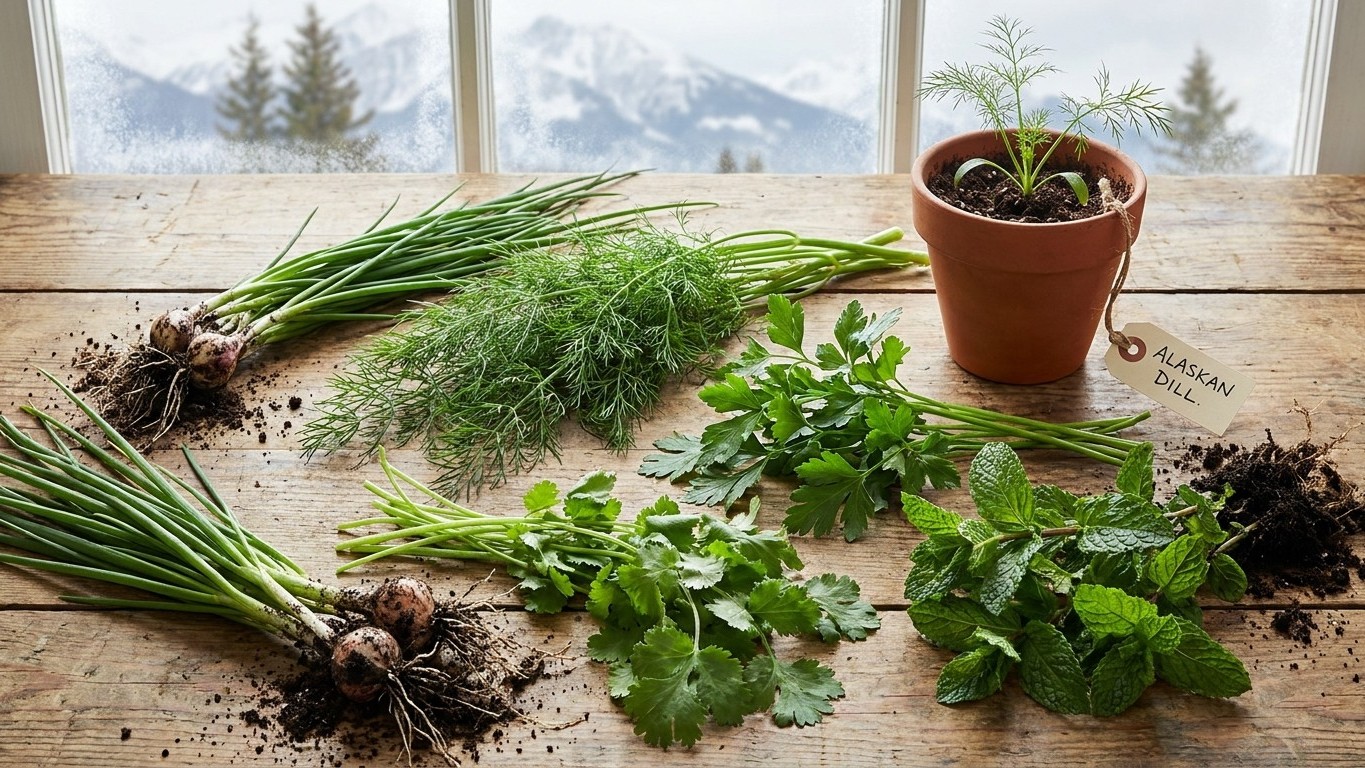

The best herbs for Nunavut are the ones that don’t need a real outdoor summer to finish: chives, parsley, and mint, grown mostly in containers, raised beds with cover, or community greenhouses. Almost every classic culinary herb from a seed catalog, basil and rosemary included, fails outdoors here, because the territory’s frost-free window and winter cold sit far outside what those plants tolerate.
The short answer for Nunavut
Environment and Climate Change Canada’s normals for the Rankin Inlet station put the average last spring frost at June 19 and the average first fall frost at September 13. That’s a mean of roughly 86 days between them on paper, but a mean date is not a promise. In half the years on record, frost arrives later than June 19 or earlier than September 13, so the real usable window shrinks in any given season, sometimes a lot.
That number alone rules out slow herbs before you even think about cold tolerance. Then there’s the winter side of the equation: the coldest month’s average daily minimum sits at -29.8°F, and the region carries a Canadian hardiness rating of zone 0a, the coldest classification the system has. No herb sold as a hardy perennial in a US catalog is bred for that.
Given those two constraints, the herbs worth planting fall into three practical types rather than a long list of names:
| Type | Typical maturity | Fit for Nunavut |
|---|---|---|
| Fast alliums (chives) | 60 days to usable leaf | Best fit; tolerates cool soil, can overwinter in a sheltered container in some years but treat as a gamble, not a given |
| Biennial umbellifers grown as annuals (parsley) | 70-75 days | Workable if started indoors and transplanted after the mean last frost, not before it |
| Vigorous mints | fast, spreads from a small start | Reliable in a container, tolerates cool damp conditions well, but needs protection to make it through winter at all |
Everything else, cilantro that bolts, dill that wants a longer stretch of warmth, basil that stalls below 50°F, belongs indoors under lights or in a heated greenhouse space, not in open ground.
What will not work here

Basil is the clearest failure case, and it’s worth spelling out why. Basil needs soil consistently above roughly 50°F to grow at all, and it stops cold, sometimes permanently, at the first brush of anything near freezing. With a mean frost-free stretch of about 86 days that in many years runs shorter, and with soil that has no real chance to hold summer warmth this far north, basil planted outdoors in Nunavut is planted to fail, not to struggle. The same math defeats any herb rated for 80-plus days to maturity: there simply isn’t a reliable stretch of that length between the two mean frost dates, and a late spring or early fall in any given year cuts it further.
Woody Mediterranean perennials are the second casualty, and this one is about winter, not summer. Rosemary, thyme, sage, and oregano are typically rated for hardiness zones running from roughly 4 to 8 depending on variety, using the US system. Nunavut’s reference zone is Canadian 0a, and the two systems don’t convert on a shared scale, but the coldest-month minimum of -29.8°F makes the point on its own: that’s a temperature no rosemary plant, container-grown or in the ground, is built to survive unprotected. Anyone who’s tried overwintering rosemary outdoors even in a mild US zone 6 knows it’s touchy; there’s no version of that plant surviving a Nunavut winter outside.
Tight spacing and a “just water it weekly” routine don’t fit either, but for the opposite reason from what fails plants in a hot, dry state. Cool, short-season conditions favor herbs that don’t need a long uninterrupted stretch of heat to bulk up, and it favors starting everything indoors well ahead of the mean last frost date rather than direct-sowing and hoping the calendar cooperates. Anything marketed as needing “full, hot summer sun for 90 days” is describing a growing season this territory’s frost dates don’t offer, on average, in most years.
What changes across Nunavut
Nunavut is not one climate, and the zone 0a figure cited here belongs specifically to the Rankin Inlet reference station, not to the whole territory. Natural Resources Canada builds its hardiness zones from seven separate climate variables, not just a single temperature, and it publishes the zone map precisely because conditions shift dramatically across a territory this size. Rankin Inlet, on the Kivalliq coast, is a very different growing environment from the High Arctic communities on Ellesmere or Cornwallis Island, which run colder and shorter still, or from Iqaluit further southeast.
There is no single answer for “what zone is Nunavut,” because the territory spans conditions from already-extreme zone 0a down to colder classifications further north, with no meaningfully milder pocket to point to inland. A gardener in the Kitikmeot region and one in the Qikiqtaaluk region are not working with the same frost dates or the same winter minimum, even though both fall under the same territorial government and the same general Arctic climate label.
This is exactly the kind of detail a territory-wide page can’t settle for an individual reader, and it shouldn’t try to. The right move is to check the actual zone for a specific community on the Plant Hardiness Zone map at planthardiness.gc.ca rather than assuming Rankin Inlet’s numbers apply community-by-community. For anyone at a coastal site facing prevailing Arctic winds, or at a slightly inland location with more tree or building shelter, the practical difference in what survives a winter can be real even within a short distance.
Where to check this for your own county
Nunavut doesn’t have counties in the way US states do, but the equivalent step still applies: check a source closer to your own community than a territory-wide page can be. The territorial agriculture department’s own site currently refuses automated verification checks, so the reliable link to use is the federal one, Agriculture and Agri-Food Canada at agriculture.canada.ca/en, confirmed working as of this writing.
What to look for there isn’t a restatement of the frost dates already covered above, it’s anything more local: growing guidance tied to a specific hamlet or region (Kivalliq, Kitikmeot, or Qikiqtaaluk), notes on community greenhouse programs, which several Nunavut communities run precisely because open-ground growing is so limited, and any varieties that local growers or extension staff have actually trialled in that specific location. A recommendation tied to your own community, or even your own greenhouse program, will always outrank a territory-wide average built from one reference station’s data.
The territorial layer covers broad frost dates, a single hardiness reference point, and the general logic of what type of herb fits a short, cold-defined season. It is not, and isn’t meant to be, a substitute for whatever your own community’s growing program or extension contact has learned from actually running plants through a real Nunavut summer. Fast alliums beat slow Mediterranean herbs here, so use a local contact to confirm what’s actually been grown successfully nearby.
Checking this against your own garden
None of the dates above beat what’s happening in your own soil and containers right now. The mean frost dates describe an average year, not this year, and in a territory where half of all years fall outside that average by definition, your own observation is the more reliable guide every single season.
Three things are worth watching by hand and by eye rather than by calendar. First, soil warmth: press a bare hand into the top couple inches of your growing container or bed. If it still feels cold to the touch, chives and parsley transplants will sit and sulk rather than grow, regardless of what the calendar says about the mean last frost having passed. Second, watch for the first true leaves on any seedlings started indoors, the second set that appears after the initial rounded seed leaves. That’s the signal a plant is actually established enough to handle the shock of being moved outside or into a colder greenhouse bay, not just alive. Third, keep an eye on new growth tips after any cold snap, even a mild one; blackened or wilted tips on mint or chives tell you that spot in your garden ran colder than the rest, information no territory-wide frost date can give you.
These three checks matter more here than almost anywhere else on this site, because Nunavut’s growing conditions vary so sharply over such short distances, between a sheltered wall and an open yard, between a heated greenhouse bay and an unheated one, that no single date from a single weather station can stand in for what’s actually happening in front of you.