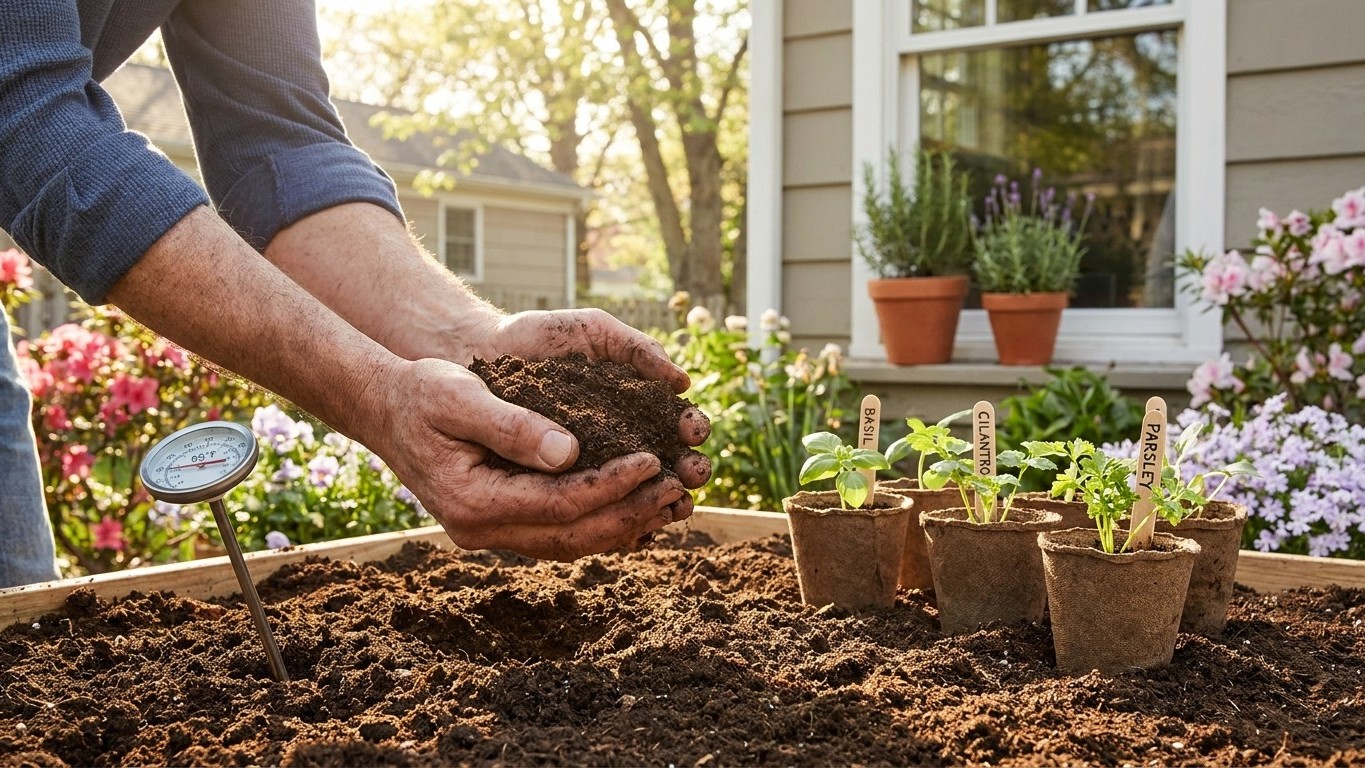

In Nunavut, herbs mean containers, cold frames, or a windowsill more often than an open bed. With an average frost-free window of roughly 86 days and a Canadian hardiness zone of 0a, the territory rewards fast, compact, cool-tolerant herbs grown in soil you control rather than soil you wait on.
When the soil is warm enough in Nunavut

The date most gardeners ask about first is the last spring frost, and for this territory that figure comes from Environment and Climate Change Canada’s Canadian Climate Normals for 1981-2010, recorded at the RANKIN INLET A station: on average, June 19. That is not a promise. It is a mean date, which means that in roughly half the years on record, frost showed up later than June 19, sometimes well into the following weeks. Treat it as the midpoint of a window, not a green light.
What actually matters for herbs is not the frost date itself but what it stands in for: soil temperature. Frost is a proxy, a convenient marker, but it lags behind the real signal a seed or a young plant responds to. Air can clear of frost risk while the ground underneath is still cold, wet, and slow. In a territory sitting at Canadian hardiness zone 0a, with a coldest-month mean daily minimum of -29.8°F, the ground itself takes a long time to release that cold. Soil this deeply frozen through winter does not simply thaw and warm on the calendar’s schedule; it warms gradually, and unevenly, well after the air around it has moderated.
That gap is the reason experienced growers in short-season, high-latitude climates wait past the average frost date rather than sow the moment it arrives. It is also the reason indoor starts, cold frames, and raised beds with dark mulch matter more here than in milder territories: each of those tools does the same job, warming the root zone faster than open ground would on its own. A raised bed a few inches off grade catches more sun and drains meltwater away from the roots, which in a cold, slow-draining soil is often the difference between a seedling that grows and one that sits stalled.
None of this is about which variety germinates fastest or produces the biggest harvest by a certain day count, because this page does not have reliable numbers for that in this climate, and inventing one would be worse than saying nothing. It is about types and timing: cool-season herb types that tolerate a slow start and the soil-warming approach that makes June 19 something more than a hopeful guess.
How long the season lasts here
Subtract the two mean frost dates from Environment and Climate Change Canada’s Rankin Inlet A record, June 19 for the last spring frost and September 13 for the first fall frost, and the average frost-free window comes to about 86 days. Under three months. That number sets almost every other decision in a Nunavut herb bed.
An 86-day window is short enough that it changes the basic math of the season. In a territory with four or five frost-free months, a gardener can plant an early crop, harvest it, and put in a second sowing behind it. Here, that second attempt is rarely realistic outdoors. The first sowing is effectively the only sowing, which raises the stakes on timing it well and on choosing herb types that mature quickly rather than ones that need a long, steady stretch of warmth to bulk up.
That same short window also reshapes the transplanting question. Where the season runs long, gardeners can afford to start seed indoors, transplant, and accept some root disturbance because there is time for the plant to recover and still finish strong. With only about 86 frost-free days on average, and even that figure describing a mean rather than a guarantee, a transplant that sulks for two weeks after being moved has burned through a meaningful share of the whole growing season. That makes root-check timing, and choosing herb types that transplant cleanly with minimal shock, worth far more attention here than it would in a longer-season province.
It is also worth remembering that this 86-day figure is itself an average built from two averages, each of which runs later or earlier in roughly half of all years. A cautious grower plans around a shorter effective window than the mean suggests, treating the full 86 days as a best case rather than a floor. For readers weighing whether a second round of sowing makes sense anywhere in the territory, or how to stagger plantings where the window does allow it, the site’s succession sowing guide walks through the timing logic in more detail.
Heat and water in Nunavut

This is where a territory like Nunavut breaks from the pattern most herb-growing advice assumes. There is no meaningful count of days above 90°F to report here, because summer in this territory almost never approaches that mark in the first place; the climate simply does not generate the kind of heat load that shapes herb-growing decisions farther south. If you have read advice written for a hot-summer garden, about giving basil afternoon shade or watching for bolting in a heat wave, set it aside. It does not apply.
What replaces summer heat as the deciding factor is winter, and the two figures that matter most are already on record for this territory: a Canadian hardiness zone of 0a and a coldest-month mean daily minimum of -29.8°F. Those numbers answer a question that summer weather never will here, which is whether a herb can live outdoors year-round at all. At -29.8°F as a monthly average low, the answer for almost every common culinary herb is no. Perennial herb types that survive winters in temperate provinces, the woody, Mediterranean-origin kinds especially, have no realistic path through a Nunavut winter planted in open ground.
That single fact reorganizes the whole approach to an herb bed here. Instead of asking which herbs are hardy enough to leave outside, the more useful question becomes which herbs are worth growing as annuals for one short summer, and which are better treated as potted plants that spend the growing season outdoors and the winter indoors on a bright windowsill or under grow lights. The container approach sidesteps the hardiness-zone problem entirely, because the pot never has to survive -29.8°F in the ground; it moves indoors before that cold arrives.
Where summer heat is not a threat, a cool, often damp Arctic summer brings its own set of problems instead. Slow ripening is one; herbs that would size up quickly with more warmth simply take longer here, which loops back into the pressure that an 86-day window already puts on timing. Fungal issues and mildew are the other risk in cool, moist conditions, particularly for herb types with dense foliage that holds moisture. Airflow around plants, whether in a raised bed or a container, does more work in this climate than any amount of feeding or watering discipline.
| Factor | Value | What it decides |
|---|---|---|
| Last spring frost (mean) | June 19 | Earliest realistic outdoor sowing window |
| First fall frost (mean) | September 13 | End of the frost-free growing window |
| Frost-free window (mean) | ~86 days | Whether a second sowing is realistic |
| Coldest month, mean daily min | -29.8°F | Whether a herb can overwinter outdoors at all |
| Hardiness zone | 0a (Canadian system) | Perennial vs. container-only status for each herb type |
Which herbs suit Nunavut
Given an 86-day mean window and a Canadian zone 0a winter, the herb types that make sense here are the fast, compact, cool-tolerant ones, and the plan for nearly all of them is container or raised-bed cultivation rather than permanent outdoor planting. Herb types in the allium family, such as chives, tend to handle cool, short seasons well and can be brought indoors as potted plants to extend their usefulness past the outdoor window. Leafy, quick-maturing types like parsley and cilantro, and cool-tolerant umbellifers like dill, are better suited to a short summer than the slower, heat-loving Mediterranean shrubby herbs, which struggle to bulk up in 86 days of cool weather and cannot survive an outdoor winter at -29.8°F regardless of how they are planted.
Because the season is short, earliness matters more than almost any other trait when choosing what to grow. Because summers here run cool and sometimes damp rather than hot, disease resistance and airflow around the plant matter more than heat tolerance or shade-seeking traits that dominate advice written for warmer territories. A herb type that resists mildew in cool, moist air is doing more useful work in a Nunavut garden than one bred to shrug off drought and heat it will never actually face.
This page will not name a specific variety, and that is a deliberate choice rather than an oversight. Variety trials, the kind that tell a grower which named cultivar of a given herb actually performed well in local trial plots, are done at the provincial and territorial level, not on a general information page like this one. A cultivar that thrives in a milder province can fail here for reasons no general description would catch, and recommending one without that local trial data would be a guess dressed up as advice. The reader’s own federal agriculture resource is the starting point for finding which named varieties have actually been trialled and recommended for growing conditions in this territory; provincial extension contacts, where reachable, can usually go further still.
What this page can say with confidence is the shape of a sound choice: pick herb types that mature quickly enough to finish inside an 86-day mean window, plan on containers or a bright indoor spot for anything meant to live past one summer, and treat airflow and drainage as the daily maintenance that matters most in a cool, damp climate where heat is never the enemy but slow growth and mildew often are.